ArchbishopLefebvre.com
Links
  • Archbishop Lefebvre
    • Biography of Archbishop Lefebvre
    • Who is he?
    • In his own words
  • Sermons
    • Sunday Sermons
  • Letters
    • Archbishop Lefebvre >
      • To Friends and Benefactors
      • Other Letters
    • Bishop Williamson >
      • Friends and Benefactors
      • Eleison Comments >
        • Italiano
        • Espanol
      • To SSPX Priests
  • Blog
  • Books
    • E-Books
    • Free Catholic Books
    • Archbishop Lefebvre
    • Bibles
    • Blessed Sacrament
    • Children Books
    • Childrens Saints
    • DVDs
    • Hell
    • Purgatory
    • Our Lady
    • Sacred Heart
    • Missals
    • Missale Romanum
    • Summa Theologica
    • Saints
  • Catholic Faith
    • Catechisms
    • Catholic Art
    • Chant
    • Dogmas of the Catholic Church
    • Encyclicals
    • Sermons
    • History >
      • HughesVol1index
    • Liturgy
    • Sacraments
    • Prayers >
      • Blessings
    • Way of the Cross
  • SSPX Crisis
    • sspx Archbishop Lefebvre
    • monks nuns
    • SSPX Bishop Fellay
    • SSPX Bishop Tissier
    • ex-sspx Bishop Williamson
    • ex-sspx chazal
    • sspx couture
    • sspx fox
    • ex-sspx fuchs
    • ex-sspx girouard
    • ex-sspx hewko
    • sspx laisney
    • sspx ockerse
    • ex-sspx pfeiffer
    • sspx themann
    • Fr. Ringrose
  • Links
    • Other Sites
    • Donate
    • Facebook
    • Twitter
    • You Tube
  • TradCat Items
    • Beeswax Candles
    • Chapel Veils
    • Prayer Cards - Our Lady
    • Prayer Cards - Espanol
    • Protected Scapulars
    • Scapulars
    • Unbreakable Rosaries
  • Crisis in Church
    • Declaration of the 2006 Chapter (SSPX)
    • Fr Hewko to SSPX Superiors
    • History of the Archbishop and Rome
    • Vatican II more important than Nicea!
    • The Archbishop and Religious Liberty
    • The right to resist an abuse of power
    • How Are Catholics To Respond To The Present Crisis

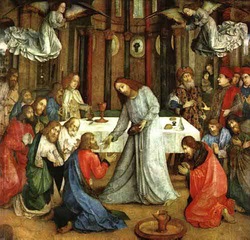
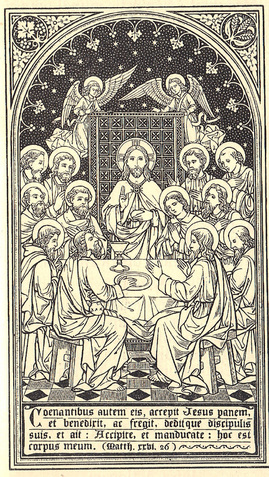
Holy Thursday Changes 1952-56

4/17/2014

 
Picture
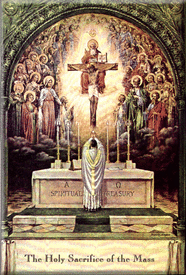
HOLY THURSDAY

1. (OHS 1956): Introduction of the stole as part of the choir dress of priests.

Commentary: This is the beginning of the myth of concelebration on Holy Thursday. The bolder among the reformers wished to introduce it along with this reform, but resistance—especially from members of the Commission such as Cardinal Cicognani and Msgr. Dante—blocked this novelty. Father Braga writes: “As to the ‘participation’ of the priests, sacramental concelebration did not seem attainable (the mind-set, even of certain members of the Commission, was not yet prepared for it).” In effect, there was a strongly hostile feeling against concelebration on Holy Thursday because it was not traditional: “Concelebration, whether sacramental or purely ceremonial, was to be excluded.”  To introduce the idea of concelebration, its proponents had to be content with the creation of the practice of having every priest present don a stole, (60) not at the moment of communion only but beginning with the start of the Mass.

(MR 1952): The priests and deacons wear the usual choir dress, without the stole, and put on the stole at the time of communion only, as is the usual custom.

2. (OHS 1956): The practice is introduced of giving communion with only those hosts consecrated on this day.


Commentary: It is incomprehensible why those present cannot communicate with hosts already consecrated previously. The Roman practice of the “Fermentum”—which is historically documented—was to communicate, in general, from a particle of the Eucharist from the Sunday prior, to show the communion of the Church throughout time and space, within the reality of the Body of Christ. This presence, being “real and substantial,” continues when the assembly departs and at the same time, with even greater logical coherence, precedes the reuniting of the assembly. With this [new] rubric, the idea is introduced of the Real Presence being tied to the day of the celebration, as well as the idea that one is obliged to communicate from hosts consecrated on the same day. It is as much as to say that those hosts are in some way different from those consecrated earlier. One should note that this obligation relates not merely to the symbolism of the tabernacle being empty before the Mass of Holy Thursday—which, at most, might have had some significance, albeit a novel one—since the text affirms that those who receive communion must receive only hosts consecrated on this day.  The underlying theology does not seem very solid, while the symbolism is debatable.

(MR 1952): There is no mention of this practice of giving communion with hosts consecrated on Holy Thursday.

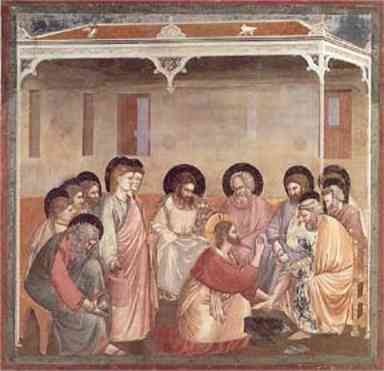
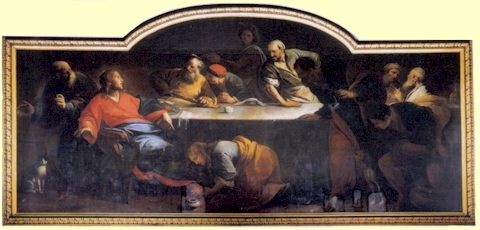
3. (OHS 1956): The washing of feet is no longer at the end of Mass but in the middle of Mass.


Commentary: The reform appealed to a restoration of the “veritas horarum” [i.e., observance of the “true times” of the services], an argument used in season and out, like a veritable hobby horse. In this case, however, the chronological sequence given in the Gospel is abandoned. Rivers of ink flowed in order to convince others of the scandal of an horarium that was not in full accord with that of the Gospels, but in this case not only was a rite anticipated, or postponed, for practical reasons, but the chronological order of the Gospel narrative was inverted within a single ceremony. St. John writes that Our Lord washed the feet of the Apostles after the supper: “et cena facta” [“the supper having been finished”] (John 13: 2). It escapes understanding why the reformers, for whatever obscure motive, chose, arbitrarily, to put the washing of the feet directly in the middle of Mass. While Mass is being celebrated, consequently, some of the laity are allowed to enter the sanctuary and take off their shoes and socks. Apparently there was a desire to re-think the sacredness of the sanctuary and the prohibition of the laity from entering it during divine services. The washing of feet, therefore, is spliced into the offertory, an abuse whereby the celebration of Mass is interrupted with other rites, a practice founded on the dubious distinction of Liturgy of the Word and Liturgy of the Eucharist.

(MR 1952): The rite known as the Mandatum, or washing of the feet, is carried out after Mass and not in the sanctuary, after the stripping of the altars and without interrupting Mass or allowing the laity to enter the sanctuary during the service, and withal respecting the chronological sequence given in the Gospel.

4. (OHS 1956): Omission of the Confiteor recited by the deacon before Holy Communion.


Commentary: The third, despised Confiteor is done away with, without recognition of the fact that the confession made by the deacon, or the server, although borrowed from the rite for communion extra missam [outside of Mass], is a confession of the unworthiness of the communicants to receive the sacred Species. It is not a “duplication” of the confession made by the priest and ministers at the beginning of Mass, since at that point they have simply recited their own unworthiness to approach the altar and to celebrate the sacred mysteries. (Hence, at a sung Mass it is recited sotto voce.) This is distinct from one’s unworthiness to approach Holy Communion.

(MR 1952): The Confiteor is recited before communion.

5. (OHS 1956): At the end of Mass, during the stripping of the altars, it is mandated that even the cross and candlesticks are to be removed.


Commentary: It was decided that everything should be stripped from the altar, even the cross. The rubrics of the reformed Holy Thursday do not explain, however, what to do with the altar cross, but one learns this by accident, as it were, from the rubrics of the following day. In effect, the rubrics of Good Friday speak of an altar without a cross, which one can deduce from the fact that it was taken away during the stripping of the altars, or perhaps in a more private manner during the night. (This and other problems arise when one changes a liturgy which has benefited from layers of tradition and which is all but intolerant of hasty alterations.) Perhaps, on the basis of a certain liturgical archeologism, the reformers wished to prepare souls for the spectacle of a bare table in the middle of the sanctuary—something which makes little sense theologically.

(MR 1952): The cross remains on the altar, veiled and accompanied by the candlesticks, enthroned there in expectation of being unveiled the following day.

GOOD FRIDAY CHANGES
Maundy Thursday

4/17/2014

 
Picture
The Lesson is taken from the Treatise on the Psalms by St. Augustine the Bishop

Hear my prayer, O God, and hide not thyself from my petition: take heed unto me, and hear me: how I mourn in my trial, and am vexed; because of the crying of the enemy, and of the tribulation which cometh from the ungodly.  These are the words of one who is disquieted, beset by trouble and anxiety.  He prayeth as one under much suffering, desiring deliverance from evil.  Let us see from what evil he doth suffer: and as we hear what that evil is, let us recognize that we also suffer from the same thing; so that as we share his tribulation, we may also join in his prayer.  I mourn in my trial (saith he) and am vexed.  When doth he mourn?  When is he vexed?  In my trial, saith he.  He hath in mind the ungodly that cause him tribulation, which same he calleth his trial.  Therefore, think not that the wicked can serve no good purpose in this world, and that God is unable to accomplish good by means of them.  Every wicked person is permitted to live in order that he may be made righteous, or else that the righteous may be tried by him.

I would to God that the ungodly who now try us were converted, and so were on trial with us.  Yet, though they continue to try us, let us not hate them: for we know not whether any of them will continue to the end in his evil ways.  And mostly, when thou thinkest thyself to be hating thine enemy, thou hatest thy brother, and knowest it not.  Only the devil and his angels are shewn to us in Scripture as doomed to eternal fire: their amendment alone is hopeless, against whom we wage a hidden strife.  For which strife the Apostle would arm us, saying: We wrestle not against flesh and blood (that is, not against men, whom we see) but against principálities, against powers, against the rulers of the darkness of this world.  Mark that he saith not: The rulers of this world: lest perchance thou shouldst think that devils are rulers of heaven and earth; but rather, he saith: The rulers of the darkness of this world.  When he speaketh thus of the world, he would have us understand the lovers of the world whereof the Gospel saith: And the world knew him not.

For I have spied unrighteousness and strife in the city.  Give heed now to the glory of the Cross itself.  On the brow of kings is now placed that Cross, which once enemies did deride.  Effect hath proven strength.  He hath subdued the world, not with a sword, but with Wood.  The Wood of the Cross seemed a worthy object of scorn to his enemies; and standing before that very Wood, they wagged their heads, saying, If thou be the Son of God, come down from the Cross!  Thus did he stretch forth his hands to a disobedient and gainsaying people.  If he is just who doth live by faith, then is he unrighteous who hath not faith.  Wherefore, when he saith: Unrighteousness: understand that it is the disobedience of unbelief.  The Lord then saw unrighteousness and strife in the city, and stretched out his hands unto an unbelieving and gainsaying people.  And yet, looking upon the very same, he saith: Father, forgive them, for they know not what they do.

Picture
The Lesson is taken from the Former Epistle of blessed Paul to the Corinthians

Now in this that I declare unto you I praise you not, that ye come together not for the better, but for the worse.  For first of all, when ye come together in the church, I hear that there be divísions among you; and I partly believe it.  For there must be also heresies among you, that they which are approved may be made manifest among you.  When ye come together therefore into one place, this is not to eat the Lord's supper.  For in eating every one taketh before other his own supper: and one is hungry, and another is drunken.  What? have ye not houses to eat and to drink in? or despise ye the church of God, and shame them that have not? what shall I say to you? shall I praise you in this? I praise you not. For I have received of the Lord that which also I delivered unto you, that the Lord Jesus the same night in which he was betrayed took bread: and when he had given thanks, he brake it, and said, Take, eat: this is my body, which is broken for you: this do in remembrance of me.  After the same manner also he took the cup, when he had supped, saying, this cup is the new testament in my blood: this do ye, as oft as ye drink it, in remembrance of me.  For as often as ye eat this bread, and drink this cup, ye do shew the Lord's death till he come. Wherefore whosoever shall eat this bread, and drink this cup of the Lord, unworthily, shall be guilty of the body and blood of the Lord.  But let a man examine himself, and so let him eat of that bread, and drink of that cup.  For he that eateth and drinketh unworthily, eateth and drinketh damnation to himself, not discerning the Lord's body.  For this cause many are weak and sickly among you, and many sleep.  For if we would judge ourselves, we should not be judged.  But when we are judged, we are chastened of the Lord, that we should not be condemned with the world.  Wherefore, my brethren, when ye come together to eat, tarry one for another.  And if any man hunger, let him eat at home; that ye come not together unto condemnation. And the rest will I set in order when I come.


The Gradual for Mass
Christ was made for us obedient unto death, even the death of the cross. 
Wherefore God also hath highly exalted him, and given him a name which is above every name.

Sung during the Washing of the feet
Picture
Where charity and love abide, there is God.

V.
  The love of Christ joined us in one.
V.
  Let us rejoice and be glad in him.
V.
  Let us fear and love the living God.
V.
  And love one another in sincerity of heart.
Where charity and love abide, there is God.

V.
  When, therefore, we are joined together.
V.
  Let us see that we be not divided in spirit.
V.
  Let all malicious wranglings and contentions cease.
V.
  And let Christ our God be in the midst of us.
Where charity and love abide, there is God.

V.
  So may we with the blessed see.
V.
  In glory thy countenance, O Christ our God.
V.
  Joy that is infinite and undefiled.
V.
  Sæcula per infiníta sæculórum.  Amen.
V.  For ever and for evermore.  Amen.

Where charity and love abide, there is God.

Wednesday in Holy week - Spy Wednesday

4/16/2014

 
Picture
Why is it called Spy Wednesday?

In the Old Testament Joseph, who prefigured Christ, was betrayed by his older brother, Judah -- the father of the tribe whence came King David and through which the Messianic prophecies were fulfilled -- when Judah sold Joseph into slavery in Egypt for so many shekels of silver (see Genesis 37-38, and also Psalm 68:2-29 and Acts 1:13-20).

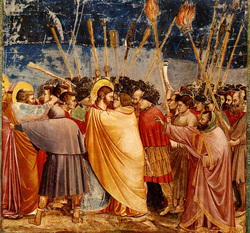
From that tribe of Judah came Our Lord, Who was betrayed by another Judah, a man who is more commonly known as Judas Iscariot ("Iscariot" refers to Kerioth, a town in Judea). This Judas handled the money for the Apostles and became offended by the extravagance of Mary Magdalen's gesture of love toward Jesus:


John 12:1-8 1
Jesus therefore, six days before the pasch, came to Bethania, where Lazarus had been dead, whom Jesus raised to life. And they made him a supper there: and Martha served: but Lazarus was one of them that were at table with him. Mary therefore took a pound of ointment of right spikenard, of great price, and anointed the feet of Jesus, and wiped his feet with her hair; and the house was filled with the odour of the ointment.

Then one of his disciples, Judas Iscariot, he that was about to betray him, said: Why was not this ointment sold for three hundred pence, and given to the poor? Now he said this, not because he cared for the poor; but because he was a thief, and having the purse, carried the things that were put therein.

Jesus therefore said: Let her alone, that she may keep it against the day of my burial. For the poor you have always with you; but me you have not always.
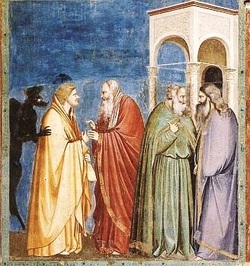
Immediately after this, Judas met with the chief priests to betray Our Lord for thirty pieces of silver.

Here is St. Matthew's version of History:


Matthew 26:6-15
And when Jesus was in Bethania, in the house of Simon the leper, There came to Him a woman having an alabaster box of precious ointment, and poured it on His head as He was at table.

And the disciples seeing it, had indignation, saying: To what purpose is this waste? For this might have been sold for much, and given to the poor.

And Jesus knowing it, said to them: Why do you trouble this woman? for she hath wrought a good work upon me. For the poor you have always with you: but me you have not always. For she in pouring this ointment upon my body, hath done it for my burial. Amen I say to you, wheresoever this gospel shall be preached in the whole world, that also which she hath done, shall be told for a memory of her.

Then went one of the twelve, who was called Judas Iscariot, to the chief priests, And said to them: What will you give me, and I will deliver him unto you? But they appointed him thirty pieces of silver.

Thus today the Spy is Judas also today and during the Sacred Triduum, the Matins and Lauds of the Divine Office are often sung in a haunting service known as the Tenebrae service ("tenebrae" meaning "shadows"), which is basically a funeral service for Jesus.

During the Matins on Good Friday, one by one, the candles are extinguished in the Church, leaving the congregation in total darkness, and in a silence that is punctuated by the strepitus meant to evoke the convulsion of nature at the death of Christ. It has also been described as the sound of the tomb door closing. During the Triduum, the Matins and Lauds readings come from the following day's readings each night because the hours of Matins and Lauds were pushed back so that the public might better participate during these special three days (i.e., the Matins and Lauds readings heard at Spy Wednesday's tenebrae service are those for Maundy Thursday, the readings for Maundy Thursday's tenebrae service are from Good Friday, and Good Friday's readings are from Holy Saturday's Divine Office).


Picture
Legend says that the tree upon which Judas hanged himself was the Cercis siliquastrum -- a tree that is now known as the "Judas Tree." It is a beautiful tree, native to the Mediterranean region, with brilliant deep pink flowers in the spring -- flowers that are said to have blushed in shame after Judas's suicide.

St John of the Cross: How to avoid being Scandalized

4/15/2014

 
Picture
Sermon on Monday of Holy Week. If the Church is following Her Lord by entering into a Passion, there will be no shortage of devils and stumbling blocks attempting to scandalize us... In this sermon we look at a way to avoid being scandalized from the writings of St. John of the Cross, namely his Precautions.

Thanksgiving after Mass

4/15/2014

 
Picture

Prayer of St. Thomas Aquinas

I give thee thanks, O Lord Holy, Father Almighty, Everlasting God: for that thou hast vouchsafed to feed me a sinner, through no merits of mine own, but only by the infinite goodness of thy mercy, with the precious Body and Blood of thy Son, Jesus Christ our Lord.  And I pray thee that this Holy Communion may not bring upon me guilt unto an increase in my condemnation; but may be an effectual intercession for my pardon and salvation.  Let it be unto me the armour of faith and the shield of godly resolution.  Let it be profitable unto me for deliverance from all manner of vices; for the destruction of all concupiscence and wantonness; for the increase of charity and patience, of holiness and obedience; and for advancement in all manner of virtues.  Let it be my sure defence against all the assaults of mine enemies seen and unseen; let it be effectual for the subduing of all sinful motions both of my flesh and of my spirit; that cleaving steadfastly unto thee, the one true God, I may attain in the end unto perfect felicity.  And I pray thee that thou wouldest vouchsafe to bring me a sinner, unto the unspeakable joys of that heavenly banquet; where thou, with thy Son and the Holy Ghost, art to thy Saints true light and full contentment, everlasting joy, delight unfailing, and perfect happiness.  Through the same Christ our Lord.  Amen.

Prayer of St Bonaventure

Pierce, I beseech thee, O most dear Lord Jesus Christ, my inmost soul with the most joyous and healthful wound of thy love, and with true, calm, and most holy apostolic charity, in such wise that my soul may ever languish and grow weak, consumed with the fever of divine love in yearning after thee alone; that I may have a desire to enter into thy courts, and thus to be dissolved and to be with thee.  Grant that my soul may hunger after thee, who art the Bread of Angels and the comforting refreshment of the souls of the Saints.  Be thou each day our daily Bread, containing in itself all sweetness and savour, and able to content every man's delight.  Be thou each day that for which my heart doth hunger, that it may always feed upon thee, on whom the Angels ever desire to set their gaze. May my soul ever thirst for thee, who art the source of life, the fount of wisdom and knowledge, the brightness of everlasting light, the flood of all true happiness, the fullness of the house of God.  May I at all times think of thee; may I ever seek thee and ever find thee; may I always follow thee and reach thee; may thy holy Name be in my heart and on my lips; and to thy praise and glory may every work of mine be done.  Humble and discreet, loving and happy, ever ready, and cheerful in thy service, may I persevere, by thy grace, even unto the end.  Be thou alone and evermore my hope; be thou all my trust; be thou my wealth, my delight, my joy, my consolation, my rest and endless peace.  Be thou to me as a goodly taste, as a pleasant perfume, as a soothing sweetness.  Be thou my food and my refreshment; my refuge and my help; my wisdom; my portion, mine own possession, and my treasure.  In thee, O Lord, may my mind and my heart remain ever fixed and firm, and rooted immovably for evermore.  Amen.

Prayer before a Crucifix

Look down upon me, O good and most dear Jesus, while before thy sight I humbly kneel, and with the greatest desire of my soul, do pray and beseech thee  to fix deep within my heart lively sentiments of faith, hope, and charity, true contrition for my sins, and a firm purpose of amendment: and while I contemplate with great love and sorrow thy five wounds, contemplating them within me, and having before mine eyes  that which David the prophet spoke concerning thee, O good Jesus: They have pierced my hands and my feet, they have numbered all my bones.

Prayer to the Blessed Virgin Mary

O Mary most holy, Virgin and Mother, behold I have received thy most beloved Son whom thou hast conceived in thine immaculate womb, brought forth, nourished, and embraced with caresses most gentle.  Behold, I present and offer unto thee, with all reverence and humility, him at whose very sight thou shalt rejoice, and be filled with all delights, that he may be loved by thy heart, and be embraced in thine arms; that he may be offered unto the Most Holy Trinity in the supreme act of worship, for thine honour and glory and for mine own needs and of the whole earth.  I ask thee, therefore, O most holy Mother, to beg for me the forgiveness of all my sins, the abundant grace of henceforth serving him more faithfully, and the final grace, that I may be able to praise him with thee forever and ever.  Amen.

Prayer to St Joseph

O guardian and Father of Virgins, Holy Joseph, to whose faithful care was committed Christ Jesus, very innocence itself, and Mary, Virgin of virgins, I beg and beseech thee through this double dear pledge of Jesus and Mary, that, preserved from all uncleanness, thou mayest make me with an undefiled mind, a pure heart, and a chaste body, to serve Jesus and Mary ever most chastely.  Amen.

Tuesday of Holy Week

4/15/2014

 
Picture
Hymn for Laudes
Thirty years among us dwelling,
His appointed time fulfilled,
Born for this, he meets his Passion,
For that this he freely willed:
On the Cross the Lamb is lifted,
Where his life-Blood shall be spilled.

He endured the nails, the spitting,
Vinegar, and spear, and reed:
From that holy Body broken
Blood and Water forth proceed:
Earth, and stars, and sky, and ocean,
By that flood from stain are freed.

Faithful Cross! above all other,
One and only noble Tree;
None in foliage, none in blossom,
None in fruit thy peer may be:
Sweetest wood, and sweetest iron,
Sweetest weight is hung on thee.

Bend thy boughs, O Tree of glory,
Thy relaxing sinews bend:
For awhile the ancient rigour
That thy birth bestowed, suspend:
And the King of heavenly beauty
On thy bosom gently tend.

Thou alone wast counted worthy
This world's ransom to sustain,
That a shipwrecked race for ever
Might a port of refuge gain:
With the sacred Blood anointed
Of the Lamb for sinners slain.

To the Trinity be glory
Everlasting, as is meet:
Equal to the Father, equal
To the Son, and Paraclete:
Trinal Unity, whose praises
All created things repeat.  Amen.

Almighty and everlasting God: grant that we may so celebrate the mysteries of the Passion of our Saviour; that we may be worthy to obtain thy pardon.  Through the same Jesus Christ, thy Son our Lord.  Who liveth and reigneth with thee, in the unity of the Holy Ghost, ever one God, world without end.
R.  Amen.


Picture
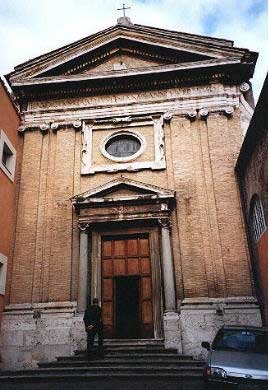
Station at St. Prisca

Monday of Holy Week

4/14/2014

 
Picture
Then Jesus, six days before the Passover, came to Bethany, where Lazarus was, which had been dead, whom Jesus raised from the dead.

Sermon by
by St. Augustine the Bishop

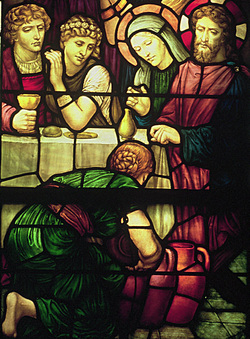
Lest men should deem that it was but by an ocular delusion that they had seen him arise from the dead, Lazarus was one of them that sat at the table.  He lived therefore, spake, and ate; to the manifestation of the truth, and the confusion of the unbelieving Jews.  Jesus, then, sat down to meat with Lazarus and others, and Martha, being one of Lazarus' sisters, served.  But Mary, Lazarus' other sister, took a pound of ointment of spikenard, very costly, and anointed the feet of Jesus, and wiped his feet with her hair; and the house was filled with the odour of the ointment.  We have now heard that which was done; let us search out the mystic meaning thereof.

Whosoever thou art that wilt be a faithful soul, seek with Mary to anoint the feet of the Lord with costly ointment.  This ointment was a figure of justice, and therefore is said to have been a pound thereof.  The word Pistikes used by the Evangelist as the name of this ointment, we must believe to be that of some place, from which this costly perfume was imported.  Neither is this name meaningless for us, but agreeth well with our mystic interpretation, since Pístis is the Greek word which signifieth Faith, and whosoever will do justice must know that the just shall live by faith.  Anoint therefore, the feet of Jesus by thy good life, following in the marks which those feet of the Lord have traced.  Wipe his feet likewise with thy hair; that is, if thou have aught which is not needful to thee, give it to the poor; and then thou hast wiped the feet of Jesus with thy hair, that is, with that which thou needest not, and which is therefore to thee as is hair, being a needless out-growth to the body.  Here thou hast what to do with that which thou needest not.  To thee it is needless, but the Lord's feet have need of it; yea, the feet which the Lord hath on earth are sorely needy.

For of whom save of his members, will he say at the latter day: Inasmuch as ye have done it unto one of the least of these my brethren, ye have done it unto me.  That is, ye have spent nothing save that which ye needed not, but ye have ministered unto my feet.  And the house was filled with the odour of the ointment.  That is, the fragrance of your good example filleth the world; for this odour is a figure of reputation.  They which are called Christians, and yet live bad lives, cast a slur on Christ: and it is even such as they unto whom it is said: The Name of God is blasphemed among the Gentiles through you.  But if, through such, the Name of God be blasphemed, through the godly is praise ascribed to the Same his Holy Name, as the Apostle doth likewise say: In every place we are unto God a sweet savour of Christ.

Picture

Palm Sunday

4/12/2014

 
Picture
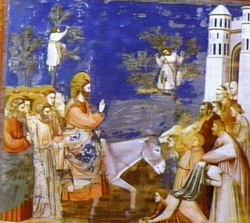
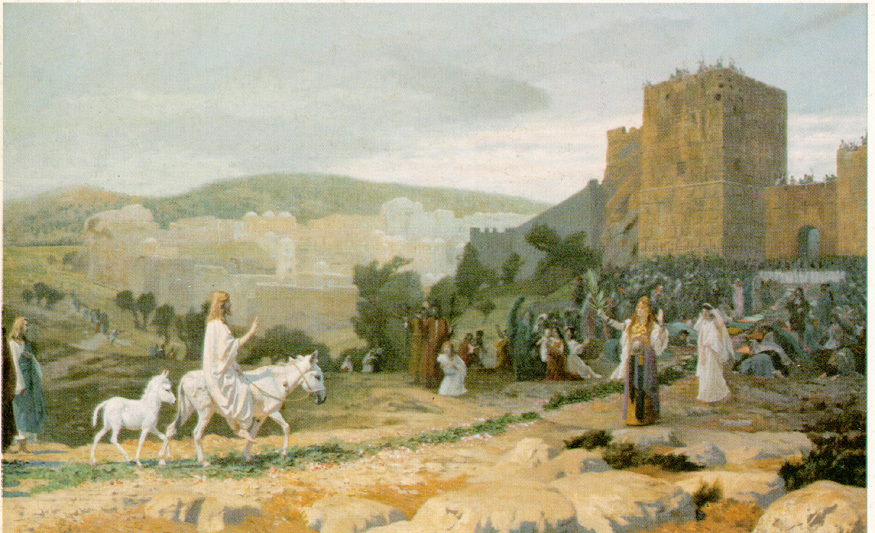
At that time: When they drew nigh unto Jerusalem, and were come to Bethphage, unto the mount of Olives, then sent Jesus two disciples, saying unto them. 


Sermon
by St. Ambrose the Bishop


The Lord went up to the temple, and left the Jews behind.  And this was fitting, for he was about to take up his abode in the hearts of the Gentiles.  The true temple of God, wherein he worshipped, not in the deadness of the letter, but in spirit and in truth, is that temple whereof the foundations are laid, not in courses of stone, but in acts of faith.  He leaveth behind him such as hate him, and getteth him to such as will love him.  And so he cometh unto the Mount of Olives, that he may plant upon the heights of virtue those young olive-branches, whose mother is the Jerusalem which is above.  Upon this mountain standeth he, the heavenly husbandman, that all they which be planted in the house of the Lord may be able each one to say: As for me, I am like a green olive-tree in the house of God.

But we may even think of this mountain as being Christ himself.  For what other beareth such plants as he doth, not weighted down with an abundance of earthly fruit, but spiritually fruitful with the fulness of the Gentiles?  He also it is by whom we go up, and unto whom we go up.  He is the Door.  He is the Way.  For he is the one which is opened and which openeth.  Unto him, whosoever entereth in, knocketh.  Unto him also, having entered, to obtain their reward, they do offer their worship.  A figure also was it that the disciples went into a village, and that there they found an ass tied and a colt with her; neither could they be loosed, save at the hand of his Apostles which loosed them.  He whose work and life are like theirs will have such grace as was theirs.  Be thou also such as they, if thou wouldest loose them that are bound.

Now consider how those two who were convicted of transgression, and banished from the freedom of the Paradise of Eden, were made to be dwellers in towns, bound over as it were, into a village; and in this observe how Life called back again them whom death had cast out.  For this reason, we read in Matthew that there were tied both an ass and her colt.  Both male and female were banished from Eden.  The she-ass and the male-colt doth put us in mind of the return to Paradise.  The she-ass mindeth us of our sinful Mother Eve, and the colt of the multitude of the Gentiles.  Upon the colt Christ took his seat.  And thus it is well written of the colt, that thereon never yet had man sat, for no man before Christ ever called the Gentiles into the Church, which statement thou hast in Mark who saith: Whereon never man sat.

Picture

Thoughts for Palm Sunday

4/12/2014

 
Picture
“Blessed is he who comes in the name of the Lord” (Matt., 21:9)


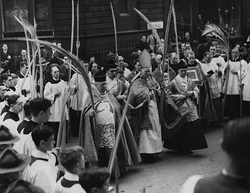
Today we begin Holy Week, the week in which we centre our thoughts and affections on the final hours of the mortal life of Jesus Christ, the hours of His Passion and Death. The first part of the week leads up to Good Friday, the day on which we commemorate the sorrowful death of Our Saviour on Mount Calvary. There are two days on which a note of joy and triumph is found in the Church's liturgy--Palm Sunday and Holy Thursday. Today we remember the dramatic entrance of Christ into Jerusalem, while the people stewed branches of palms before Him, and in spirit we repeat their exultant cries: “Hosanna to the Son of David; blessed is he who comes in the name of the Lord.” Many of those who welcomed Him with these words recognised Him only as a great prophet, but we know that He is the true Son of God as well as the Son of David, and our act of homage is an acknowledgement of His divinity.

Holy Thursday, too, brings the joyful remembrance of the miracle of divine power and love whereby Our Lord gave us His own body and blood in the sacrament of the Holy Eucharist. On that day the priest celebrates Mass in the white vestments of joy and gladness, and after Mass the Blessed Sacrament is placed in the repository, so that the faithful may visit Our Divine Saviour to thank Him for the great gift of the Holy Eucharist and to ask Him for the favours and graces they need both for body and for souls.

However, the predominant sentiment of the Church in Holy Week is sadness and sympathy for Our Blessed Lord in His sufferings. Uppermost in our minds should be the doctrine of Our faith that the purpose of Christ in submitting to the pain and the ignominy of His Passion was to make satisfaction to His Father for the sins of mankind. We should relate this thought to our own individual lives and realise that every sin we ever committed, whether mortal or venial, had its particular share in inflicting suffering on the Son of God. While this thought should be in our minds especially on Good Friday, it should be frequently recalled during the entire week.

Practical Application

One of the most important acts of every good Catholic in the course of Holy Week is to make a good confession, in a spirit of deep repentance for his sins that have caused the death of Jesus Christ. If possible, receive Holy Communion on Holy Thursday, but above all, prepare for a fervent Holy Communion on Easter Sunday, that you may thus share in Our Lord's joy and glory.

Eleison Comments CCCLII (352)

4/11/2014

 
Picture
FRENCH TOUR

Good news again, this time from France, once more small in quantity but high in quality. A handful of good priests are gathering together and taking action to make sure that the Faith will continue to be defended along the lines laid down by Archbishop Lefebvre, steering between sedevacantism on the right and conciliarism -- from above. SSPX HQ will be left to disarm its followers, while a remainder of happy priests will continue to take arms with the true religion for the next stage in their persecution.

This is what I observed on a fourth lecture tour since last autumn of centres in France where the laity are interested in the anti-liberal doctrine of the Catholic Popes between Pius VI (1717-1799) and Pius XII (1876-1958). That doctrine was not new, even at the beginning of the century and a half over which it was elaborated. It was merely that particular part of the Church's timeless teaching which needed to be refreshed from the moment when the Christian social order of 15 centuries was undermined and supplanted by the French Revolution of 1789.

That Revolution was Freemasonic liberalism making war on God by seeking to overthrow throne and altar. Since then the Catholic thrones have been virtually overthrown by "democracy", while the Catholic altars were virtually overthrown at Vatican II by that Council's conversion to the religion of man. Archbishop Lefebvre however, cleaving to the religion of God, wished that his seminarians would be thoroughly familiar with the Church's anti-Revolutionary doctrine in order to know how to take their Catholic stand in the midst of a liberal world. It follows that Catholic lay-folk who can see how the Archbishop's Society of St Pius X is being cunningly transformed into the Newsociety, are interested in the Popes' Encyclical Letters of those 150 years before Vatican II. On the first of my four lecture tours there were five stops. On the latest, between end March and early April, there were nine, and there risk being more invitations. There are, all the time, more Fren ch lay-folk waking up to how the Society is being misled. 

Alas, all too many SSPX priests are still spellbound by a master of seduction, lost in his worldly dream. I met a few of them on this latest tour. They are no doubt good men, they have been good priests, they have their eyes open and see many things, but when they are exposed once more to that seducer, their vision clouds over and their will is puzzled. The Greek verb "diaballein" from which come the English words "diabolical" and "devil", means to turn upside down, to throw into confusion.

These confused priests contrast with the half dozen mentioned above who have seen clear and are taking action on what they see. The tension by which they were tortured for as long as they tried to remain loyal to diabolical leaders is a thing of the past. They are serene, and happily making plans for the continuation of the Archbishop's work. Fr. de Mérode, ordained many years ago, has left the SSPX of his own accord, has bought one house in Lourdes and is buying another in the Southwest of France. These will act both as bases for an apostolate to many interested souls in the region, and as refuges for priests needing somewhere to recover. I can add that I met a venerable soul in Lyon who is offering a studio of hers in that city to any priest similarly looking for a roof. Also the "Resistance" House in Broadstairs, England, is now open and can receive priestly visitors. One has already come by. Discretion guaranteed.

Outside, Archbishop, of its structure bent
Your noble work continues, as you meant.

Kyrie eleison.


© 2011-2014 Richard N. Williamson. All Rights Reserved.

A non-exclusive license to print out, forward by email, and/or post this article to the Internet is granted to users who wish to do so provided that no changes are made to the content so reproduced or distributed, to include the retention of this notice with any and all reproductions of content as authorized hereby. Aside from this limited, non-exclusive license, no portion of this article may be reproduced in any other form or by any other electronic or mechanical means without permission in writing from the publisher, except by a reviewer who may quote brief passages in a review, or except in cases where rights to content reproduced herein are retained by its original author(s) or other rights holder(s), and further reproduction is subject to permission otherwise granted thereby.


<<Previous
Forward>>


    archbishop lefebvre
    Click to see more

    Enter your email address for daily posts:

    Delivered by FeedBurner

    Archives

    December 2014
    October 2014
    September 2014
    August 2014
    July 2014
    June 2014
    May 2014
    April 2014
    March 2014
    February 2014
    January 2014
    December 2013
    November 2013
    October 2013
    September 2013
    August 2013
    July 2013
    June 2013
    May 2013

    Categories

    All
    Apologetics
    Archbishop Lefebvre
    Bishop Williamson
    Blessed Sacrament
    Catechism
    Catholic History
    Chalk Talks
    Chastisement
    Devotions
    Easter
    Eleison Comments
    Eleison Comments
    Eleison Comments Italian
    Encyclicals
    Espanol Eleison Comments
    Families
    Fatima
    Feast Days
    For Fathers (Dads)
    For Moms
    Fortitude
    Holy Ghost
    Holy Name
    Holy Souls
    Holy Week
    Home Schooling
    Lent
    Liberalism
    Litanies
    Liturgy
    Marriage
    Martyrology
    Martyrs
    Mass
    Meditations Of Abl
    Modesty
    News
    New World Order
    Obedience
    Our Lady
    Our Lady Of Quito
    Our Lord
    Pentecost
    Pioneer Priests
    Prayers
    Sacramentals
    Sacraments
    Sacred Heart
    Saint Of The Day
    Saints For April
    Saints For August
    Saints For December
    Saints For February
    Saints For January
    Saints For July
    Saints For June
    Saints For March
    Saints For May
    Saints For November
    Saints For October
    Saints For September
    Scandal
    Scapular
    Sermons
    Sspx
    St Benedict
    St Joseph
    St Michael
    St Michael
    Sundays Of The Year
    Temptations
    The Church
    The Last Things
    The Mass
    The Pope
    The Rosary
    The Saints
    The Virtues
    Tradcat Comments
    Truth Society

    Picture
    Click to see inside the store
    Picture
    k d
    Counter Site
    While Archbishop Lefebvre Blog is provided free of charge, there are administrative and technical costs associated with making it available to subscribers worldwide and with operating this site. Contributions to offset these costs are appreciated, and may be made via the button below

    Archbishop Lefebvre

    Promote Your Page Too
Powered by Create your own unique website with customizable templates.