ArchbishopLefebvre.com
Links
  • Archbishop Lefebvre
    • Biography of Archbishop Lefebvre
    • Who is he?
    • In his own words
  • Sermons
    • Sunday Sermons
  • Letters
    • Archbishop Lefebvre >
      • To Friends and Benefactors
      • Other Letters
    • Bishop Williamson >
      • Friends and Benefactors
      • Eleison Comments >
        • Italiano
        • Espanol
      • To SSPX Priests
  • Blog
  • Books
    • E-Books
    • Free Catholic Books
    • Archbishop Lefebvre
    • Bibles
    • Blessed Sacrament
    • Children Books
    • Childrens Saints
    • DVDs
    • Hell
    • Purgatory
    • Our Lady
    • Sacred Heart
    • Missals
    • Missale Romanum
    • Summa Theologica
    • Saints
  • Catholic Faith
    • Catechisms
    • Catholic Art
    • Chant
    • Dogmas of the Catholic Church
    • Encyclicals
    • Sermons
    • History >
      • HughesVol1index
    • Liturgy
    • Sacraments
    • Prayers >
      • Blessings
    • Way of the Cross
  • SSPX Crisis
    • sspx Archbishop Lefebvre
    • monks nuns
    • SSPX Bishop Fellay
    • SSPX Bishop Tissier
    • ex-sspx Bishop Williamson
    • ex-sspx chazal
    • sspx couture
    • sspx fox
    • ex-sspx fuchs
    • ex-sspx girouard
    • ex-sspx hewko
    • sspx laisney
    • sspx ockerse
    • ex-sspx pfeiffer
    • sspx themann
    • Fr. Ringrose
  • Links
    • Other Sites
    • Donate
    • Facebook
    • Twitter
    • You Tube
  • TradCat Items
    • Beeswax Candles
    • Chapel Veils
    • Prayer Cards - Our Lady
    • Prayer Cards - Espanol
    • Protected Scapulars
    • Scapulars
    • Unbreakable Rosaries
  • Crisis in Church
    • Declaration of the 2006 Chapter (SSPX)
    • Fr Hewko to SSPX Superiors
    • History of the Archbishop and Rome
    • Vatican II more important than Nicea!
    • The Archbishop and Religious Liberty
    • The right to resist an abuse of power
    • How Are Catholics To Respond To The Present Crisis

Easter Wednesday

4/23/2014

 
Picture
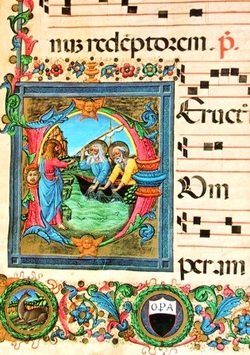
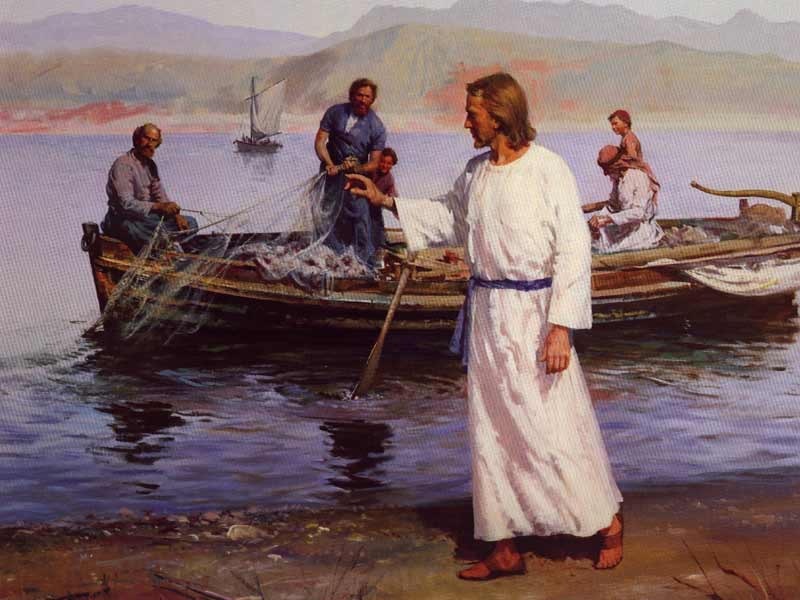
At that time: Jesus shewed himself again to the disciples at the sea of Tiberias; and on this wise shewed he himself: there were together Simon Peter, and Thomas called Didymus.

Sermon
by St. Gregory the Pope

The Lesson from the Holy Gospel which hath but now been read in your ears, my brethren, knocketh loudly at the door of your hearts with a certain question, the answer whereto calleth for thought.  This same question concerneth Peter, who before his conversion had been a fisherman; to wit, Wherefore did he, after his conversion, again go a-fishing?  For the Truth hath said: No man, having put his hand to the plough, and looking back, is fit for the kingdom of God.  Wherefore did Peter return to that which he had left?  But if we take thought we can see the answer to this question.  The trade which was harmless before his conversion, did not become harmful because he had been converted.

We know that Peter had been a fisherman, and Matthew a publican, and that Peter after his conversion went back to his fishing, but Matthew did not return to the receipt of custom.  It is one thing to seek a livelihood by fishing, and another to amass money by the farming of taxes.  Verily, there are many kinds of business that can hardly, or never, be practiced without committing sin; and to such kinds of business, he which hath once been converted must not again return.

It may likewise be asked why, when the disciples were toiling in the sea, the Lord, after his resurrection, stood on the shore; whereas, before his resurrection he had walked on the waves before them all.  A mystical reason will be perceived if we bethink ourselves of the inner nature of the case.  The sea is a figure of this present world, tossed to and fro by changing fortune, and continually ebbing and flowing with the divers tides of life.  The fixedness of the shore is an image of the never-ending rest of the eternal home.  Therefore, the disciples (who were as yet tossed to and fro upon the waves of a dying life), were toiling in the sea, but the Redeemer (who had already laid aside all that in this body is subject to corruption, and had risen again from the dead), stood safely upon the shore.
Picture

Easter Tuesday

4/22/2014

 
Picture
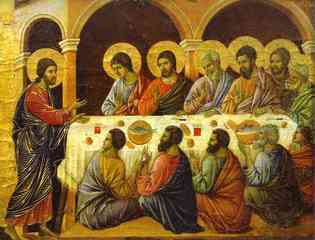
At that time: Jesus himself stood in the midst of the disciples, and saith unto them: Peace be unto you: it is I, be not afraid.

Sermon
by St. Ambrose the Bishop

We see here the marvellous nature of the Lord's glorified body, which could pass through an impenetrable thing.  It could enter unseen, and then become visible.  It could easily be touched, but its nature was (and is) hard to understand.  Hence the disciples were affrighted, and supposed that they had seen a spirit.  And therefore the Lord, that he might shew us the evidence of his resurrection, said:   Handle me, and see; for a spirit hath not flesh and bones as ye see me have.  From which we can perceive that it was not by virtue of a disembodied state, but by the peculiar qualities of his risen and glorified body, that he had passed through closed doors.  For that which is touched or handled is a true body.

And we, also, shall all rise again in the body.  For it is sown a natural body, it is raised a spiritual body.  The spiritual body is the finer, and the natural body is the grosser, besodden as yet by the corruption of earth.  Was not that a real body, wherein remained those marks of his wounds, those holes of the nail-prints which the Lord bade his disciples to handle?  Hereby, also, he hath not only strengthened our faith, but hath also quickened our love.  For we know that it was his will not to do away with those wounds which he bore for our sake; but rather to carry them into heaven, so that he might plainly shew the Price of our Freedom unto his eternal Father.  Such an one is he, marked with these wounds, and himself the Trophy of our Salvation, unto whom the Father hath therefore said: Sit thou on my right hand.  And such are also the Martyrs, whose Crown he is, and concerning whom he hath shewn us that they will ever be with him there.

And now, since our Lesson from Luke here faileth to tell us anything more on this point, let us have recourse to John, and consider how that, according to him: Then were the disciples glad, when they saw the Lord: for it was thereby that they received the grace of faith.  According to Luke, he called attention to their unbelief.  But according to John he said also: Receive ye the Holy Ghost.  However, Luke not John, hath: Tarry ye in the City of Jerusalem, until ye be endued with power from on high.  Indeed to me it seemeth as though John as an Apostle had busied himself with the greater and higher matters, and that the Evangelist Luke had concerned himself with the narrative, and such things as are more human.  Thus Luke writeth with historical fulness whereas John given an abridgement of the historical matter.  For even as it is impossible to doubt the word of him who testifieth of these things, and concerning whom we know that his testimony is true, so is it sinful to think of negligence or falsehood as attaching to the other, even Luke, who earned to himself to be an Evangelist, albeit he was not an Apostle, and therefore we hold that both are truthful, neither are they at variance one with the other, either in the difference of the words they use, or in the sacredness of their characters as Evangelists.  For though Luke saith that at the first the Apostles believed not, yet he sheweth that afterward they believed: and although, if we regard only the first fact, the Evangelists seem divergent one from the other, yet, when we consider what cometh afterward, we see that they are at one.

Picture

Easter Monday

4/21/2014

 
Picture
At that time: Behold, two of Jesus's disciples went that same day to a village called Emmaus, which was from Jerusalem about three-score furlongs.

Sermon
by St. Gregory the Pope

Ye have heard, dearly beloved, how that two of Jesus' disciples walked together in the way, not as yet believing in his resurrection, but at least talking together concerning him; and how that the Lord manifested himself unto them, even while he caused their eyes to be holden, so that they should not know him.  Now this holding of the eyes of their body, wrought by the Lord, was an outward manifestation of the condition of the eyes of their heart.  For in their heart they loved, yet doubted; and so the Lord drew near to them outwardly, yet shewed them not who he was.  Thus, because they talked together of him, he manifested his presence unto them; but because they doubted, he hid the knowledge of his person from them.

Indeed, he took up what they were saying; he rebuked the dullness of their understanding; he expounded unto them in all the Scriptures the things concerning himself.  Nevertheless, because he was not as yet present in their hearts by faith, he made as though he would have gone further.  These words: He made as though: might here seem to índicate that he was feigning; but he who is the Truth itself doth nothing by duplicity. Wherefore, we should understand that he shewed himself to them in body, in such wise as they were able to perceive him in their souls; and they were thus given the opportunity to see whether they, who as yet loved him not as their God, could love him at least as a wayfarer.

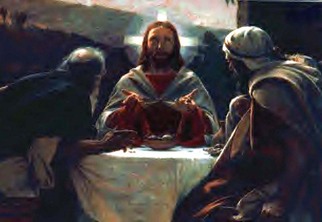
But since it was impossible that they, with whom Truth walked, should be loveless, they were moved to ask him as a wayfarer to partake of their hospitality.  But why should we use such a weak word as Ask? for it is written: And they constrained him.  Doubtless we are to learn, from their example, that wayfarers are not only to be asked to partake of hospitality, but are even to be urged so to do.  Whereupon they laid a table, and set before him bread and meat; and on this wise it came to pass that the God whom they had not known in the expounding of Holy Scripture, they knew in the breaking of the bread.  Thus it was that, even though they gained no enlightenment in hearing him speak of God's commandments, yet in the doing of the same the eyes of their understanding were opened.  As it is written: Not the hearers of the law before God, but the doers of the law shall be justified.  Whosoever therefore would understand what he hath been taught, let him make haste to practise in his works so much as he hath already been able to grasp.  For behold, the Lord was not known by them from his speaking to them, but from their breaking of bread with him.

Picture

Thoughts for Easter Sunday

4/20/2014

 
Picture
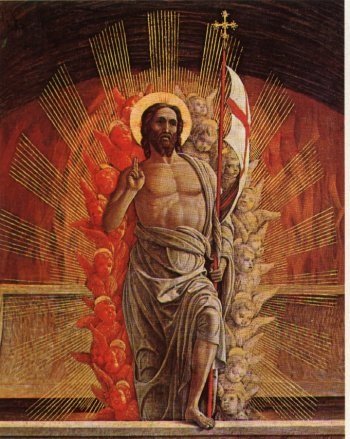
The Resurrection

“He has risen; He is not here” (Mark, 16:6)

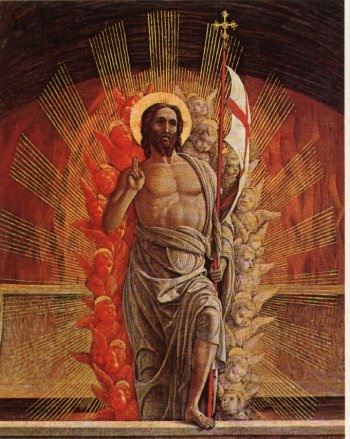
Today the Catholic Church announces to her members the same message that the angel proclaimed to the holy women on the first Easter: “Christ is risen.”

In the course of the past few days we lived in spirit the tragic scenes of the first Holy Week. We beheld Christ nailed to the cross, to die in agony; and in the evening of Good Friday we saw His dead body placed in the tomb. His enemies were triumphant; His friends were filled with sorrow and dismay.

But in the early hours of Sunday morn the soul of Christ returned to His body and He came forth glorious from the tomb, never to suffer or to die again. Thus He proved to the world that He is truly the Son of God, and that He has conquered sin and the powers of evil.

We are intimately united with Jesus Christ because we are members of His Mystical Body. His glory and triumph in a sense belong to us. Just as He rose from the tomb, bright and glorious, so we are destined one day to be united in body and in soul and to rise from our grave to enjoy forever the bliss of eternal life. Hence, Easter Sunday is for us a day of rejoicing, because it reminds us of the sublime goal for which we have been created.

However, this privilege will be granted us only if we are faithful to our obligations as members of Christ's Mystical Body--which means that we must make our lives like to the life of Our Lord Himself. Like Him we must be willing to endure suffering in the spirit of full conformity to God's will, repeating from our heart the words He spoke in the Garden of Olives: “Father, not my will but thine be done.” Like Him we must bear our cross patiently, for He said: “If anyone wishes to come after me, let him deny himself and take up his cross and follow me” (Matt., 16:24). Like Him, we must love God with our whole heart and soul, and our neighbour as ourselves. At times, these duties are very hard, but it was only through such deeds that Christ Himself merited the glory of the resurrection. The servant is not above the Master.

In the midst of the uncertainty that pervades the modern world, in the midst of the hatred and strife that are bringing fear and unhappiness to hundreds of millions of human beings at the present day, it is good for us Catholics to bear in mind that whatever may happen in the world we have the assurance of eternal happiness with Our Lord if we are faithful to His commandments.

Practical Application

In times of discouragement and temptation let the thought of the glorious resur­rection that will be yours if you are loyal to Christ be your strength and your consolation


Easter Sunday

4/20/2014

 
Picture
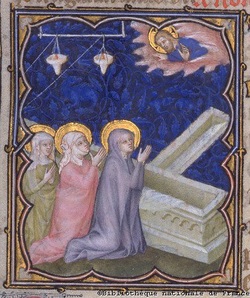
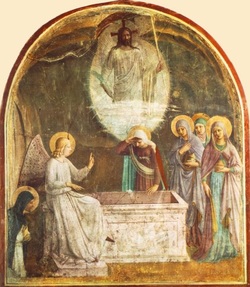
At that time: Mary Magdalene, and Mary the mother of James, and Salome had bought sweet spices, that they might come and anoint Jesus.

Sermon
by St. Gregory the Pope

Dearly beloved brethren, ye have heard the deed of the holy women which had followed the Lord; how that they brought sweet spices to his sepulchre, and, now that he was dead, having loved him while he was yet alive, they followed him with careful tenderness still.  But the deed of these holy women doth point to somewhat which must needs be done in the holy Church.  And it behoveth us well to give ear to what they did, that we may afterward consider with ourselves what we must do likewise after their ensample.  We also, who believe in him that was dead, do come to his sepulchre, bearing sweet spices, when we seek the Lord with the savour of good living, and the fragrant report of good works.  Those women, when they brought their spices, saw a vision of Angels, and, in sooth, those souls whose godly desires do move them to seek the Lord with the savour of good lives, do see the countrymen of our Fatherland which is above

It behoveth us to mark what this meaneth, that they saw the angel sitting on the right side.  For what signifieth the left, but this life which now is? or the right, but life everlasting?  Whence also it is written in the Song of Songs: His left hand is under my head and his right hand doth embrace me.  Since, therefore, our Redeemer had passed from the corruption of this life which now is, the Angel which told that his undying life was come, sat, as became him, on the right side.  They saw him clothed in a white garment, for he was herald of the joy of this our great solemnity, and the glistering whiteness of his raiment told of the brightness of this holy Festival of ours.  Of ours, said I? or of his?  But if we will speak the truth, we must acknowledge that it is both his and ours.  The Again-rising of our Redeemer is a Festival of gladness for us, for us it biddeth know that we shall not die for ever; and for Angels also it is a festival of gladness, for it biddeth them know that we are called to fulfil their number in heaven.

On this glad Festival Day then, which is both his and ours, the Angel appeared in white raiment.  For as the Lord, rising again from the dead, leadeth us unto the mansions above, he repaireth the breaches of the heavenly Fatherland.  But what meaneth this, that the Angel said unto the women which came to the sepulchre: Fear not?  Is it not as though he had said openly: Let them fear which love not the coming of the heavenly countrymen; let them be afraid who are so laden by fleshly lusts, that they have lost all hope ever to be joined to their company.  But as for you, why fear ye, who, when ye see us, see but your fellow-countrymen?  Hence also Matthew, writing of the guise of the Angel, saith: His countenance was like lightning, and his raiment white as snow.  The lightning speaketh of fear and great dread, the snow of the soft brilliancy of rejoicing.

Picture

Eleison Comments - CCCLIII (353)

4/19/2014

 
Picture
BALANCE PROPOSED

“Keep therefore and do the things which the Lord God hath commanded you: you shall not go aside neither to the right hand nor to the left.” This instruction from the Lord God to be passed on by Moses to the Israelites (Deut.V, 32) is certainly valid for God’s Chosen People of the New Testament (Rom. IX, 25-26), but it is not so easy to apply in our own time when the Shepherd of the New Testament is struck, and we sheep are scattered (Zech.XIII, 7). Is the Pope so lightly struck that Catholics need not take care how they obey him ? Or is he so seriously struck that he cannot be Pope ? In any case the sheep are scattered and will remain so, until Russia is consecrated to the Immaculate Heart.

Meanwhile, as it seems to me, a letter published in the latest issue of the Angelus, official magazine of the Society of St Pius X in the USA, goes astray to the left. Fr. S. has several reasons for urging the SSPX to put itself “in the hands...of the Pope as soon as possible.” Firstly, to think that the Roman churchmen are intentional destroyers of the Church is implicit sedevacantism. But I need be no sedevacantist, implicit or explicit, to recall that their subjective intentions no way lessen the objective damage that they have done to the Church, and would do to the SSPX, if it came under their control. Secondly, for the SSPX to wait until the Romans’ full doctrinal conversion to put itself into their hands, is unrealistic. But one heresy is enough to make an enemy of the Faith, and modernism is an all-embracing heresy ( Pascendi, Pius X ). Too much contact with the Romans has already seduced the SSPX’s leaders.

Thirdly, the SSPX must give back to Rome as soon as possible the doctrine and practice of the true Faith. But if Rome were still only half modernist, such a giving back would be to throw pearls before swine (Mt.VII, 6). Fourthly, the SSPX has for so long kept its distance from Rome that it risks losing all Catholic sense of hierarchy, obedience and authority. But the true Faith must be kept at a safe distance from all-embracing heresy. If the heresy is not my fault, God can look after my Catholic senses, so long as I am faithful to him, for 40 years or more in the desert, just as he looked after the faithful Israelites (Exod. – Deut.). And fifthly, the so-called “Resistance” is dividing and weakening the SSPX’s true resistance to Conciliar Rome. But unity around any non-doctrinal understanding with modernists will be unity around error, fatal for Archbishop Lefebvre’s SSPX. In brief, Fr. S. has lost sight of just how seductive and deadly for the Faith is the error of modernism.

On the other hand, as it seems to me, a priest now refusing any longer to mention the Pope’s name in the Canon of the Mass is in danger of going astray to the right. If I see the deadly danger of modernism to the Faith, certainly I see the enormous objective damage done to the Church by Conciliar Popes. But can I truthfully say that there is nothing at all still Catholic left in them ? For example, as Fr. S. would say, do they not still have at least good subjective intentions ? Have they not all at least meant to serve the Church ? In which case can I not celebrate Mass in union with whatever is still Catholic in them ? The mainstream Church may be sick unto death, but I for one could not maintain that there is nothing Catholic whatsoever still happening within it. It is not yet completely dead.

“In things certain, unity. In things doubtful, liberty. In all things, charity.”

Kyrie eleison.

True priests should neither flirt with Rome today, Nor cut the Pope out of their Mass, I say.


© 2011-2014 Richard N. Williamson. All Rights Reserved.

A non-exclusive license to print out, forward by email, and/or post this article to the Internet is granted to users who wish to do so provided that no changes are made to the content so reproduced or distributed, to include the retention of this notice with any and all reproductions of content as authorized hereby. Aside from this limited, non-exclusive license, no portion of this article may be reproduced in any other form or by any other electronic or mechanical means without permission in writing from the publisher, except by a reviewer who may quote brief passages in a review, or except in cases where rights to content reproduced herein are retained by its original author(s) or other rights holder(s), and further reproduction is subject to permission otherwise granted thereby.

Changes to Holy Saturday 1952 -56

4/19/2014

 
Picture
HOLY SATURDAY

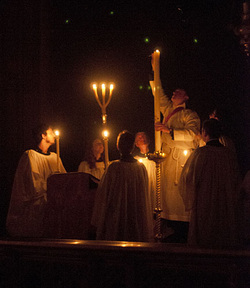
1. (OHS 1956): A blessing of the Paschal candle is introduced using a candle that has to be carried by the deacon during the entire ceremony.

Commentary: When this reform came into effect all the Paschal candlesticks in Christendom were rendered useless for Holy Saturday itself, even though some dated back to the dawn of Christianity. Under the pretext of returning to the sources, such liturgical masterpieces from antiquity became unusable museum pieces. The three-fold chanting of “lumen Christi” [“The light of Christ”] no longer has a liturgical reason to exist.

(MR 1952): The new fire and the grains of incense are blessed outside the church, but not the candle; the fire is passed to a reed, a kind of pole with three candles at the top, which are lit during the procession, successively with each invocation of “lumen Christi”; hence the three-fold invocation, one for each candle as it is lit. With one of these candles was lit the Paschal candle, which remained from the beginning of the ceremony on the Paschal candlestick. (In many early Christian churches, the height of the candlestick required the ambo to be built to the same height so that the candle could be reached.) [See the picture below. CAP.] The fire (the light of the Resurrection) was brought in on the reed with its triple candle (the Holy Trinity) to the great Easter candle (the Risen Christ), in order to symbolize the Resurrection as the work of the Most Holy Trinity.


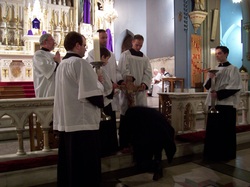
Ambo and Paschal candelabrum
2. (OHS 1956): The fabrication of placing the Easter candle in the center of the sanctuary after a procession with it in a church that is progressively lit up at every invocation of “Lumen Christi” [“The light of Christ”]; and at every invocation all genuflect toward the candle [sic!]; at the third invocation, the lights in the entire church are lit.

Commentary: After the fabrication of a procession with the candle, it was decided to have it placed in the center of the sanctuary, where it becomes the reference point of the prayers, just as it was during the procession; it becomes more important than the altar and the cross, a strange novelty that shifts the orientation of prayer in successive stages.

(MR 1952): The candle remains unlit on its candelabrum, often (according to a rubricist I consulted, this should be "always". CAP) at the Gospel side; the deacon and subdeacon go up to it with the reed to light it during the singing of the praeconium [i.e., “Exsultet”]; until the singing of the “Exsultet,” the only candles lit from the “fire of the Resurrection” are those on the reed.


The singing of the Exultet
3. (OHS 1956): A twisting of the symbolism of the “Exsultet” and of its nature as a diaconal blessing.

Commentary: Some reformers wished to do away with this ceremony, but the love which the singing of the “Exsultet” was always enjoyed resulted in others opposing any change in the text: “the Commission, however, considers it opportune to preserve the traditional text, given that the passages to be eliminated are few and of little importance.”  The result was the nth pastiche of a traditional chant wedded to a rite now totally altered. Thus it happened that one of the most significant moments of the liturgical cycle became a theater-piece of astonishing incoherence.

In effect, the actions spoken of during the singing of the “Exsultet” have already been performed about a half-hour before in the narthex. For the grains of incense there is sung: “Suscipe, Pater, incensi hujus sacrificium vespertinum” [“Accept, Father, the evening sacrifice of this incense”],  but they have already been inserted into the candle for a good while. The lighting of the candle with the light of the Resurrection is elaborated with the words: “Sed jam columnae hujus praeconia novimus quam in honorem Dei rutilans ignis accendit” [“But now we know the tidings of this column which the flickering fire lights to the honor of God”],  but the candle has long been lit by then and a goodly amount of wax consumed. There is no longer any logic. The symbolism of the light is twisted even further when the order of lighting all the lights—the symbol of the Resurrection—is triumphantly chanted: “Alitur enim liquantibus ceris, quas in substantiam pretiosae hujus lampadis apis mater eduxit” [“For it is nourished by the flowing wax which the Mother bee has drawn out unto the substance of this precious Light”],  but it is sung in a church which for quite some time has been totally illuminated by the candles lit from the new fire.

This reformed symbolism is incomprehensible for the simple reason that it is not symbolic: the words being proclaimed have no relation to the reality of the rite. Furthermore, the singing of the Easter proclamation, in union with the actions that accompany it, constitutes the diaconal blessing par excellence. After the reform, the candle is blessed outside the church with holy water, but it was desired to retain a part of the ancient blessing since it had great esthetic beauty; unfortunately, this approach reduces the liturgy to theater.

(MR 1952): The singing of the “Exsultet” begins with the candle unlit; the grains of incense are fixed in it when the chant speaks of the incense; the candle is lit by the deacon and the lights in the church are lit when the chant makes mention of these actions. These actions, in union with the chant, make up the blessing.

4. (OHS 1956): Introduction of the unbelievable practice of dividing the litanies in two, in the midst of which the baptismal water is blessed.

Commentary: This decision is simply extravagant and incoherent. Never was it known that an impetratory prayer was split into two parts. The introduction of the baptismal rites in the middle is of an even greater incoherence.

(MR 1952): After the blessing of the baptismal font is finished, the litanies are sung before the beginning of Mass.

5. (OHS 1956): Introduction of placing the baptismal water in a basin in the middle of the sanctuary, with the celebrant turned towards the faithful, his back to the altar.


Commentary: Basically, it was decided to substitute the baptismal font with a pot placed in the middle of the sanctuary. This choice was dictated, once again, by the obsession that all the rites should be carried out with the “sacred ministers facing the people,” but with their back towards God; the faithful, by this logic, become the “true actors of the celebration …. The Commission was receptive to the aspirations poured out by the people of God …. The Church was open to the ferment of renovation.”  These reckless decisions, founded on a pastoral populism that the people never requested, ended by destroying the entire sacred edifice, from its origins until the present.

At one time, the baptismal font was outside the church or, in succeeding ages, inside the walls of the edifice but close to the main door, since, according to Catholic theology, Baptism is the door, the “janua Sacramentorum” [“the door to the Sacraments”]. It is the Sacrament that makes those still outside the Church members of the Church. As such, it was symbolized in these liturgical customs. The catechumen receives [in Baptism] the character that makes him a member of the Church; therefore, he is to be received at the entrance, washed in the baptismal water, and thus acquire the right to enter into the nave as a new member of the Church, as one of the faithful. But, as a member of the faithful, he enters only the nave and not the sanctuary, wherein are the clergy, who are composed of those with the ministerial priesthood or who stand in relation to it. This traditional distinction was insisted on because the so-called “common” priesthood of the baptized is distinct from the ministerial priesthood and is distinct essentially, not superficially. They are two different things, not degrees of one single essence.

With the mandated changes, however, not only the baptized (as was already done on Holy Thursday) but even the non-baptized are summoned into the sanctuary, a place set aside for the clergy. One who is still “prey to the demon,” because still with Original Sin, is treated just like one who has received Holy Orders and enters into the sanctuary even though still a catechumen. The traditional symbolism, consequently, is completely massacred.

(MR 1952): The blessing of the baptismal water is given at the baptismal font, outside the church or near the entrance. Any catechumens are received at the entrance of the church, given Baptism, and then bid enter the nave, but not the sanctuary, as is logical, neither before nor after their Baptism.

6. (OHS 1956): Alteration of the symbolism of the chant “Sicut cervus” [“Like the hart that yearns”] of Psalm 41.


Commentary: After the creation of a baptistery inside the sanctuary, one is confronted with the problem of carrying away the baptismal water to some other location. It was decided, accordingly, to contrive a ceremony for carrying the water to the font after blessing it in front of the faithful and especially after conferring any baptisms as there might be. The transport of the baptismal water is accomplished while “Sicut cervus” is sung, i.e. that part of Psalm 41 which speaks of the thirst of the deer after it has fled from the bite of the serpent and which can only be slaked by drinking the water of salvation. At any rate, insufficient attention was paid to the fact that the deer’s thirst is sated by the waters of Baptism after the bite of the infernal serpent; for if Baptism has already been conferred, then the deer no longer thirsts, since, figuratively speaking, it has already drunk! The symbolism is changed and thus turned on its head.

(MR 1952): At the end of the singing of the prophecies, the celebrant goes to the baptismal font, to continue with the blessing of the water and to the conferral of Baptism as necessary; meanwhile, the “Sicut cervus” is sung. (127) The chant precedes, as is logical, the conferral of Baptism.

7. (OHS 1956): Creation ex nihilo of the “Renewal of Baptismal Promises.”


Commentary: One is, in a certain sense, proceeding blind when devising pastoral creations that have no true foundation in the history of the liturgy. Pursuing the notion that the Sacraments ought to be re-enlivened in the conscience, the reformers thought up the renewal of the baptismal promises. This became a kind of “examination of conscience” concerning the Sacrament received in the past. A similar tendency was observed in the twenties of the last century. In a veiled polemic with the provision of St. Pius X concerning the communion of children, the singular practice of a “solemn communion” or “profession of faith” was introduced; children of around thirteen years had to “remake” their first communion, in a kind of examination of conscience on the Sacrament already received several years before. This practice—although without calling into question the Catholic doctrine of “ex opere operato” [“from the work performed”]—emphasized the subjective element of the Sacrament over the objective. The new practice eventually ended up obscuring and overshadowing the Sacrament of Confirmation. A similar approach will be encountered in 1969 with the introduction on Holy Thursday of the “renewal of priestly promises.” With this latter practice is introduced a linkage between sacramental Holy Orders and a sentimental, emotional order, between the efficacy of the Sacrament and an examination of conscience, something rarely encountered in tradition.

The substrate of these innovations—which have no foundation either in Scripture or in the practice of the Church—seems to be a weakened conviction of the efficacy of the Sacraments. Although not in itself a plainly erroneous innovation, it appears nonetheless to lean towards theories of Lutheran provenance, which, while denying that “ex opere operato” has any role to play, hold that the sacramental rites serve more to “reawaken faith” than to confer grace.

It is difficult, moreover, to understand what was actually being sought with these reforms, since in fact edits were made to shorten the length of the celebrations, but tedious passages were introduced which burden the ceremonies unduly.

(MR 1952): The renewal of baptismal promises does not exist, just as, in this form, it has never existed in the traditional history of the liturgy of either East or West.

8. (OHS 1956): Creation of an admonition during the renewal of promises, which can be recited in the vernacular.


Commentary: The tone of this moralizing admonition betrays all too well the era in which it was composed (the mid-fifties). Today it already sounds dated, besides being a rather tedious adjunct. There is also the typical a-liturgical manner of turning to the faithful during this rite, a hybrid between homily and ceremony (which will enjoy great success in the years to follow).

(MR 1952): Does not exist.

9. (OHS 1956): Introduction of the Our Father recited by everyone present, and possibly in the vernacular.


Commentary: The Our Father is preceded by a sentimental-sounding exhortation.

(MR 1952): Does not exist.

10. (OHS 1956): With no liturgical sense whatsoever, there is introduced here the second part of the litany, broken off at the half-way point prior to the blessing of the baptismal water.


Commentary: Before the blessing of the baptismal water, the litany is recited kneeling; afterwards, a great number of ceremonies are performed, along with movements in the sanctuary; then there is the joy following the blessing of the baptismal water and any Baptisms that follow; and then the same impetratory prayer of the litany is resumed at the precise point where it was broken off a half-hour before and left hanging. (It would be difficult to determine if the faithful remember when they left this prayer half-finished.) This innovation is incoherent and incomprehensible.

(MR 1952): The litany, recited integrally and without interruption, is chanted after the blessing of the baptismal font and before Mass.

11. (OHS 1956): Suppression of the prayers at the foot of the altar, the Psalm “Judica me” (Ps. 42), and the Confiteor at the beginning of Mass.


Commentary: It was decided that Mass should begin without the recitation of the Confiteor or the penitential psalm. Psalm 42, which recalls the unworthiness of the priest to ascend to the altar, was not appreciated, perhaps because it has to be recited at the foot of the altar before one can go up to it. When one understands the underlying liturgical logic here relative to the altar viewed as the “ara crucis” [“altar of the Cross”], a place sacred and terrible, where the redemptive Passion of Christ is made present, a prayer expressing the unworthiness of anyone to ascend those steps makes sense. The disappearance of Psalm 42 (which in the following years would be eliminated from every Mass) seems, instead, to be a wish for a preparation ritual having to do with an altar that is, symbolically, a common table rather than Calvary. As a consequence, the holy fear and sense of unworthiness affirmed by the psalm are no longer inculcated.

(MR 1952): Mass begins with the prayers at the foot of the altar, Psalm 42 (“Judica me, Deus”), and the Confiteor.

12. (OHS 1956): In the same decree, all the rites of the Vigil of Pentecost are abolished, except the Mass.


Commentary: This hasty abolition has all the marks of being tacked on at the last moment. Pentecost always had a vigil similar in its ceremonies to that of Easter. The reform, however, was not able to deal with Pentecost. But then again, the reformers could not leave untouched two rites which, fifty days apart, would have been, in the one case, a reformed version and, in the other, a traditional version. In their haste they decided to suppress the one they did not have time to reform; the ax fell on the Vigil of Pentecost. Such improvident haste resulted in rapid editing of the rites of the Vigil of Pentecost, so that the texts of the Mass which traditionally followed those rites no longer harmonized with them. Consequently, in the rite thus violently mutilated phrases remain which are rendered incongruous with the words of the celebrant during the Canon. The Canon presumes that the Mass is preceded by the rites of Baptism, which have been, however, suppressed. As a result, thanks to this reform, the celebrant recites during the special “Hanc igitur” words related to the sacrament of Baptism during the Vigil, whether the blessing of the font or the conferral of the Sacrament: “Pro his quoque, quos regenerare dignatus es ex aqua et Spiritu Sancto, tribuens eis remissionem peccatorum” [“For these, too, whom Thou hast deigned to regenerate with water and the Holy Spirit, granting them remission of their sins”]. (136) But there is not a trace of this rite anymore. The Commission, in its haste to suppress, perhaps did not notice.

(MR 1952): The Vigil of Pentecost has rites which are baptismal in character, of which the “Hanc igitur” of the Mass makes mention.

GOOD FRIDAY Changes

Holy Saturday

4/19/2014

 
Picture
The Lesson is taken from the Treatise on the Psalms by St. Augustine the Bishop

They imagine wickedness, and practise it; that they keep secret among themselves, every man in the deep of his heart.  And they say that no man shall see them.  Now one known as Man came up against these communings, and in the form of Man he did suffer himself to be laid hold upon.  For they could not have laid hold upon him, had he not been Man; neither could he have been seen, had he not been Man; nor been scourged, had he not been Man; nor been crucified, nor died, had he not been Man.  As Man, therefore, he came to endure all those sufferings which could have had none effect upon him had he not been Man.  And further, had he not been Man, in no wise could man have been redeemed.  So it was, as the Psalmist saith, that he came, as Man, unto a deep heart; that is, something that passeth human understanding.  For he shewed his Manhood to the eyes of men, but kept his Godhead hidden deep within: thus concealing the form of God, wherein he is equal to the Father; but exhibiting the form of a servant, wherein he is inferior to the Father.

How far did they encourage themselves in those diligent searchings, wherein they failed so greatly?  So far that even when the Lord was dead and buried, they set a watch over the sepulchre.  For they said of Christ to Pilate: That deceiver.  By this name the Lord Jesus Christ was named, to the comfort of his servants, when they be called deceivers.  That deceiver (say they to Pilate) said while he was yet alive, After three days I will rise again: command, therefore, that the sepulchre be made sure until the third day, lest his disciples come by night, and steal him away, and say unto the people, He is risen from the dead; so the last error shall be worse than the first.  Pilate said unto them: Ye have a watch; go your way, make it as sure as ye can.  So they went, and made the sepulchre sure, sealing the stone, and settling a watch.

They placed a watch of soldiers over the sepulchre.  The earth quaked!  The Lord rose again!  Such were the miracles wrought round about the sepulchre, that the very soldiers who kept watch might have become witnesses, if they had been willing to declare the truth.  But that covetousness which possessed the disciple and companion of Christ, possessed also the soldiers who guarded his tomb.  We will give you money (say they), and say ye that his disciples came and stole him away while ye slept.  Truly, they failed in their snare and communings.  What is this thou saidst, O wretched cunning?  Dost thou so far forsake the light of prudence and duty, and plunge thyself so deep in craftiness, as to speak thus: Say ye that his disciples came and stole him away while ye slept?  Thou producest sleeping witnesses!  Surely thou wast thyself asleep, who didst thus snare thyself in such a snare.

Picture

Good Friday Changes 1952-56

4/18/2014

 
Picture
GOOD FRIDAY

1. (OHS 1956): The name “Solemn Liturgical Action” is devised, (73) thus eliminating the very ancient names “Mass of the Presanctified” and “Feria Sexta in Parasceve.”


Commentary: The terminology of “Presanctified” underlined the fact that the sacred Species had been consecrated at an earlier ceremony and showed the connection with the return of the Eucharist, an important and ancient part of the rite. But the Commission despised this concept and decided to reform the name along with the rite itself: “[We need] to trim back the medieval extravagances, so little noted, of the so-called Mass of the Presanctified to the severe and original lines of a great, general communion service.” (74) The usage “in Parasceve” [i.e., Friday “in Preparation”] was no longer in favor, even though its Hebraic overtones indicate its great antiquity.

(MR 1952): The name is “Mass of the Presanctified” or “Feria Sexta in Parasceve.”

2. (OHS 1956): The altar no longer has the veiled cross (and candlesticks -- CAP) on it


Commentary: The cross, especially the one on the altar, has been veiled since the first Sunday of the Passion, so that it should remain where it naturally ought to stand, namely at the center of the altar, later to be unveiled solemnly and publicly on Good Friday, the day of the triumph of the redemptive Passion. The authors of the reform apparently did not like the altar cross and decided to have it removed to the sacristy on the evening of Holy Thursday, and not in a solemn way but in the containers used to carry away the altar cloths after the stripping of the altars, or perhaps during the night in some unknown way, about which the rubrics for Holy Thursday are silent. On the very day of greatest importance for the Cross, when it ought to tower over the altar even though veiled at the beginning of the ceremony, it is absent. The fact that it remained present for nearly fifteen days on the altar, though publicly veiled, makes for the logic of its corresponding public unveiling, instead of an a-liturgical return of the cross from the sacristy as though someone hid it there in a closet during the night.

(MR 1952): The cross remains veiled at its usual place, i.e. on the altar, stripped of its cloths, and flanked by the usual candlesticks.

3. (OHS 1956): The reading of the Gospel is no longer distinct from that of the Passion.


Commentary: The entire passage is given a more narrative title: “The History of the Passion.” The motive behind this change is not clear, given that the Commission seemed to oppose such a change in the analogous case of Palm Sunday. (78) Perhaps the intention was, as elsewhere, to do away with everything that made reference to the Mass, such as the reading of the Gospel, and consequently to justify the suppression of the name “Mass of the Presanctified.”

(MR 1952): The Gospel is sung in a way distinct from the singing of the Passion, but on this day of mourning, without incense or torches.

4. (OHS 1956): The altar cloths are no longer placed on the altar from the beginning of the ceremony; at the same time, it is decided that the priest is not to wear the chasuble from the start, but only the alb and stole.


Commentary: The fact that the celebrant wears the chasuble even for a rite that is not, strictly speaking, the Mass witnesses to the extreme antiquity of these ceremonies, which the members of the Commission recognized as well. On the one hand, they maintained that the ceremonies of Good Friday were composed of "elements that (since ancient times) remained substantially untouched," but on the other hand they desired to introduce a change that would separate the Eucharistic liturgy from the "first part of the liturgy, the liturgy of the word."  This distinction, in embryonic form at the time, was to be marked--according to Father Braga--by the fact that the celebrant wore the stole only and not the chasuble: "For the liturgy of the word [the celebrant] was left only the stole."

(MR 1952): The priest wears the black chasuble, prostrates himself before the altar, while the servers, meanwhile, spread a single cloth on the bare altar.

The question of the prayer for the Jews, though completely pertinent to the study of Holy Week, cannot be addressed except by a study that gives clarity to the philological misunderstanding relative to the erroneously interpreted words "perfidi" and "perfidia."

5. (OHS 1956): For the seventh prayer, the name "Pro unitate Ecclesiae" ["For the unity of the Church"] is introduced.


Commentary: With this expressive ambiguity the idea is brought in of a Church in search of its own social unity, hitherto not possessed. The Church, according to traditional Catholic doctrine, solemnly defined, does not lack social unity in the earthly realm, since the said unity is an essential property of the true Church of Christ. This unity is not a characteristic that is yet to be found through ecumenical dialogue; it is already metaphysically present. In effect, the words of Christ, "Ut unum sint" ["That they may be one"], is an efficacious prayer of Our Lord, and as such is already realized. Those who are outside the Church must return to her, must return to the unity that already exists; they do not need to unite themselves to Catholics in order to bring about a unity that already exists. The aim of the reformers, however, was to eliminate from this prayer, says Father Braga, some inconvenient words that spoke of souls deceived by the demon and ensnared by the wickedness of heresy: "animas diabolica fraude deceptas" and "haeretica pravitate." By the same logic, they desired to do away with the conclusion, which expressed hope for a return of those straying from the unity of Christ's truth back into His Church: "Errantium corda resipiscant et ad veritatis tuae redeant unitatem." At any rate, it was not possible to reform the text of the prayer but only the title, since at the time—laments Father Braga again—“unity was conceived in terms of the preconciliar ecumenism." In other words, in 1956 the unity of the Church was conceived of as already existing, and God was being beseeched to bring back into this already existing unity those who were separated or far off from this unity. In the Commission there were members with traditional ideas who opposed the work of doctrinal erosion, though powerless to stop the creation of theological hybrids, such as the choice to leave the traditional text but to give it a new title. Annibale Bugnini himself, about ten years later, acknowledged that to pray for the future unity of the Church constitutes a heresy, and he mentions this in an article for L'Osservatore Romano that found fault with the title of the prayer "For the unity of the Church" introduced ten years prior by the Commission of which he was a member. Praising the prayers recently introduced in 1965, he writes that the prayer's name was changed from "For the unity of the Church" to "For the unity of Christians," because "the Church has always been one," but with the passage of time they were successful in eliminating the words "heretics" and "schismatics."  It is sad to note that these shifting maneuvers were employed with the liturgy in order to bring in theological novelties.

(MR 1952): The text is the same as that of 1956, wherein it is prayed that heretics and schismatics would return to the unity of His truth: "ad veritatis tuae redeant unitatem,"  but without the ambiguous title of the 1956 version: "Pro unitate Ecclesiae."

6. (OHS 1956): At this point, there is the creation of a return procession of the cross from the sacristy.


Commentary: This time, the cross returns in a liturgical manner, i.e. publicly rather than placed into the hampers used to collect the candlesticks and flowers from the previous evening [the Mass of Holy Thursday]. In the liturgy, when there is a solemn procession of departure, there is a solemn return; this innovation makes for a solemn return of a symbol that, the evening before, was carried away together with other objects in a private form, placing it—in the best-case scenario—in a wicker basket. There seems to be, in fact, no liturgical significance for introducing this procession of the return of the hidden cross. Perhaps we are confronted with a maladroit attempt to restore the rite carried out at Jerusalem in the fourth and fifth centuries and made known to us by Egeria: "In Jerusalem the adoration took place on Golgotha. Egeria recalls that the community assembled early in the morning in the presence of the bishop ... and then the silver reliquary [theca] containing the relics of the true Cross were brought in."  The restoration of this procession of the return of the cross took place in a context that was not that of Mount Calvary of the early centuries but in the context of the Roman liturgy, which over time had wisely elaborated and incorporated such influences from Jerusalem into a rite handed down over many centuries.

(MR 1952): The cross remains veiled on the altar beginning with Passion Sunday; it was unveiled publicly in the precincts of the altar, that is in the place where it remained publicly veiled until that point.


7. (OHS 1956): The importance of the Eucharistic procession is downplayed.


Commentary: The procession with the cross is a new creation, but the reform decides to downgrade the return procession with the Body of Christ to an almost private form in an inexplicable inversion of perspective. The Most Holy Sacrament was carried out the day before in a solemn manner to the altar of the Sepulcher. (We deliberately use the name "Sepulcher" because all of Christian tradition calls it thus, including the Memoriale Rituum and the Congregation of Rites, even if the Commission members barely tolerated this term (95); it appears to us profoundly theological and suffused with that sensus fidei [sense of the Faith] that is lacking in certain theologians.) It seems logical and "liturgical" that there should be for a solemn procession like that of Holy Thursday an equally dignified return on Good Friday. After all, here there is a particle of the same Blessed Sacrament from the previous day, the Body of Christ. With this innovation the honors to be paid to the Blessed Sacrament are reduced, and, in the case of Solemn Mass [of the Presanctified], it is the deacon who is instructed to go to the altar of the Sepulcher to bring back the Sacrament, while the priest sits tranquilly resting on the sedilia. The celebrant graciously arises when Our Lord, in the form of the sacred Species, is brought in by a subaltern, and then goes to the high altar. Perhaps it was for this reason that John XXIII did not want to follow this rubric at the Mass celebrated at Santa Croce in Gerusalemme and desired to go himself, as Pope and as celebrant, to bring back the Most Holy Sacrament.

(MR 1952): The Most Blessed Sacrament returns in a procession equal in solemnity to that of the preceding day. It is the celebrant who goes to bring It back, as is natural. Since one is dealing with Our Lord Himself, present in the Host, one does not send a subordinate to bring Him to the altar.

8. (OHS 1956): Elimination of the incensing due to the consecrated Host.

Commentary: There is no apparent reason why the honors rendered to God on Good Friday should be inferior to those rendered on other days.
(MR 1952): The consecrated Host is incensed as usual, although the celebrant is not incensed. (98) The signs of mourning are evident here, but they do not extend to the Real Presence.

9. (OHS 1956): Introduction of the people reciting the Our Father.


Commentary: "The pastoral preoccupation with a conscious and active participation on the part of the Christian community" is dominant. The faithful must become "true actors in the celebration .... This was demanded by the faithful, especially those more attuned to the new spirituality.... The Commission was receptive to the aspirations of the people of God." (100) It remains to be proven whether these aspirations belonged to the faithful or to a group of avant-garde liturgists. It remains as well to specify theologically what this above-mentioned "new spirituality" and its "aspirations" were.

(MR 1952): The Pater [Our Father] is recited by the priest.

10. (OHS 1956): Elimination of the prayers that make reference to sacrifice while the Host is consumed.


Commentary: It is true that on this day, in the strict sense, there is no Eucharistic sacrifice with the separation of the sacred Species, but it is also true that the consuming the Victim, immolated the preceding day, is a part, though not an essential one, of the sacrifice. This is, in a certain sense, the sacramental continuation of the sacrifice, because the Body, when consumed, is nevertheless always the Body as immolated and sacrificed. Accordingly, tradition always speaks of the sacrifice in the prayers connected with the consuming of the Host. Some members of the Commission held that after so many years of tradition the time had come to correct errors and to declare that words such as "meum ac vestrum sacrificium" ["my sacrifice and yours"] were "completely out of place in this instance, since one is not dealing with a sacrifice but only with communion." (103) The decision was then taken to abolish these age-old prayers.

(MR 1952): The prayer, "Orate, fratres, ut meum ac vestrum sacrificium, etc." is recited, but, given the unique context, it is not followed by the usual response.

11. (OHS 1956): Placing a part of the consecrated Host into the wine in the chalice is abolished.


Commentary: Placing a particle of the consecrated Host (a rite also known in the Byzantine rite) into the unconsecrated wine obviously does not consecrate the wine, nor was that ever believed by the Church. Simply put, this union manifests symbolically, though not really, the reuniting of the fragment of the Body of Christ with the Blood, to symbolize the unity of the Mystical Body in eternal life, the final cause of the entire work of redemption, which is not unworthy of being recalled on Good Friday.
The “Memoire” preserved in the archives of the Commission affirm that this part of the rite absolutely had to be suppressed, because “the existence of a belief in the Middle Ages that the commingling of the consecrated bread [sic!] alone in the wine was sufficient to consecrate even the wine itself also brought about this rite; once the Eucharist was studied more profoundly, the lack of foundation for this belief was understood. But the rite remained.” This affirmation is rendered scandalous by the absence of any historical foundation and by the scientific method; and it implies quite profound theological consequences. In addition, it remains to be proven historically that during the Middle Ages the belief under discussion was in currency. Some theologians may have held erroneous opinions, but this does not prove that in fact the Roman Church fell into error to the point that she made it part of the liturgy with this precise theological view in mind. (The belief that the wine is consecrated by mere commingling with the Bread of Angels was not unknown among medieval Catholics, and is still held by the Greek Orthodox, as shown by the rubrics of the Liturgy of the Presanctified as observed by the Greeks and by some Slavs. However, it was never officially accepted by Rome as a legitimate belief, and it is interesting to note that by and large the Russian Orthodox share the Roman stand. CAP.) In this context, one would be affirming that the Roman Church, conscious of the serious error, did not wish to correct it; one would be maintaining [in effect] that the Roman Church could change her view over the course of the centuries on a point that is so fundamental; and one would also be affirming that the she could err in relation to a dogmatic fact (such as the universal liturgy), and that for several centuries. Perhaps justification was sought for the work of reform already undertaken, which sought to correct all the errors that entire generations of Popes failed to detect but that the keen eye of the Commission had finally unmasked.
It is not pleasant to note that these affirmations are imbued with a pseudo-rationalism of a positivist stamp, the kind in vogue during the fifties. Often it relied on summary and less than scientific studies in order to demolish those deplorable “medieval traditions” and introduce useful “developments.”

(MR 1952): A part of the consecrated Host is placed in the wine, but, with great theological coherence, the prayer before consuming the Precious Blood is omitted.

12. (OHS 1956): The change of times for the service, which could have been accomplished in harmony with popular customs, ended up creating notable pastoral and liturgical problems.

Commentary: In the past, pious customs and practices were developed in a way that was consonant with the liturgy. A common example in very many places: from noon, even today, a great crucifix is set up, in front of which the Tre Ore [“Three Hours”] of Christ’s suffering is preached (from noon until three o’clock). As a consequence of the change in time for the service, one is confronted with the paradox of a sermon delivered before the crucifix at a time when the crucifix ought to remain veiled, because the Good Friday service is to be held in the afternoon. (108) Some dioceses even today are constrained to hold the “Liturgical Action” [of the Passion of the Lord] in one church, while in another the ancient pious practices are conducted, in order to avoid a too obvious visual incongruity. Numerous similar examples could be adduced. It is clear, though, that the “pastoral” reform par excellence was not “pastoral,” because it was born of experts who had no real contact with a parish nor with the devotions and piety of the people—which they often enough disdained.
According to the reformers, during the hours of the afternoon a “liturgical void” had been created, and an attempt to remedy this was sought “by introducing paraliturgical elements, such as the Tre Ore, the Way of the Cross, and the Sorrowful Mother.” (109) The Commission decided, therefore, to remedy this scandal using the worst “pastoral” method: namely writing off popular customs and paying them no mind. The disdain in this type of “pastoral” method forgets that inculturation is a Catholic phenomenon of long standing. It consists of a reconciliation, one as generous as possible, of piety to dogma, and not of a unilateral imposition of provisions by “experts.”

(MR 1952): The problem is not a question of times: liturgy and piety have developed over the centuries in a fusion of one with the other, without, however, coming into conflict in an antagonism as pointless as it is imaginary.

HOLY SATURDAY Changes

Good Friday

4/18/2014

 
Picture
The Lesson is taken from the Treatise on the Psalms by St. Augustine the Bishop

Hide me from the gathering together of the froward, and from the insurrection of wicked doers.  In our consideration of this Psalm, let us contemplate our Head himself.  Many Martyrs have suffered such things as the Psalmist prayeth against; but no Martyr shineth with such glory as the Head of the Martyrs.  In him we best perceive what they endured.  He particularly was hidden from the insurrection of wicked doers, to wit, in the sense that God the Son, who was made man, hid himself under the veil of his own flesh.  For he is both Son of Man and Son of God: yea, he was the Son of God (for he was in the form of God), and as such became in the flesh the Son of Man, in the form of a servant; whereby he had power to lay down his life, and power to take it again.  What could his enemies do unto him?  They could only kill the body: the soul they could not kill.  Give heed: it were little for the Lord to exhort the Martyrs by word, did he not confirm them by this his example.

We know what was the gathering together of the froward amongst Jewry, and what was the insurrection of wicked doers.  How were they wicked doers?  In that they desired to kill the Lord Jesus Christ.  Many good works (saith he) have I shewed you: for which of these works do ye desire to kill me?  He bore all their infirmities.  He healed all their sick.  He preached the kingdom of heaven.  He held not his peace at their iniquities, so that they might rather hate the same, than the Physician who would heal them.  Yet being ungrateful for all these his remedies, like men raging in high fever, they did rage against the Physician who had come to heal them, and took counsel for his destruction.  It was as though they would put it to the proof, whether he were man that could die, or whether he were something more than man that would not suffer himself to die.  In Chapter 2 of the Book of Wisdom we have, as it were, their very words: Let us examine him with despitefulness: let us condemn him with a shameful death: for he shall be visited according to his words: for if the just man be the Son of God, he will help him, and deliver him from the hand of the enemies.

They have whet their tongue like a sword.  Let not Jewry say: We did not kill Christ.  For they delivered him up to Pilate's tribunal in order that they should themselves seem innocent of his death.  Thus when Pilate said to them: Take ye him, and crucify him: they answered: It is not lawful for us to put any man to death.  So it was that they sought to cast the guilt of their crime upon a human judge: but by this could they deceive God the Judge?  What Pilate did, made him perforce in some sort partaker of their crime.  But in comparison with them, he was less guilty.  For he did what he could to rescue him out of their hands, and therefore ordered him to be scourged and brought before them.  That is to say, not by way of persecution did he scourge the Lord, but as wishing to satisfy their rage, that when they saw him scourged, they might relent, and cease to desire his death.  Nevertheless he did do it.  But if we hold him to be guilty who did it against his will, shall they be innocent who did force him to do it?  By no means.  Pilate did pronounce sentence on him, and commanded him to be crucified, and so in some wise it might be said that he did kill him.  But O ye, his own Jewish people, ye in full truth did kill him.  And how did ye kill him?  With the sword of the tongue.  For like a sword ye whet your tongue.  And when did ye strike the blow, but when ye cried out: Crucify him, crucify him?

Picture
<<Previous
Forward>>


    archbishop lefebvre
    Click to see more

    Enter your email address for daily posts:

    Delivered by FeedBurner

    Archives

    December 2014
    October 2014
    September 2014
    August 2014
    July 2014
    June 2014
    May 2014
    April 2014
    March 2014
    February 2014
    January 2014
    December 2013
    November 2013
    October 2013
    September 2013
    August 2013
    July 2013
    June 2013
    May 2013

    Categories

    All
    Apologetics
    Archbishop Lefebvre
    Bishop Williamson
    Blessed Sacrament
    Catechism
    Catholic History
    Chalk Talks
    Chastisement
    Devotions
    Easter
    Eleison Comments
    Eleison Comments
    Eleison Comments Italian
    Encyclicals
    Espanol Eleison Comments
    Families
    Fatima
    Feast Days
    For Fathers (Dads)
    For Moms
    Fortitude
    Holy Ghost
    Holy Name
    Holy Souls
    Holy Week
    Home Schooling
    Lent
    Liberalism
    Litanies
    Liturgy
    Marriage
    Martyrology
    Martyrs
    Mass
    Meditations Of Abl
    Modesty
    News
    New World Order
    Obedience
    Our Lady
    Our Lady Of Quito
    Our Lord
    Pentecost
    Pioneer Priests
    Prayers
    Sacramentals
    Sacraments
    Sacred Heart
    Saint Of The Day
    Saints For April
    Saints For August
    Saints For December
    Saints For February
    Saints For January
    Saints For July
    Saints For June
    Saints For March
    Saints For May
    Saints For November
    Saints For October
    Saints For September
    Scandal
    Scapular
    Sermons
    Sspx
    St Benedict
    St Joseph
    St Michael
    St Michael
    Sundays Of The Year
    Temptations
    The Church
    The Last Things
    The Mass
    The Pope
    The Rosary
    The Saints
    The Virtues
    Tradcat Comments
    Truth Society

    Picture
    Click to see inside the store
    Picture
    k d
    Counter Site
    While Archbishop Lefebvre Blog is provided free of charge, there are administrative and technical costs associated with making it available to subscribers worldwide and with operating this site. Contributions to offset these costs are appreciated, and may be made via the button below

    Archbishop Lefebvre

    Promote Your Page Too
Powered by Create your own unique website with customizable templates.