ArchbishopLefebvre.com
Links
  • Archbishop Lefebvre
    • Biography of Archbishop Lefebvre
    • Who is he?
    • In his own words
  • Sermons
    • Sunday Sermons
  • Letters
    • Archbishop Lefebvre >
      • To Friends and Benefactors
      • Other Letters
    • Bishop Williamson >
      • Friends and Benefactors
      • Eleison Comments >
        • Italiano
        • Espanol
      • To SSPX Priests
  • Blog
  • Books
    • E-Books
    • Free Catholic Books
    • Archbishop Lefebvre
    • Bibles
    • Blessed Sacrament
    • Children Books
    • Childrens Saints
    • DVDs
    • Hell
    • Purgatory
    • Our Lady
    • Sacred Heart
    • Missals
    • Missale Romanum
    • Summa Theologica
    • Saints
  • Catholic Faith
    • Catechisms
    • Catholic Art
    • Chant
    • Dogmas of the Catholic Church
    • Encyclicals
    • Sermons
    • History >
      • HughesVol1index
    • Liturgy
    • Sacraments
    • Prayers >
      • Blessings
    • Way of the Cross
  • SSPX Crisis
    • sspx Archbishop Lefebvre
    • monks nuns
    • SSPX Bishop Fellay
    • SSPX Bishop Tissier
    • ex-sspx Bishop Williamson
    • ex-sspx chazal
    • sspx couture
    • sspx fox
    • ex-sspx fuchs
    • ex-sspx girouard
    • ex-sspx hewko
    • sspx laisney
    • sspx ockerse
    • ex-sspx pfeiffer
    • sspx themann
    • Fr. Ringrose
  • Links
    • Other Sites
    • Donate
    • Facebook
    • Twitter
    • You Tube
  • TradCat Items
    • Beeswax Candles
    • Chapel Veils
    • Prayer Cards - Our Lady
    • Prayer Cards - Espanol
    • Protected Scapulars
    • Scapulars
    • Unbreakable Rosaries
  • Crisis in Church
    • Declaration of the 2006 Chapter (SSPX)
    • Fr Hewko to SSPX Superiors
    • History of the Archbishop and Rome
    • Vatican II more important than Nicea!
    • The Archbishop and Religious Liberty
    • The right to resist an abuse of power
    • How Are Catholics To Respond To The Present Crisis

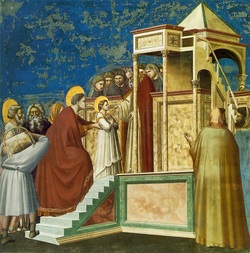
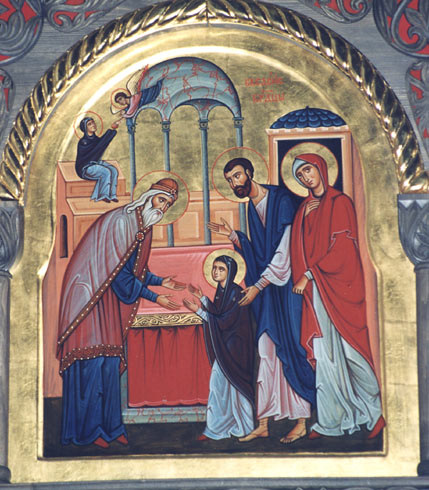
Presentation of the Blessed Virgin Mary

11/21/2013

 
Picture
The Lesson is taken from the Book upon the Orthodox Faith by St. John of Damascus

Joachim took to wife that most eminent and praiseworthy woman, Anne.  And even as the holy Hannah, being stricken with barrenness, by prayer and promise became the mother of Samuel, so likewise this holy Anne, through prayer and promise, received from God the Mother of God, that in fruitfulness she might not be behind any of the famous matrons.  And thus Grace (for such is the signification of the name of Anne) is mother of the Lady (for such is the signification of the name of Mary).  And indeed this child of grace became the Lady of every creature, since she has been Mother of the Creator.  She first saw the light in Joachim's house, hard by the Pool of Bethesda, at Jerusalem, and was carried to the temple.  There planted in the Lord, the dew of his Spirit made her to flourish in the courts of her God, where she was like unto a green olive tree, so that all the doves of grace came and lodged in her branches.  And there she in such wise raised her mind utterly above the pride of life, and the lust of flesh, that she kept her soul virgin in her virgin body, as became her that was to receive God into her womb.

Such was Mary that her single life offereth an example to all.  If then we be not displeased by the doer, let us applaud the deed; if any other woman seek like reward, let her follow after like works.  In the one Virgin how many glorious examples do shine forth.  Hers was the hidden treasure of modesty, hers the high standard of faith, hers the self-sacrifice of earnestness, hers to be the pattern of maidenhood at home, of kins-womanhood in ministry, of motherhood in the temple.  O to how many virgins hath she been helpful!  How many hath she taken in her arms and presented unto the Lord, saying: Here is one who, like me, hath kept stainlessly clean the wedding chamber, the marriage-bed of my Son.

Why should I go on to speak of the scantiness of her eating, or of the multiplicity of her work? how her labour seemed above human capacity, and her refreshment insufficient for human strength; how her toil never missed a moment, and her fasting took as much as two days together?  And when she was fain to eat, she took not dainties, but whatsoever food came first to hand that would keep body and soul together.  She would not sleep till need was, and even then, while her body rested, her soul watched.  I opine that often she talked in her sleep, either repeating things that she had read, or going on with what she was doing before sleep interrupted her, or rehearsing things executed, or talking of things projected.
Picture

Saint for Today - St. Felix of Valois

11/20/2013

 
Picture
Felix, once called Hugh, was born in France of the royal family of the Valois.  From his earliest years he gave many indications of his future sanctity, especially that he would be charitable to the poor.  While still a small child, he would distribute with his own hand, money to the needy just as though he were grown up and had reached years of mature judgment.  A little older, he sent them food from his own table, and delighted poor young children with those dishes they liked best.  More than once, after he had reached manhood, he stripped himself of his own garments to clothe the destitute.  From his uncle Theobald, Count of Champagne and Blois, he begged the life of a criminal condemned to death, predicting that this man, hitherto a notorious criminal would, if set free, reform and become a holy man.  The result showed the truth of this prophecy.

After a youth spent in a most praiseworthy fashion, his zeal for heavenly contemplation led Felix to think of retiring into solitude.  He decided to take Holy Orders first, however, and so to cut himself off from all possibility of succeeding to the crown, for according to Salic Law Felix was not far removed from the succession.  Ordained a priest, he said his first Mass with great devotion.  Shortly after he retired into a desert where he lived a life of strictest abstinence, fed mostly by an abundance of heavenly graces.  In company with the saintly doctor John of Matha, a Parisian who had been directed by divine inspiration to seek and find Felix, he lived a most holy life for some years.  Then counseled by an angel of God, both set out for Rome to receive a special rule of life from the Sovereign Pontiff.  About this time, Pope Innocent III, during a Solemn Mass, received a revelation about a religious order and society for the ransoming of captives.  The Pope personally clothed Felix and his company in a white habit, marked with a cross of two colours, similar to the one the Angel of the revelation had worn.  The Pope specified, moreover, that because of the three colours of the habit, the new Order should bear the Name of the most Holy Trinity.

After receiving the approval of their particular rule from the Supreme Pontiff Innocent, Felix enlarged the first monastery of the Order.  This he and his companions had built shortly before in a place called Cerfroid, in the diocese of Meaux.  There Felix cultivated in a truly marvellous way religious observance and the ransoming of captives.  From this monastery he zealously directed the propagation of his Order by sending disciples into other provinces.  It was here, too, he received an extraordinary favour from the Blessed Virgin Mary.  During the night watch on the Feast of the Nativity of the Mother of God, while the brethren slept, and in the providence of God did not wake for midnight office, Felix who had been watching, as was his habit, in anticipation of reciting the Office, entered the choir.  There he found the Blessed Virgin in the middle of the choir, robed in the habit and cross of the Order.  Around her was a company of heavenly beings, clothed in similar attire.  Felix took his place among them, and as the Mother of God intoned the Office, sang with them and duly rendered praises unto God.  Then, as if already he was being summoned from an earthly choir to an heavenly one, an Angel informed him that death was at hand.  Felix exhorted his children to have love for the poor, especially the captives, then full of years and merits, he gave back his soul to God.  This was in the year 1212 after the birth of Christ, and in the pontificate of the same Innocent III.

Saint for Today - St Elizabeth of Hungary

11/19/2013

 
Picture
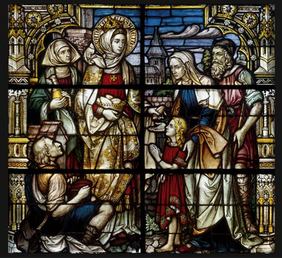
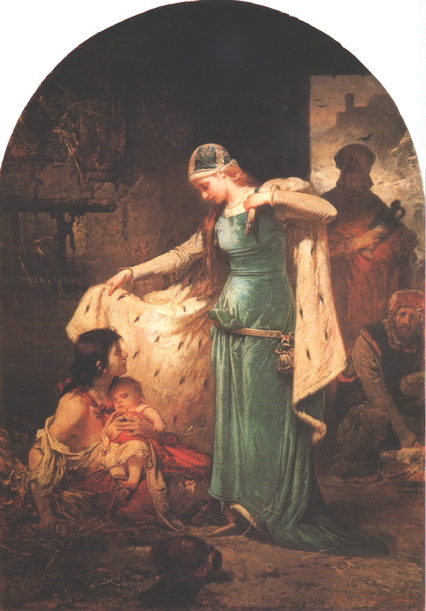
Elisabeth, daughter of Andrew II, King of Hungary, began to fear God even from a little child, and grew in grace as she grew in years.  She was married to Ludwig, Landgrave of Hesse and Thuringia, and thenceforth gave herself up the things of her husband, with as much zeal as to the things of God.  She rose in the night to make long prayers.  She consecrated herself to works of mercy.  She waited continually on widows and orphans, the sick and the needy.  When a sore famine came she provided corn bountifully from her own house.  She founded an house of refuge for lepers, and would even kiss their hands and feet.  She built also a great hospital for the suffering and starving poor.

Her husband died, and Elisabeth, more utterly to be God's only, laid aside all the garments of earthly state, clad herself in mean raiment, and entered the Third Order of St. Francis, wherein she was a burning and shining light of long-suffering and lowliness.  Stripped of all her goods, and turned out of her own house, she was deserted by all, and assailed with insults, gibes, and calumnies, but she bore it all with patience, yea, even rejoicing that she suffered such things for God's sake.  She gave herself to the meanest services toward the poor and sick, and sought for them the necessities  of life, while she lived herself only on potherbs and vegetables.

In these and many other holy works she prayerfully passed the rest of her life, till the end of her earthly pilgrimage came, as she had already foretold to her servants.  With her eyes fixed on heaven, absorbed in the thought of God, by him wondrously comforted, and strengthened by the Sacraments, she fell asleep in the Lord.  Forthwith many miracles were wrought at her grave, which being known and duly proved, Gregory IX numbered her name among those of the Saints.

Picture

Dedication of the Basilicas of Sts. Peter and Paul

11/18/2013

 
Picture
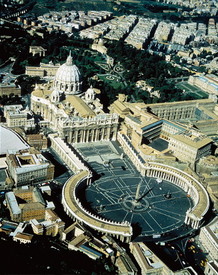
Among the hallowed places which have from of old time been held in honour among Christians, the most famous and sought after were those where the bodies of the Saints were buried, or where there was some trace or token of the Martyrs.  Among these spots so hallowed hath been ever among the most noteworthy that place on the Vatican Hill which is called the Confession of St. Peter.  Thither Christians do come from all parts of the earth as unto the rock of faith and the foundation-stone of the Church, and surround with godly reverence and love the spot hallowed by the grave of the Prince of the Apostles.

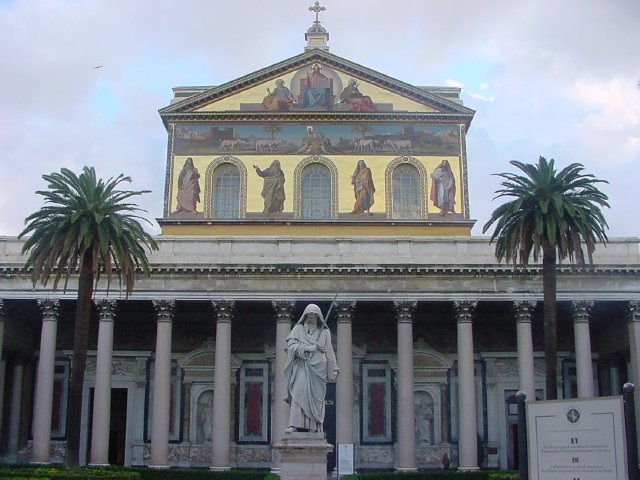
Thither came the Emperor Constantine the Great upon the eighth day after his Baptism, and, taking off his crown, cast himself down upon the ground, and wept abundantly.  Then presently he took a spade and pick-axe, and began to break up the earth, whereof he carried away twelve baskets-full in honour of the twelve Apostles, and built a Church upon that spot, appointed for the Cathedral Church of the Prince of the Apostles.  This Church was hallowed by holy Pope Sylvester upon the 18th day of November, in like manner as he had hallowed the Church of the Lateran upon the 9th day of the same month.  In this Church did the Pope set up an altar of stone, and pour ointment thereon, and ordain that from thenceforth no altars should be set up, save of stone.  The same Emperor Constantine likewise built a very stately Church upon the road to Ostia, in honour of the holy Apostle Paul, which Church also was hallowed by the blessed Sylvester.  These Churches the Emperor enriched by grants of much land, and adorned with exceedingly rich gifts.

The Basilica of St. Peter upon the Vatican fell in course of times to ruins, and having been rebuilt from the foundations, enlarged and garnished, by the zeal of many Popes, was solemnly consecrated anew by Urban VIII, upon the same day, in the year 1626.  The Basilica of St. Paul upon the road to Ostia was almost entirely consumed by fire in the year 1823, but was rebuilt in a more splendid form, and, as it were, raised from the dead, by the unwearied zeal of four successive Popes.  In the year 1854 Pius IX seized the happy occasion when the doctrine concerning the Immaculate Conception of the Virgin Mary, which he had just set forth, had drawn together to Rome a great multitude of Cardinals and Bishops from all quarters of the Catholic world, solemnly to dedicate this new Church in their presence upon the 10th day of December in the year aforesaid; but he decreed that the yearly Feast in honour of that dedication should be kept upon this day, being the same as that of the Dedication of the Church of St. Peter.

Picture
Basilica of St. Paul Outside the Walls, Rome

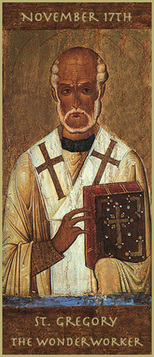
St. Gregory the Wonderworker - November 17th

11/17/2013

 
Picture
St. Gregory, Thaumaturgus

by Father Francis Xavier Weninger, 1876

St. Gregory, bishop of Neo-Caesarea in Pontus, was born in that city, of rich but heathen parents.
He is called Thaumaturgus, or Worker of Wonders, on account of the many and great miracles which he wrought during his life. He was naturally inclined to be good, and was filled with an intense desire to gain knowledge; therefore, on coming to riper years, he went to Caesarea in Palestine, and thence to Alexandria, to study the liberal arts. The reading of heathen books disgusted him with paganism; for he learned by it how weak and unstable its doctrines are; and at the same time, becoming acquainted with the true faith by reading some Christian books, he began highly to esteem Christianity.

He led a blameless life and especially abhorred the vice of unchastity, so general among the heathens. This displeased some of his fellow students, and they persuaded a wicked woman, to ask him, in the presence of many others, the money that he had promised her. This was done at the moment when Gregory, in the presence of a great crowd of people, was disputing on some subject with some other learned men. All were startled at the woman's words, as they had never heard anything wrong of Gregory. The latter best knew his own innocence, but would neither talk to the woman, nor allow himself to be disturbed in his disputation. He quietly requested one of his friends to give her as much money as she demanded; but she had hardly got it, when the Evil One took possession of her, and tormented her so that she howled terribly, made a public confession of her wickedness and begged Gregory's pardon. The young man, although he had not received holy baptism, called with confidence on the God of the Christians and relieved the possessed. Thus did the Almighty save Gregory, and bring the wickedness of his enemies to shame. This incited him anew not to delay any longer to embrace Christianity.

After he had been baptized, he endeavored to live in accordance with the promises he had made, and to conform his actions entirely to the maxims of the Christian faith. He continued his studies for several years, and then returned to his home, where he passed his time in solitude, prayer and meditation. To those who visited him he spoke rarely of other things than the blindness of idolatry, the truth of the Christian faith, the beauty of virtue, and the horror of vice, which caused him to be highly esteemed by the inhabitants of the city, although most of them were heathens. Phasdimus, bishop of Amasea, informed of this, resolved to consecrate Gregory bishop of Neo-Caesarea. The humble servant of the Lord endeavored to avoid this honor by flight; but Phaedimus was firm in his resolution and declared Gregory, in the presence of all the people, bishop of the city, and thus silenced all further objections. At that time, there were only seventeen Christians in the city and all the other inhabitants were idolaters.

Before the new bishop commenced his functions, he retired for several days into solitude, where he prayed to God to bestow upon him, through the intercession of the Blessed Virgin, the grace to lead his small flock in the right path, and to increase its small number by converting the heathen. During his prayers the Virgin Mother appeared to him, in the night, accompanied by St. John, whom she commanded to instruct Gregory, how to conduct himself and to teach others. Having received these instructions, St. Gregory left his solitude, comforted and strengthened, and began to labor for the conversion of the heathens. The miracles he wrought had the happiest results. Before he entered the city, he was obliged to take shelter, with his companion, in the most celebrated heathen temple, where Satan, speaking through the idols, answered various questions. Gregory passed the whole night in prayer, and, making the sign of the cross over the whole building, he drove Satan away. When the chief of the idolatrous priests came, on the following day, with his sacrifice, he heard before the temple a terrible howling of the devils, who lamented that, driven away by Gregory, they could not return into their old dwelling. The heathens ran after the bishop and complained of what he had done. Gregory improved the opportunity, to explain to them the power of the Christian God, in whose name he had driven away Satan and his legions, but could also force him to return. Of this the heathen priest desired a proof. Gregory wrote on the tablet the word " Enter," gave it to the idolatrous priest, and told him to lay it on the Altar, and then, he added, the devils will be obliged to return to the temple, in the name of Jesus. The heathen did as he was told, and as all happened as the bishop had said, he recognized the power of the Christian God, was converted with his wife and children, and received holy baptism.

This first conversion was daily followed by others. As the number of the Christians greatly increased in this manner, the Saint resolved to build a church. The place was selected, but a high mountain prevented him from giving the building the dimensions he desired. In this emergency, the bishop had recourse to prayer, and the mountain, by the power of God, retired, in the presence of a multitude of heathens and Christians, as far back as was needed. This and many other miracles which the Saint almost daily wrought, had such influence over the minds of the pagans, that they came in crowds to be baptized, and in all their troubles they asked his advice. The river Lycus, which flowed by the city, was frequently so swollen, that the surrounding fields were overflowed, with great damage. Some of the sufferers came and asked the bishop to help them. Going with them, he first prayed; then he stuck his staff into the ground near the bank of the river. The staff took root immediately, and since that time, the river has never overstepped the place thus marked. Two brothers quarreled on account of a pond abounding in fishes. Each desired to be the possessor of it, and they became so embittered, that they intended to kill each other. Gregory succeeded several times in calming them, but on seeing that this never lasted long, he prayed to God to end the contention, and in the same night, the whole pond so thoroughly dried up, that neither water nor fishes were to be seen. In this manner, peace was restored between the brothers.

How highly the Saint was esteemed for these and other miracles can easily be supposed, although he endeavored to decline all honors, by ascribing his wonders to a holy relic which he always carried with him. But the more he fled from human praise, the more was he venerated and loved. Still there were some who disliked him and who even dared to mock him. Among these were two Jews, one of whom, pretending to be dead, laid himself down in a place where the Saint was to pass. The other remained standing there also, and when Gregory came, he began to weep and lament for his dear dead friend, begging the Saint to give him an alms to enable him to bury him. The intention of these deceivers was to deride the bishop on account of his miracles, and to make others laugh at him. Gregory, who had no money with him, gave the man his cloak and went on. Rejoiced at having thus deceived the Saint, the man called his pretended dead companion, telling him to rise ; but found, to his horror, that the man was really dead. Many volumes would hardly suffice to contain all the miracles wrought by the holy man on the possessed and the sick, and to recount the labors he undertook to propagate the true faith.

After a long, well spent and holy life, he felt, at last, that his end was approaching, and visiting once more his whole diocese, he redoubled his zeal in instructing his flock, admonished all to constancy, and endeavored to practice more good works then ever before. Soon after, he fell sick, and ended his days by a happy death. Shortly before closing his eyes, he asked if there were yet some in the city who had not received holy baptism. " Seventeen," was the answer. The Saint, already in his agony, raised his eyes to heaven and said: " Thanks and praise to God ! When I took possession of my See, I found only seventeen Christians. May God preserve all in the true faith, and give to all infidels, in the whole world, the light of the Savior's divine Word!" The death of St. Gregory took place in the seventieth year of his age, and the 270th of the Christian Era.


Saint for Today - St Gertrude

11/16/2013

 
Picture
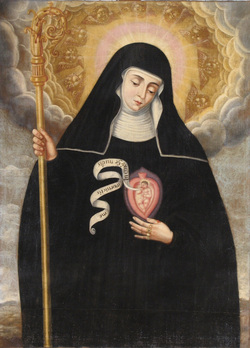
Gertrude was born of a noble family at Eisleben, in Saxony.  At five years of age, she offered her virginity and herself to Jesus Christ, in the Benedictine nunnery at Rodersdorf.  From that time forth she was utterly estranged from earthly things, ever striving for things higher, and began to lead a kind of heavenly life.  To learning in human letters she added knowledge of the things of God.  In the thought thereof she earnestly desired, and soon reached, the perfection of a Christian soul.  Of Christ, and of the things in his life, she spake often-times with movings of spirit.  The glory of God was the one end of all her thoughts, and to that her every longing and her every act were given.  Though God had crowned her with so many and so noble gifts both of nature and of grace, her belief regarding herself was so humble that she was used to number as among the greatest of the wonders of his goodness that he had always in his mercy borne with one who was so utterly unworthy.

In the thirtieth year of her age she was elected Abbess of Rodersdorf, where she had professed herself in the religious life, and afterwards of Helfta.  This office she bore for forty years in love, wisdom, and zeal for strict observance, so that the house seemed like an ideal exsample of a sisterhood of perfect nuns.  To each one she was a mother and a teacher, and yet would be as the least of all, being in sooth in all lowliness among them as she that served.  That she might be more utterly God's only, she tormented her body with sleeplessness, hunger, and other afflictions, but withal ever true to herself, stood forth a pattern of innocence, gentleness, and long-suffering.  The salvation of her neighbours was her constant earnest endeavour, and her godly toil bore abundant fruit.  The love of God oftentimes threw her into trances, and she was given the grace of the deepest contemplation, even to union of spirit with God.

Christ himself, to show what such a bride was to him, revealed that he had in the heart of Gertrude a pleasant dwelling-place.  The Virgin Mother of God she ever sought with deep reverence as a mother and warden whom she had received from Jesus himself, and from her she had many benefits.  Toward the most Divine Sacrament of the Eucharist, and the sufferings of the Lord, her soul was moved with love and gratitude, so that she sometimes wept abundantly.  She helped with daily gifts and prayers the souls of the just condemned to the purifying fire.  She wrote much for the fostering of godliness.  She was glorified also by revelations from God, and by the gift of prophecy.  Her last illness was rather the wasting of a home-sickness to be with God than a decay of the flesh, and she left this life in the year of our Lord 1292.  God made her bright with miracles both during her life and after her death.

Saint for Today - St Albert the Great

11/15/2013

 
Picture
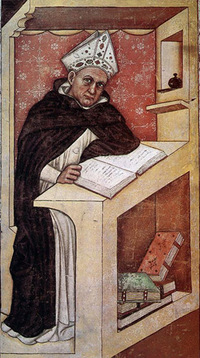
Saint Albert the Great was born in the region of Ausgbourg, of parents rich in the goods of fortune. From the time he was a child, he manifested in his studies an unusual aptitude for the exact sciences. While he was still a boy, he had himself let down the side of a cliff to examine at close range an eagle's nest which interested him. At the age of fifteen he was already a student of the natural sciences and the humanities at Bologna; Saint Dominic had died in that city the preceding year, 1221, and was buried in the Dominican Convent. Their house, in a suburban area of Bologna, was closely associated with the activities at the University, and students in large numbers were requesting admission to the Order.

Blessed Reginald of Orleans, Dominican, a former professor in Paris, came to preach there in the streets. The second Dominican General, Blessed Jordan of Saxony, a compatriot of Albert and a very eloquent preacher, was in Padua, and when the students of Bologna were transferred there Albert heard him at the Padua Dominican Church. He had already desired to enter the Order, but his uncle opposed to that plan a very vigorous opposition, and Albert was still very young. He dreamed one night that he had become a Dominican but left the Order soon afterwards. The same day he heard Master Jordan preach, and the Dominican General spoke of how the demon attempts to turn aside those who want to enter into religion, knowing that he will suffer great losses from their career in the Church; he persuades them in dreams that they will leave it, or else they see themselves on horseback, or clothed in purple, or as solitaries in the desert, or surrounded by cordial friends; thus he makes them fear entering because they would not be able to persevere. This was precisely Albert's great concern, faced as he was with his uncle's opposition. Afterwards the young student, amazed, went to Blessed Jordan, saying: "Master, who revealed my heart to you?" And he lost no time then in entering the Order at the age of sixteen, in 1223, having heard the same preacher remark to him personally that he should consider what a pity it would be if his excellent youthful qualities became the prey of eternal fires.

When he had earned the title of Doctor in theology, he was sent to Cologne, where for a long time his reputation attracted many illustrious disciples. The humble Albert, filled with the love of God, taught also in Padua and Bologna, in Saxony, at Fribourg, Ratisbonne and Strasbourg, and when Blessed Jordan of Saxony died in 1237, he occupied his place and fulfilled his functions until 1238, when the election of his successor was held. He returned then to Cologne, where he would encounter a disciple who alone among all of them would suffice for his glory -- Saint Thomas Aquinas. This young religious, already steeped in the highest theological studies, was silent among the others, to the point of being called by his fellow students "the Mute Ox of Sicily." But Albert silenced them, saying, "The bellowings of this ox will resound throughout the entire world."

From Cologne, Saint Albert was called to the University of Paris, with his dear disciple. There his genius appeared in all its brilliance, and there he composed a large number of his writings. Later, obedience took him back to Germany as Provincial of his Order. Without a murmur, he said farewell to his cell, his books, and his numerous disciples, and as Provincial thereafter journeyed with no money, always on foot, visiting the numerous monasteries under his jurisdiction, throughout an immense territory in which were included Austria, Bavaria, Saxony, and other regions even to Holland.

He was no longer young when he had to submit to the formal order of the Pope and accept, in difficult circumstances, the episcopal see of Ratisbonne; there his indefatigable zeal was rewarded only by harsh trials, in the midst of which his virtue was perfected. When, in response to his persevering requests to be relieved of the responsibilities of a large see, Pope Urban IV restored to him the conventual peace of his Order, he was nonetheless obliged to take up his apostolic journeyings again. Finally he could enter into a definitive retreat, to prepare for death. One is astonished that amid so many labors, journeys and works of zeal, Albert could find the time to write on the natural sciences, on philosophy and theology, works which form from twenty-one to thirty-eight volumes, depending on the edition -- and one may ask in which of his titles he most excelled, that of scholar, of Saint, or of Apostle.

He died, apparently of fatigue, at the age of seventy-three, on November 15, 1280, and his body was buried in Cologne in the Dominican church. He had to wait until December 16, 1931 for the honors of canonization and the extension of his cult to the universal Church. Proclaiming his holiness, Pope Pius XI added the glorious title, so well merited, of Doctor of the Church. From time immemorial, he has been known as Albert the Great.


Saint for Today - St Josaphat

11/14/2013

 
Picture
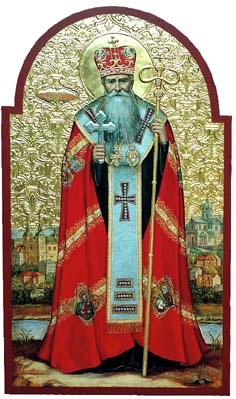
Josaphat Kuncewitz was born of noble Catholic parents at Vladimir in Volhynia.  Once as a child, as he listed to his mother tell the story of the Passion, a dart came forth from the side of Christ on the crucifix and wounded the boy in the heart.  Set on fire with love of God, he devoted himself to prayer and works of charity with such zeal that he became the admiration and the model for youths far older than he.  When Josaphat was twenty years old he was professed among the cloistered followers of the monastic rule of Saint Basil.  Almost at once he made remarkable progress in evangelical perfection.  He went barefoot, even in the severe winters of that country.  He never ate meat, and drank wine only when obliged to do so under obedience.  He disciplined his body by wearing rough hair-shirts until the day of his death.  He kept unspotted the flower of chastity which in his youth he had dedicated to the Virgin Mother of God.  He became so celebrated for virtue and learning that despite his youth he was made superior of the monastery at Byten, and the Archimandrite of Vilnius.  Finally much against his will, but to the very great joy of the Catholic people, he was made Archbishop of Polotsk.

In the years following the promotion to this dignity, Josaphat did not relax in any way his austere mode of living.  Nothing was so close to his heart as service to God and the salvation of the flock entrusted to his care.  He was a vigorous champion of Catholic unity and truth.  He laboured to the utmost of his ability to win back schismatics and heretics to unity with the See of blessed Peter.  Both by preaching and writing he defended the Supreme Pontiff and the doctrine of the Pope's plenitude of power.  He directed these works, full of piety and learning against most shameful calumnies and the errors of wicked men.  Josaphat vindicated episcopal rights and restored ecclesiastical propterty seized by laymen.  He won back an incredible number of heretics to the bosom of holy Mother Church.  How successfully he laboured to re-establish communion between the Greek and Latin Churches is told in Papal commendations.  He gladly spent the revenues set aside for his maintenance to rebuild God's house, to erect convents for consecrated virgins, and to carry on other charitable works.  So generous was Josaphat towards the poor that in one instance when he did not have money enough to supply the needs of a certain widow, he pawned his omophorion, that is, his episcopal pallium.

The great progress made by the Catholic faith so stirred up the anger of certain of its wicked enemies that they conspired to murder this athlete of Christ.  In a sermon he foretold to his people what was about to happen.  As he was setting out for Vitebsk on a pastoral visit, these enemies broke into the episcopal palace, attacking and wounding every one they found.  Undaunted, this most kindly man hurried out to the assassins of his own free will and addressed them mildly.  My little children, he said, why do ye strike my servants?  If ye have any complaint against me, I am here.  Thereupon they rushed at him, overwhelmed him with blows and pierced him through with spears.  Finally they slew him a stroke of a great axe and threw his body into the river.  This happened on November 12th, 1632, when he was forty-three years old.  Later his body, surrounded by a marvellous light, was raised from the deepest part of the river.  The blood of this Martyr benefited first of all those murderers of their spiritual father.  Sentenced to die for their crime, almost all abjured their schism and repented of their crime.  Because this wonderful high priest became famous after his death for many miracles, the Supreme Pontiff, Urban VIII, honoured him with the title Blessed.  On the 29th of June, 1867, during the solemn observance of the centenaries of the Princes of the Apostles, in the presence of the college of cardinals, of about five hundred others, patriarchs, metropolitans, and bishops of every rite from all parts of the world, assembled in the Vatican basilica, with all solemn ceremonies, Pius IX canonized the first eastern Christian to uphold the unity of the Church.  The Supreme Pontiff, Leo XIII, extended his Mass and Office to the universal Church.

Saint for Today - St Didacus

11/13/2013

 
Picture
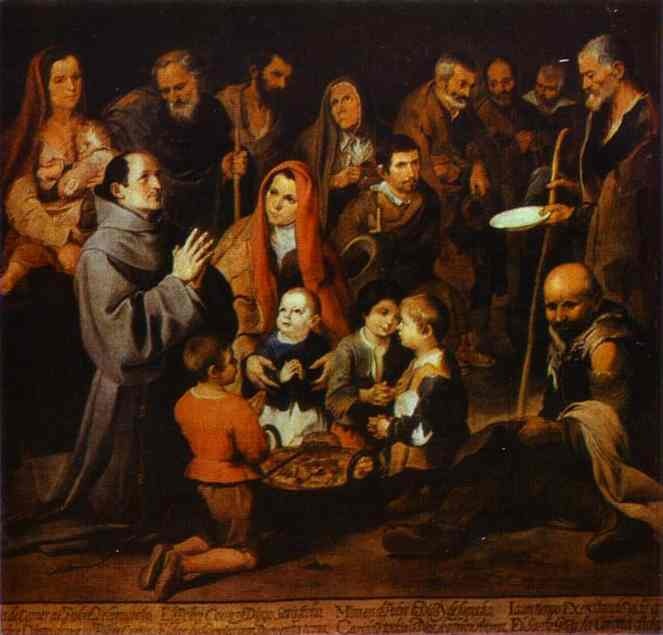
Didacus was a Spaniard, and was born at the little town of San Nicolas del Puerto, in the diocese of Seville.  From his childhood he learnt the more holy life under a godly Priest in a lonely church, and so served his apprenticeship.  Afterwards, being fain to be more utterly God's only, he professed himself as a lay brother under the Rule of St. Francis in the convent of the Friars Minor, called Observant, of Arrizafa.  There he cheerfully bore the yoke of the lowliest obedience and the strictest observance.  He was much given to contemplation, and a wonderful light from God shone in him, so that, though he was untaught, he could speak touching heavenly things strangely and as it were supernaturally.

In the Canary Islands, where he was warden of the brethren of his Order, he underwent much, earnestly willing to be a martyr, and by his word and ensample brought many unbelievers to Christ.  He came to Rome in the year of the Jubilee, in the reign of Pope Nicholas V, and there was set to tend the sick in the Convent of Ara Coeli, which work he did with such love, that although the city was plagued with a famine, the sufferers (whose sores he would sometimes cleanse even with his tongue) scarcely lacked anything needful.  He was a burning and shining light of faith, and had the gift of healing, taking the oil from the lamp which burned before the image of the most blessed Mother of God, to whom he was earnestly devoted, and anointing the sick therewith, whereupon many were marvellously cured.

He was at Alcalá when he understood that the end of his life was at hand.  Clothed in a ragged cast-away habit, he fixed his eyes upon the Cross, and said with extraordinary earnestness: Sweet the nails, and sweet the iron, sweet the Weight that hung on thee, thou that wast chosen to up-bear the Lord, the King of heaven, and so he gave up his soul to God, upon the 12th day of November, in the year of our Lord 1463.  To satisfy the godly wishes of the multitude, his body was kept unburied for not a few months, and lay in a right sweet savour, as though the corruptible had already put on incorruption.  He was famous for many and great miracles, and Pope Sixtus V enrolled him in the number of the Saints.

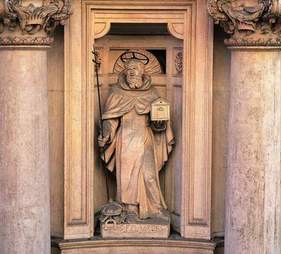
st didacus
St. Didacus giving alms

St Martin I - November 12th

11/12/2013

 
Picture
Martin was born at Todi in Umbria.  At the beginning of his Popedom, he was careful to send an embassage with letters to Paul, Patriarch of Constantinople, to call upon him to return to the truth of the Catholic faith from the blasphemous heresy of the Monothelites.  But Paul, being backed up by the heretic Emperor Constans, had become so rabid, that he sent away the messengers of the Apostolic See into divers places in the islands.  This crime moved the Pope to gather together at Rome a council of one hundred and five Bishops, by whom Paul was condemned.

Thereupon Constans sent Olympius into Italy as Exarch, straitly commanding him either to slay Pope Martin, or else to bring him into his Imperial presence.  Olympius therefore came to Rome and bade a lictor to kill the Pope while as he was celebrating the Liturgy solemnly in the Cathedral Church of St. Mary-at-the-Manger.  But when the lictor went thither, he was struck with blindness.

From that time forth many evils befell the Emperor Constans; but he repented not.  He sent the Exarch Theodore Calliopas to Rome, with command to lay hands on the Pope.  By him Martin was treacherously taken and brought to Constantinople, till he was sent to the Crimea.  There his sufferings for the Catholic faith utterly broke him down, and he left this life for a better, upon the 12th day of November.  He was famous for miracles.  His body was afterwards brought back to Rome and buried in the church dedicated under the names of St. Silvester and St. Martin.  He ruled the Church for six years, one month, and twenty-six days.  He held two ordinations in the month of December, wherein he made eleven Priests, five Deacons, and thirty-three Bishops for divers places.

<<Previous
Forward>>


    archbishop lefebvre
    Click to see more

    Enter your email address for daily posts:

    Delivered by FeedBurner

    Archives

    December 2014
    October 2014
    September 2014
    August 2014
    July 2014
    June 2014
    May 2014
    April 2014
    March 2014
    February 2014
    January 2014
    December 2013
    November 2013
    October 2013
    September 2013
    August 2013
    July 2013
    June 2013
    May 2013

    Categories

    All
    Apologetics
    Archbishop Lefebvre
    Bishop Williamson
    Blessed Sacrament
    Catechism
    Catholic History
    Chalk Talks
    Chastisement
    Devotions
    Easter
    Eleison Comments
    Eleison Comments
    Eleison Comments Italian
    Encyclicals
    Espanol Eleison Comments
    Families
    Fatima
    Feast Days
    For Fathers (Dads)
    For Moms
    Fortitude
    Holy Ghost
    Holy Name
    Holy Souls
    Holy Week
    Home Schooling
    Lent
    Liberalism
    Litanies
    Liturgy
    Marriage
    Martyrology
    Martyrs
    Mass
    Meditations Of Abl
    Modesty
    News
    New World Order
    Obedience
    Our Lady
    Our Lady Of Quito
    Our Lord
    Pentecost
    Pioneer Priests
    Prayers
    Sacramentals
    Sacraments
    Sacred Heart
    Saint Of The Day
    Saints For April
    Saints For August
    Saints For December
    Saints For February
    Saints For January
    Saints For July
    Saints For June
    Saints For March
    Saints For May
    Saints For November
    Saints For October
    Saints For September
    Scandal
    Scapular
    Sermons
    Sspx
    St Benedict
    St Joseph
    St Michael
    St Michael
    Sundays Of The Year
    Temptations
    The Church
    The Last Things
    The Mass
    The Pope
    The Rosary
    The Saints
    The Virtues
    Tradcat Comments
    Truth Society

    Picture
    Click to see inside the store
    Picture
    k d
    Counter Site
    While Archbishop Lefebvre Blog is provided free of charge, there are administrative and technical costs associated with making it available to subscribers worldwide and with operating this site. Contributions to offset these costs are appreciated, and may be made via the button below

    Archbishop Lefebvre

    Promote Your Page Too
Powered by Create your own unique website with customizable templates.