ArchbishopLefebvre.com
Links
  • Archbishop Lefebvre
    • Biography of Archbishop Lefebvre
    • Who is he?
    • In his own words
  • Sermons
    • Sunday Sermons
  • Letters
    • Archbishop Lefebvre >
      • To Friends and Benefactors
      • Other Letters
    • Bishop Williamson >
      • Friends and Benefactors
      • Eleison Comments >
        • Italiano
        • Espanol
      • To SSPX Priests
  • Blog
  • Books
    • E-Books
    • Free Catholic Books
    • Archbishop Lefebvre
    • Bibles
    • Blessed Sacrament
    • Children Books
    • Childrens Saints
    • DVDs
    • Hell
    • Purgatory
    • Our Lady
    • Sacred Heart
    • Missals
    • Missale Romanum
    • Summa Theologica
    • Saints
  • Catholic Faith
    • Catechisms
    • Catholic Art
    • Chant
    • Dogmas of the Catholic Church
    • Encyclicals
    • Sermons
    • History >
      • HughesVol1index
    • Liturgy
    • Sacraments
    • Prayers >
      • Blessings
    • Way of the Cross
  • SSPX Crisis
    • sspx Archbishop Lefebvre
    • monks nuns
    • SSPX Bishop Fellay
    • SSPX Bishop Tissier
    • ex-sspx Bishop Williamson
    • ex-sspx chazal
    • sspx couture
    • sspx fox
    • ex-sspx fuchs
    • ex-sspx girouard
    • ex-sspx hewko
    • sspx laisney
    • sspx ockerse
    • ex-sspx pfeiffer
    • sspx themann
    • Fr. Ringrose
  • Links
    • Other Sites
    • Donate
    • Facebook
    • Twitter
    • You Tube
  • TradCat Items
    • Beeswax Candles
    • Chapel Veils
    • Prayer Cards - Our Lady
    • Prayer Cards - Espanol
    • Protected Scapulars
    • Scapulars
    • Unbreakable Rosaries
  • Crisis in Church
    • Declaration of the 2006 Chapter (SSPX)
    • Fr Hewko to SSPX Superiors
    • History of the Archbishop and Rome
    • Vatican II more important than Nicea!
    • The Archbishop and Religious Liberty
    • The right to resist an abuse of power
    • How Are Catholics To Respond To The Present Crisis

What Is Our Lady's Part In Redemption?

5/20/2013

 
Picture
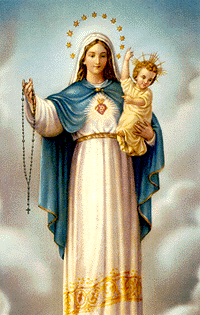
In what way did Mary take her part in the redemptive work of mankind, which was accomplished by Christ alone?

Christ was the principal Author of our redemption, but there were many secondary cooperators in the work. We even find St. Paul saying that we are to fill up what is wanting to the sufferings of Christ. The explanation of this, however, would demand a treatise on the mystical body of Christ as comprising all the members of the Church, and I can scarcely do justice to it now. All I can say is that Mary cooperated in the redemptive work in a way quite special to herself.As Jesus is the second Adam, so Mary is the second Eve.

As our first Mother Eve brought us forth to misery and suffering, so our second Mother Mary, in bringing forth our Savior, brought us forth to happiness and salvation. Mary's consent was asked by God when the time for the Incarnation was at hand; she consented to the full work of Christ from the cave of Bethlehem to the Cross of Cavalry. She provided the very blood that was shed for us. In union with Christ she had her own passion, and Simeon rightly predicted to her, under the inspiration of the Holy Ghost, "Thy own soul a sword shall pierce." With, in, and through the work of Christ her sufferings also contributed secondarily towards our redemption. And she was given to us from the Cross as a mother for a mother's work. To all of us Christ said, in the person of St. John, "Son, behold thy Mother." We Catholics, therefore, regard Mary as our spiritual Mother, entertaining towards her the love and devotion of children. Every Christian woman, above all, should regard Mary, the Mother of Christ, as the glory of her sex
Baptism, Can I Use Any Liquid?

5/20/2013

 
Picture
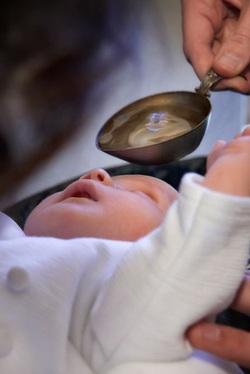
The code of canon law explains that "true, clean, and natural water" is necessary for baptism (canon 849). Liquids can be assessed in three categories: Those that are certainly valid, those that are doubtfully valid, and those that are certainly invalid.Certainly valid liquids include water as found in rivers, oceans, lakes, hot springs, melted ice or snow, mineral water, dew, slightly muddy water (as long as the water predominates), and slightly brackish water.

Doubtfully valid liquids are those that are a mixture of water and some other substance, such as beer, soda, light tea, thin soup or broth, and artificially scented water such as rose water.The last category is of liquids which are certainly invalid. It includes oil, urine, grease, phlegm, shoe polish, and milk.

The rule of thumb is that, in emergency situations, you should always try to baptize with certainly valid liquids, beginning with plain, clean water. If plain water isn't available, baptize with a doubtfully valid liquid using the formula, "If this water is valid, I baptize you in the name of the Father . . ." If the danger of death passes, the person should later be conditionally baptized with certainly valid water. Never attempt to baptize anyone with a certainly invalid liquid.

What Is Meant By A New Heaven And Earth?

5/20/2013

 
Picture
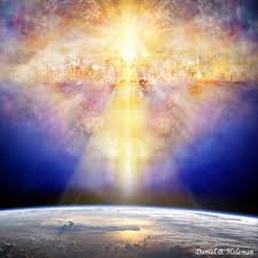
Even were the present universe left as it is, every soul that goes out of this life must see a new heavens and a new earth, if only because it will see things from a completely different aspect.

Science tells us that the atoms and molecules of even the most rigid objects are in motion and at an incalculable speed. If the soul could get a truly scientific vision of the dance of atoms and molecules, and of the very stars, it would certainly see the universe under a very new aspect. But the change to come should not only be attributed to the changed condition of the soul.

There will be a change in the actual scheme of earth and the heavens. There will be a new order, and a perfect adaptation of all things to a new end. Christ will be the organizer, as He has organized the Church and humanity. It is quite possible that all may be spiritualized and submitted to the elect, the elect to Christ, and Christ to God.

Thus, St. Paul himself says that all creation waits for the manifestation of the children of God. Exactly what will occur, of course, is a mystery which God has not deigned to reveal. But He has revealed the fact that Christ will come again in some glorious way to judge mankind. And we Catholics accept that fact on the authority of God's word.

Will Heaven Pass Away as Our Lord said?

5/20/2013

 
Picture
No. Our Lord was referring to the heavens, not to heaven as a state of eternal happiness.

The visible universe as we see it now is in a state of transition. At least in its present formation it will pass away sooner or later, even by merely natural processes. But apart from this, the final coming of Christ will mean a shock to the existing visible order of things, and a vast change in it. Through all such changes, however, the doctrine of Christ remains unchangeably true, and all that He has taught will most certainly be verified.

Will The Earth Ever Be Destroyed?

5/19/2013

 
Picture
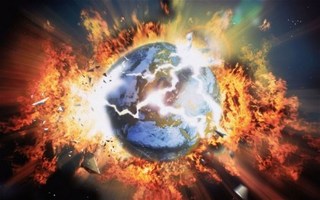
Certainly in its present form and structure. Our Lord Himself has said that the heavens and the earth will pass away, but that His words never fail. In speaking to men, He was speaking of the heavens and of the earth as they saw them, meaning that things as they are now will cease to be so. We are told that all is to end in a vast cataclysm, both material and moral. An extraordinary transformation will come over the whole material universe, and Christ, who came as an infant in mercy, will appear as a Judge to administer justice.

Sunday, What Work Can I Do?

5/19/2013

 
The same way Christians have observed it for two thousand years: Attend Mass and abstain from all unnecessary work. Fr. Kenneth Baker, S.J., explains, "Sunday should be dedicated to the Lord, at least in intention, if not by actual practice of other good works. Some activities that are in conformity with Sunday observance are reading the Bible or the life of some saint, praying the rosary, engaging in serious conversation on God and the things of the spirit, and so forth."

Sunday should be a day of joy and relaxation. It is the time for a family meal, for healthy recreation, for sport, for taking a stroll, or for going for a drive. In these and similar activities we can both praise God for his goodness and refresh our bodies and minds after the week's work.Since the time of Moses, abstinence of all unnecessary work has been an essential part of the Sunday observance. We have all heard that the Church forbids all 'servile' work on Sundays. Formerly, 'servile work' was defined as hard physical labor; thus, digging ditches, plowing, splitting wood, and so forth were so forbidden on Sunday except in cases of emergency or real necessity."In the past twenty years or so many exceptions have been placed on the meaning of servile work by moral theologians that it is just about impossible to lay down general rules.

It seems to me that what all should try to do is to observe the spirit of Sunday--worship, rest, and joy. If some kind of work does not fit into that pattern and is truly unnecessary, then it should be avoided. If anyone has serious doubt about whether or not he or she is violating God's law of the Sunday rest, then that person should seek the advice of a priest" (Fundamentals of Catholicism [San Francisco: Ignatius, 1982], I:174-175).

As a general rule with so much desecration of Sundays due to all shops being open and the sinfulness of the world, let us offer it up and spend even more time for God on His Day.

Did Christ Have Brothers And Sisters?

5/19/2013

 
Picture
Objection...I think the brothers and sisters referred to as his brethren were the children of Joseph and Mary after Jesus was born.

There is no reason to think otherwise.There is every reason to think otherwise.

  1. Firstly, the so-called brethren of Jesus are depicted by the Gospel texts as older than He Himself, criticizing and advising Him, and jealous of His popularity.
  2. Secondly, when the offer was made to Mary that she should become the Mother of the Messiah, she said, "How shall this be done, because I know not man." Almighty God provided miraculously that she should become the Mother without sacrificing her virginity. She was not likely to sacrifice it later on for other children so much less than the very Son of God. As that Son was the only-begotten of His Eternal Father, so He would be the only-begotten of His earthly Mother.
  3. Thirdly, Jesus alone in the Gospels is called the Son of Mary; and never once is she called the Mother of the brethren of the Lord.
  4. Fourthly, the only four brethren mentioned by name are James and Joseph, Simon and Jude. Now St. John tells us that there stood by the Cross of Jesus His Mother, and His Mother's sister, Mary of Cleophas. And this latter is referred to by St. Matthew as the mother of James and Joseph. Again, if you look up the first words of St. Jude's Epistle you will find him saying, "Jude, the servant of Jesus Christ, and brother of James." Why did he make that distinction? Finally, if James and Joseph, Simon and Jude, were direct children of Mary, and if there were yet other brethren and sisters of Jesus in your sense of the word, why did Jesus commit His Mother to the care of St. John after His death, so that John took her as his own mother thenceforth? That would not be necessary if she had other children to look after her.

What Does The Symbol IHS Mean?

5/18/2013

 
Picture
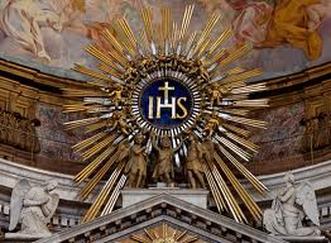
I've seen the acronym IHS all over the place--on altar cloths, holy cards, vestments, and prayerbooks -- but I have no idea what it stands for. A friend signs his letters "IHS" and says it means "In His Service." What's the scoop?

IHS is the anglicized rendering of the first three Greek letters in Jesus' name. In the early Church, especially during the time of the Roman persecution, this became a popular way of writing Jesus' name as a sort of code. Since then it has become a universally-used insignia and shows up on all types of Catholic religious art and accoutrements. After a few centuries, when the monogram was integrated into the general Latin usage of the Church, many were unacquainted with the original meaning and wrongly believed it meant, in Latin, Iesus Hominum Salvator (Jesus, Savior of Humanity), Iesus Hierosolyma Salvator (Jesus, Savior of Jerusalem), and even the exquisitely banal English version your friend favors, In His Service.

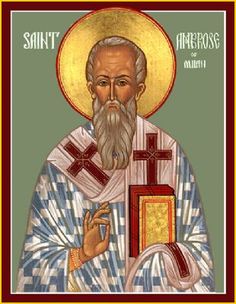
St. Ambrose On The Holy Ghost

5/18/2013

 
Picture
    Although we are baptized with water and the Spirit, the latter is much superior to the former, and is not therefore to be separated from the Father and the Son. There are, however, many who, because we are baptized with water and the Spirit, think that there is no difference in the offices of water and the Spirit, and therefore think that they do not differ in nature. Nor do they observe that we are buried in the element of water that we may rise again renewed by the Spirit.

For in the water is the representation of death, in the Spirit is the pledge of life, that the body of sin may die through the water, which encloses the body as it were in a kind of tomb, that we, by the power of the Spirit, may be renewed from the death of sin, being born again in God. And so these three witnesses are one, as John said: "The water, the blood, and the Spirit." 1 John 5:8 One in the mystery, not in nature. The water, then, is a witness of burial, the blood is a witness of death, the Spirit is a witness of life. If, then, there be any grace in the water, it is not from the nature of water, but from the presence of the Holy Spirit. Do we live in the water or in the Spirit? Are we sealed in the water or in the Spirit. For in Him we live and He Himself is the earnest of our inheritance, as the Apostle says, writing to the Ephesians: "In Whom believing you were sealed with the Holy Spirit of promise, Who is an earnest of our inheritance." Ephesians 1:13-14 So we were sealed by the Holy Spirit, not by nature, but by God, for it is written: "He Who anointed us is God, Who also sealed us, and gave the earnest of the Spirit in our hearts." We were then sealed with the Spirit by God. For as we die in Christ, in order to be born again, so, too, we are sealed with the Spirit, that we may possess His brightness and image and grace, which is undoubtedly our spiritual seal.

For although we were visibly sealed in our bodies, we are in truth sealed in our hearts, that the Holy Spirit may portray in us the likeness of the heavenly image. Who, then, can dare to say that the Holy Spirit is separated from the Father and the Son, since through Him we attain to the image and likeness of God, and through Him, as the Apostle Peter says, are partakers of the divine nature? In which there is certainly not the inheritance of carnal succession, but the spiritual connection of the grace of adoption. And in order that we may know that this seal is rather on our hearts than on our bodies, the prophet says: "The light of Your countenance has been impressed upon us, O Lord, You have put gladness in my heart."
Book 1 chapter 6

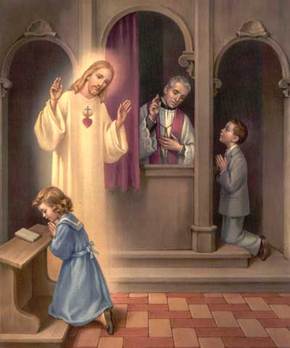
Is Confession Optional?

5/18/2013

 
Picture
The power to forgive sins was one Christ gave to his apostles (Luke 10:16; 2 Cor. 5:18-20). After he rose from the dead Christ said to the apostles, "'As the Father has sent me, so I send you.' And when he had said this, he breathed on them and said to them, 'Receive the Holy Spirit. Whose sins you forgive are forgiven them, and whose sins you retain are retained'" (John 20:22-23).

We can be truly sorry for our sins--that is essential for forgiveness--but we can't forgive our own sins. We can't absolve ourselves. That is a power reserved to God alone. Through Christ that power was conferred on his apostles and their successors, the bishops, and their helpers, the priests.

Confession is not an option. It is the ordinary (normative) means through which sins are forgiven.

<<Previous
Forward>>


    archbishop lefebvre
    Click to see more

    Enter your email address for daily posts:

    Delivered by FeedBurner

    Archives

    December 2014
    October 2014
    September 2014
    August 2014
    July 2014
    June 2014
    May 2014
    April 2014
    March 2014
    February 2014
    January 2014
    December 2013
    November 2013
    October 2013
    September 2013
    August 2013
    July 2013
    June 2013
    May 2013

    Categories

    All
    Apologetics
    Archbishop Lefebvre
    Bishop Williamson
    Blessed Sacrament
    Catechism
    Catholic History
    Chalk Talks
    Chastisement
    Devotions
    Easter
    Eleison Comments
    Eleison Comments
    Eleison Comments Italian
    Encyclicals
    Espanol Eleison Comments
    Families
    Fatima
    Feast Days
    For Fathers (Dads)
    For Moms
    Fortitude
    Holy Ghost
    Holy Name
    Holy Souls
    Holy Week
    Home Schooling
    Lent
    Liberalism
    Litanies
    Liturgy
    Marriage
    Martyrology
    Martyrs
    Mass
    Meditations Of Abl
    Modesty
    News
    New World Order
    Obedience
    Our Lady
    Our Lady Of Quito
    Our Lord
    Pentecost
    Pioneer Priests
    Prayers
    Sacramentals
    Sacraments
    Sacred Heart
    Saint Of The Day
    Saints For April
    Saints For August
    Saints For December
    Saints For February
    Saints For January
    Saints For July
    Saints For June
    Saints For March
    Saints For May
    Saints For November
    Saints For October
    Saints For September
    Scandal
    Scapular
    Sermons
    Sspx
    St Benedict
    St Joseph
    St Michael
    St Michael
    Sundays Of The Year
    Temptations
    The Church
    The Last Things
    The Mass
    The Pope
    The Rosary
    The Saints
    The Virtues
    Tradcat Comments
    Truth Society

    Picture
    Click to see inside the store
    Picture
    k d
    Counter Site
    While Archbishop Lefebvre Blog is provided free of charge, there are administrative and technical costs associated with making it available to subscribers worldwide and with operating this site. Contributions to offset these costs are appreciated, and may be made via the button below

    Archbishop Lefebvre

    Promote Your Page Too
Powered by Create your own unique website with customizable templates.