ArchbishopLefebvre.com
Links
  • Archbishop Lefebvre
    • Biography of Archbishop Lefebvre
    • Who is he?
    • In his own words
  • Sermons
    • Sunday Sermons
  • Letters
    • Archbishop Lefebvre >
      • To Friends and Benefactors
      • Other Letters
    • Bishop Williamson >
      • Friends and Benefactors
      • Eleison Comments >
        • Italiano
        • Espanol
      • To SSPX Priests
  • Blog
  • Books
    • E-Books
    • Free Catholic Books
    • Archbishop Lefebvre
    • Bibles
    • Blessed Sacrament
    • Children Books
    • Childrens Saints
    • DVDs
    • Hell
    • Purgatory
    • Our Lady
    • Sacred Heart
    • Missals
    • Missale Romanum
    • Summa Theologica
    • Saints
  • Catholic Faith
    • Catechisms
    • Catholic Art
    • Chant
    • Dogmas of the Catholic Church
    • Encyclicals
    • Sermons
    • History >
      • HughesVol1index
    • Liturgy
    • Sacraments
    • Prayers >
      • Blessings
    • Way of the Cross
  • SSPX Crisis
    • sspx Archbishop Lefebvre
    • monks nuns
    • SSPX Bishop Fellay
    • SSPX Bishop Tissier
    • ex-sspx Bishop Williamson
    • ex-sspx chazal
    • sspx couture
    • sspx fox
    • ex-sspx fuchs
    • ex-sspx girouard
    • ex-sspx hewko
    • sspx laisney
    • sspx ockerse
    • ex-sspx pfeiffer
    • sspx themann
    • Fr. Ringrose
  • Links
    • Other Sites
    • Donate
    • Facebook
    • Twitter
    • You Tube
  • TradCat Items
    • Beeswax Candles
    • Chapel Veils
    • Prayer Cards - Our Lady
    • Prayer Cards - Espanol
    • Protected Scapulars
    • Scapulars
    • Unbreakable Rosaries
  • Crisis in Church
    • Declaration of the 2006 Chapter (SSPX)
    • Fr Hewko to SSPX Superiors
    • History of the Archbishop and Rome
    • Vatican II more important than Nicea!
    • The Archbishop and Religious Liberty
    • The right to resist an abuse of power
    • How Are Catholics To Respond To The Present Crisis

2nd Sunday after Pentecost

6/22/2014

 
Picture
At that time: Jesus spoke unto the Pharisees this parable: A certain man made a great supper, and bade many. 

Sermon
by St. Gregory the Pope


Dearly beloved brethren, between the dainties of the body and the dainties of the mind there is this difference, that the dainties of the body, when we lack them, raise up a great hunger after them, and when we devour them, straightway our fulness worketh in us niceness.  But about the dainties of the mind we are nice while as yet we lack them, and when we fill ourselves with them, then are we an-hungered after them, and the more, being an-hungered, we feed thereon, the more are we an-hungered thereafter.  In the bodily dainties, the hunger is keener than the fulness, but in the spiritual the fulness is keener than the hunger.  In the bodily, hunger gendereth fulness, and fulness niceness; in the spiritual, hunger indeed gendereth fulness, but fulness gendereth hunger.

Spiritual dainties, in the very eating, do stir up the keenness of hunger in the mind which they fill, for, the more we taste their sweetness, the better we know  how well they deserve to be loved; and, if we taste them not, we cannot love them, for we know not how sweet they be.  And who can love that whereof  he knoweth nothing?  Hence saith the Psalmist: O taste and see that the Lord is good; that is, as it were, If ye taste not, ye shall not see his goodness: but let your heart once taste the bread of life, and then indeed, having tasted and proved his sweetness, ye shall be able to love him.  But these were the dainties which man lost when he sinned in Eden, and when he had shut his own mouth against the sweet bread  whereof if any man eat he shall live for ever, he forsook paradise.

And we that, from the first man, are born under the afflictions of this pilgrimage, are come into the world smitten with niceness; we know not what we ought to want, and the disease of our niceness groweth the worse, as our soul draweth itself the more away from that bread of sweetness.  We are no longer an-hungered after inward dainties, since we have lost the use of feeding on them.  And so in our niceness we starve, and the sickness of long famishing maketh prey of our health.  We will not eat of that inward sweetness which is made ready for us, and being enamoured only of things outward we sink into the wretchedness of loving starvation.
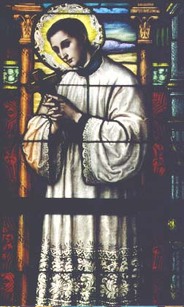
Saint for Today - St Aloyisius

6/21/2014

 
Picture
Aloysius, eldest son of Ferdinand Gonzaga, Marquess of Castiglione, was so hurriedly baptized on account of danger that he seemed to be born to heaven almost before he was born to earth, and he so faithfully kept that his first grace that he seemed to have been confirmed therein. From his first use of reason, which he employed to offer himself to God, he led a life more holy day by day. At Florence, when he was nine years old, he made a vow of perpetual virginity before the Altar of the Blessed Virgin, upon whom he always looked as in the place of a mother to him, and by a remarkable mercy, from God, he kept this vow wholly and without the slightest impure temptation, either of mind or body, during his whole life. As for any other uprisings of the soul, he began at that age to check them so sternly, that he was never more pricked by even their earliest movements. His senses, and especially, his eye-sight, he so mortified, that he never once looked upon the face of Mary of Austria, whom, when he was for several years one of the Pages of honour of the King of Spain, he saluted almost every day and he even denied himself in part, the pleasure of looking on the face of his own mother. He might indeed have been justly called a fleshless man, or an in-fleshed angel.

With this fettering of the senses he added torture of the body. He kept three days as fasts in every week, and that mostly upon a little bread and water. But indeed he as it were fasted every day, for he hardly ever took so much as an ounce weight of food at breakfast. Often also, even thrice in one day, he would lash himself to flowing of blood with cords, or prick himself with spiked chains. He sometimes used a dog-whip, instead of a scourge, and the rowels of spurs instead of hair-cloth. He privately filled his soft bed with pieces of broken plates, that he might find it easier to wake to pray. He passed great part of the night, clad only in a shirt even in the depth of winter, kneeling on the ground, or lying flat on his face when too weak and weary to remain upright, busied with heavenly thoughts. Sometimes he would keep himself thus for three, four, or five hours, until he had spent at least one without any movement of body or any wandering of mind. Such perseverance obtained for him the reward of being able to keep his understanding quite concentrated in prayer without distraction, as though rapt in God in an unbroken ecstasy. Desiring to give himself up to Him alone, he overcame, after a strong opposition for three years, the objections of his father, procured the transfer to his brother of his right to the Marquessate, and on the 25th of November, 1585, joined at Rome the Society of Jesus, to which he had been called by a voice from heaven when he was at Madrid.

In his very Novitiate he began to be held a master of all godliness. His obedience to even the most trifling rules was absolutely exact, his indifference to the world extraordinary, and his hatred of self implacable. His love of God was so keen that it gradually undermined his bodily strength. Being commanded to give his mind some rest from thinking unceasingly of God, he struggled vainly to distract himself from Him Who met him everywhere. From tender love toward his neighbour, he joyfully ministered to the sick in the public hospitals, during the great distemper at Rome in 1591, and in the exercise of this charity he caught a deadly disease. This sickness slowly wore him away, and soon after he had entered on the 24th year of his age, upon the 21st day of June, a day which he had himself foretold, after entreating that he might be scourged, and laid upon the ground to die, he passed away to heaven. What the glory is which he there enjoyeth holy Mary Magdalen de' Pazzi was enabled, by the revelation of God, to behold, and she declared that it was such as she had hardly believed existed even in heaven, and that his holiness and love were so great that she should call him an unknown martyr of charity. On earth God glorified him by many great miracles. These being duly proved, Benedict XIII inserted the name of this angellad in the Calendar of the Saints, and commended him to all young scholars both as a pattern of innocency and purity, and as a patron.


Eleison Comments - CCCLXII (362)

6/20/2014

 
Picture
DICKENS' BROADSTAIRS

A number of friends have asked me how I like the house newly purchased for the “Resistance” in Kent, England. I like it. It is spacious and it is being beautifully set up by a fellow-exile from the Society of St Pius X, Fr Stephen Abraham. Only Heaven knows how it intends the house to be used in the near and distant future, but it is meanwhile a delightful refuge, five minutes on foot from the sea which God created, and which the liberals cannot touch.

Several famous English artists and writers from the past have also found refuge in this delightful corner of north-east Kent. Most famous of the artists is J.M.W. TURNER (1775-1751). Born in London where he spent most of his working life, from age 11 he spent several formative years in Margate, some four miles up the coast from Broadstairs. Here he discovered the sea, which with its light effects was a lifelong inspiration for his painting, and to Margate he frequently returned later in life.

Also in Margate the most famous poet in English of the 20th century, T.S. ELIOT (1888-1965), composed in an open-air pavilion still standing on Margate's beach, a substantial section of the third part of his most famous poem, The Wasteland (1922). He had come to the seaside town as a refugee from London where an unhappy marriage had seriously affected his health. He did not stay long, but went on to Lausanne, Switzerland, where thanks to the care of a good doctor he completed his recovery and The Wasteland. But the prospect of the sea at Margate had no doubt helped.

Another famous poet, at least in England, was a frequent visitor to Ramsgate, two miles down the coast from Broadstairs. Samuel Taylor COLERIDGE, one of England's five outstanding Romantic poets, is best-known for his long poem, The Ancient Mariner. He loved bathing in the sea at Ramsgate, perhaps also for health reasons. In any case, the colder the sea, the more he liked it.

Most famous of all, however, was a frequent visitor to Broadstairs itself, the novelist Charles Dickens (1812-1870). He first resorted to Broadstairs in 1837, as a quiet place in which to complete his first novel, The Pickwick Papers, but he so fell in love with the antiquated little seaside town that he often returned with his family to write, or to rest from writing, through the 1840's and into the 1850's. His name and names of his novels, or of characters from his novels, are to be found all over the old town that he knew. It is now surrounded, not to say strangled, by Victorian and modern suburbs, but Broadstairs still celebrates every year its most famous visitor with a Dickens Festival in June.

Dr. David Allen White, a Catholic teacher of literature and music who is well-known to many Catholics striving to keep the Faith all over the English-speaking world, is a great lover of Dickens. Since he is passing through London this summer, he agreed to visit Broadstairs in order to hold on August 2 and 3 a 24-hour weekend seminar on Dickens, open to the public and including three conferences and Sunday Mass, and a visit which he will guide to the Dickens Museum in town, set up in a little old house known to, and visited by, Dickens himself. If you are interested in attending, let us know soon (through [email protected]), because if numbers have to be limited, first come will be first served. Meals will be provided in-house, but visitors will have to find their own accommodation outside. Beware, it will be the height of the holiday season.

Dickens was not Catholic, but Dostoevsky called him “a great Christian”. Dickens certainly had a warm and open heart, and a brilliant pen.

Kyrie eleison.


For Dickens, Broadstairs was a great delight.
To find out why, come listen to Dr White.


© 2011-2014 Richard N. Williamson. All Rights Reserved.

A non-exclusive license to print out, forward by email, and/or post this article to the Internet is granted to users who wish to do so provided that no changes are made to the content so reproduced or distributed, to include the retention of this notice with any and all reproductions of content as authorized hereby. Aside from this limited, non-exclusive license, no portion of this article may be reproduced in any other form or by any other electronic or mechanical means without permission in writing from the publisher, except by a reviewer who may quote brief passages in a review, or except in cases where rights to content reproduced herein are retained by its original author(s) or other rights holder(s), and further reproduction is subject to permission otherwise granted thereby.

Saint for Today - St Silverius

6/20/2014

 
Picture
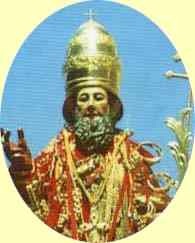
Silverius was a native of Campania, and succeeded Agapitus in the Papacy.  His orthodoxy and holiness shone brightest in his onslaughts upon heretics, and he shewed admirable firmness in upholding a sentence by Agapitus.  Agapitus had deposed Anthimus from the Patriarchate of Constantinople for defending the heresy of Eutyches; and Silverius would never allow of his restoration, although the Empress Theodora repeatedly asked him to do so.  The woman was enraged at him on this account, and ordered Bellisarius to send Silverius into exile.  He was accordingly banished to the island of Ponza, whence he is said to have written these words to Bishop Amator: I am fed upon the bread of tribulation and the water of affliction, but nevertheless I have not given up, and I will not give up, doing my duty.  But sickness and the hardships of his exile soon broke his strength, and he fell asleep in the Lord upon the 20th day of June.  His body was taken to Rome, and laid in the Vatican Basilica and made illustrious by many miracles.  He ruled the Church for more than three years, and ordained in the month of December thirteen Priests, five Deacons, and nineteen Bishops for divers Sees.

Thoughts for Corpus Christi

6/19/2014

 
Picture
 Corpus Christi


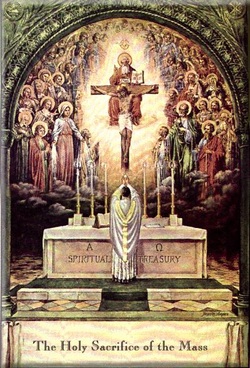
Today the Catholic Church celebrated one of the greatest feasts of the year--the Feast of Corpus Christi, which means “the Body of Christ.” The purpose of this feast is to praise and to thank Our Divine Lord for the sublime gift of the Holy Eucharist. It is true, on Holy Thursday we commemorate the anniversary of the institution of the Blessed Sacrament, and pass some time in adoring Our Lord, solemnly enthroned in the repository from the conclusion of the Mass until the Ceremonies on Good Friday. But the spirit of sorrow and sadness that prevails in Holy Week does not permit us to feel and to express the great joy that arises in our hearts when we realise our privilege of having Christ Himself as our intimate Friend.

Hence, since the thirteenth century the Church has been celebrating Corpus Christi on the Thursday after Trinity Sunday, as a day of gladness and rejoicing. The full liturgical service of this day calls for a procession of the Blessed Sacrament, and in Catholic lands this procession winds its way through the gaily decorated streets of the cities.

Every practical Catholic rejoices in meditating on the Blessed Sacrament. When, as children we were preparing for our First Communion, we looked forward eagerly and longingly to the moment when Our Lord would enter our soul. How careful we were to make a most exact and fervent confession, so that our hearts would be perfectly pure for the coming of our Divine Guest. And when Our Blessed Saviour did come into our heart, we experienced a joy that we had never known before, and we promised Our Blessed Lord that we would be faithful to Him all the days of our lives.

Perhaps with the passing of time we have not lived up to that promise, and have even grown cold in our devotion to the Blessed Sacrament. Perhaps we seldom receive Holy Communion and never think of making a visit to the Blessed Sacrament. Today gives us an opportunity to renew our faith and love for Our Divine Lord, truly present on the altar.

Sunday's Gospel tells us of the king who made a great marriage feast and sent out many invitations, but received a curt refusal from many of those invited. So, too, many Catholics refuse the invitation of Jesus Christ to partake of the banquet of His Body and Blood.

Practical Application

Thank Our Lord most profoundly for the great gift of the Blessed Sacrament. Promise that you will try to make the Blessed Sacrament the very centre of your life by frequently receiving Holy Communion

Saint for Today - St Ephraem

6/18/2014

 
Picture
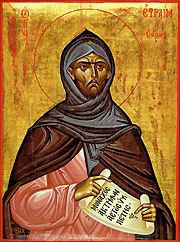
Ephraem was of Syrian descent, and son of a citizen of Nisibis.  While yet a young man he went to the holy bishop James, by whom he was baptized, and he soon made such progress in holiness and learning as to be appointed master of a flourishing school at Nisibis, a city of Mesopotamia.  After the death of the bishop James, Nisibis was captured by the Persians, and Ephraem went to Edessa.  Here he settled first on the mountain among the monks, and then, that he might avoid the great numbers of men who flocked to him, he adopted the eremitical life.  He was ordained deacon of the Church of Edessa, but refused the priesthood out of humility.  He was conspicuous with the splendour of every virtue and strove to acquire piety and religion by professing true wisdom.  He placed all his hope in God alone, despised all human and transitory things, and always longed for the divine and eternal.

When, led by the Spirit of God, he went to Caesarea in Cappadocia, there he saw Basil, that mouthpiece of the Church, and both enjoyed mutual companionship in a suitable manner.  In order to refute the countless errors which were rife at that time, and which were troubling the Church of God, and in order to expound zealously the divine mysteries of our Lord Jesus Christ, he wrote many studies in Syrian, almost all of which have been translated into Greek.  St. Jerome  beareth witness that he attained such fame, that his writings were read publicly in certain churches after the reading from the Scriptures.

His works taken as a whole, so infused with the bright light of learning, brought it about that this holy man, while yet alive, was held in great honour, and was even considered a Doctor of the Church.  He also composed songs in verse, in honour of the most blessed Virgin Mary, and of the Saints, and for this reason he was appropriately named by the Syrians the Harp of the Holy Ghost.  He was noted for his great and tender devotion towards the immaculate Virgin.  He died, rich in merits, at Edessa in Mesopotamia on the 18th day of June in the reign of Valens.  Pope Benedict XV, at the instance of many Cardinals of the Holy Roman Church, Patriarchs, Archbishops, Bishops, Abbots, and religious communities, declared him by a decree of the Congregation of Sacred Rites to be a Doctor of the universal Church.

Picture
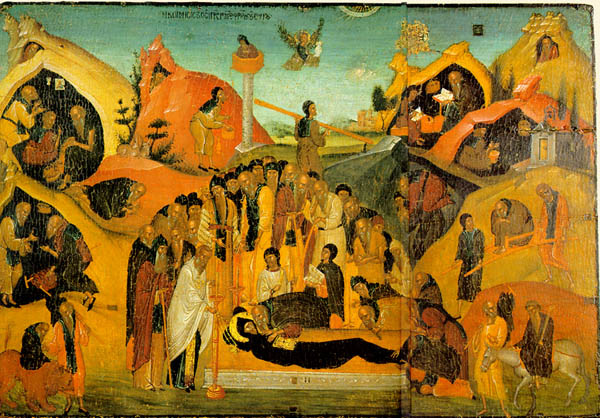
The death of St. Ephraem Syrus at Edessa

June 16th - St John Francis Regis

6/16/2014

 
Picture
Born in Fontcouverte, France, on January 31, 1597,Jean-François Régis was the son of a rich merchant. He studied at the Jesuit college of Béziers, joined the order in 1615, and was ordained in 1631. He was assigned to missionary work in southeastern France and became renowned for his fervor, preaching ability, and as a confessor.

He brought thousands back to their faith, and everywhere he went he was followed by large crowds. He also ministered to the sick in hospitals and to prisoners, organized groups to help the needy, and founded a refuge for prostitutes called “Daughters of Refuge.” He performed numerous miracles, but humbly commented, “Every time that God converts a hardened sinner He is working a far greater miracle.”

In September 1640, John had a premonition of his death and spent the next three days in retreat, making a general confession. He continued on with his missionary work, however, and in December preached tirelessly in a remote mountain village throughout the Christmas season, despite the fact that he had developed pleurisy and pneumonia. He eventually collapsed after leaving the pulpit and died four days later, his last words being “Jesus, my Savior, I recommend my soul to You.”

On the occasion of a juridical deposition regarding two miracles St. John had performed, a man who had lodged with him declared before two bishops: “His whole behavior breathed sanctity. Men could neither see nor hear him without being inflamed with the love of God. He celebrated the divine mysteries with such devotion that he seemed like an angel at the altar. I have observed him in familiar intercourse become silent and recollected, and all on fire: then speaking of God with a fervor and rapidity that proved his heart to be carried away with an impulse from heaven.”

St. John’s tomb at La Louvesc became the site of many miracles, and remains to this day a popular site of pilgrimage.


Trinity Sunday

6/15/2014

 
Picture
At that time: Jesus said unto his disciples:  All power is given unto me in heaven and in earth.  Go ye, therefore, and teach all nations, baptizing them in the Name of the Father, and of the Holy Ghost.

Sermon
by St. Gregory Nazianzen


There is no Catholic but knoweth that the Father is a very Father, the Son a very Son, and the Holy Ghost a very Holy Ghost, even as the Lord himself saith unto his Apostles: Go ye and baptize all nations in the Name of the Father, and of the Son, and of the Holy Ghost.  This is that perfect Trinity who is but One Being, and of whom therefore we testify that his Substance is One.  For we make no division in God, as divísions are made in bodies, but we testify, that, according to the power of the Divine Nature, which standeth not in matter, the Persons named have a real existence, and that God is One.

We do not say, as some have dreamt, that the Begetting of the Son of God is an outgrowing from one part to another part: neither do we say that he is the Word in the sense of a mere sound uttered by a voice, but we do believe that these three Names and the Persons meant by them are all of only One Being, One Majesty, and One Power.  And therefore we testify that God is One, because this One-ness of his Majesty forbiddeth that we should use the plural form of speech and say Gods.  It is Catholic language  to say Father and Son, but we cannot and must not say that the Father and the Son are two gods.  And that, not because the Son of God is not by himself God, yea, he is Very God of Very God, but because we know that the Son of God is not from elsewhere, but from the One Father himself.  Therefore we say that God is One.  This is the doctrine which Prophets and Apostles have delivered; this is the doctrine which the Lord himself taught when he said: I and the Father are One.  That is, he meant, as touching the One Divine Being, but as touching Persons, we are distinct.


Thoughts for Trinity Sunday

6/15/2014

 
Picture
“Baptising them in the name of the Father and of the Son and of the Holy Ghost” (Matt., 28:19)

On this day the Catholic Church observes a special feast in honour of the most profound mystery of our faith, the doctrine of the Holy Trinity. According to this doctrine, there is only one God, but in God there are three distinct Persons, known as the Father, the Son, and the Holy Ghost. In theological language this means that God is one in nature, but three in Persons.

We make no claim that we can give a clear and adequate explanation of this doctrine. It is a mystery-that is, a truth which we accept on the authority of God, but which we cannot understand. We can, indeed, understand that there is only one God. Our reason tells us that it would be a contradiction in terms to say that there is more than one God. The very idea of God indicates absolute supremacy, the possession of all perfections. If there were two Gods,neither could be absolutely perfect because neither would possess the perfections of the other.

But, how this one divine nature can be possessed by three Persons, each distinct from the other, yet each identical with the divinity is entirely above our understanding. However, this is no argument against the reasonableness of believing this doctrine. We accept the statements of our fellow men on matters that surpass our understanding when these persons are intelligent and truthful--for example, the statements of the atomic scientists. Why then should we not accept the statement of the all-knowing and all-truthful God when He tells us that He is one God in three distinct Persons?

The doctrine of the Holy Trinity is the very foundation of Christian belief. In the early Church there were many misunderstandings about this sublime doctrine, so that most of the heresies of the first centuries were centred about this mystery. But the infallible Church pointed out the way to the truth, and hence today in our Catholic theology we have a profound and consistent teaching regarding this doctrine, enabling us to answer all the objections that are raised against it, even though we make no claim to give a positive understanding of its full significance. Catholics should try to familiarise themselves with at least a general knowledge of the Church's theological doctrine on the Holy Trinity.

Practical Application

Whenever you make the sign of the Cross, remember you are making an act of faith in the most sublime Christian doctrine. Try to be recollected, and accompany the words with an interior act of faith that there is one God in three Divine Persons.

Eleison Comments - CCCLXI (361)

6/14/2014

 
Eleison comments
BRAVE PRIESTS

As a number of you will know, Fr Fernando Altamira is a young Argentinian priest of the Society of St Pius X, working in Bogotá, the capital city of Columbia in South America, who several months ago took a clear and public stand against the betrayal of the Faith and of Archbishop Lefebvre’s Society by Bishop Fellay and his team in Menzingen, Switzerland. Walking out of the Society’s Priory to found an alternative parish nearby, Fr Altamira was followed by the large part of his previous parishioners. As I was able to observe in mid-April, he is a pious, intelligent and hard-working priest, popular with the people. For his pains he is being “excluded” from the SSPX.

He wrote to Bishop Fellay, protesting that his “exclusion” is invalid. He sent a copy of his well-argued protest to a veteran priest of the SSPX who understands too well how the modern world operates to be fooled by Bishop Fellay. Here are Fr Jean-Michel Faure's wise comments:-

“It is obvious that there is a problem in the Society of St Pius X. Liberals took control, and they want to be integrated into the structure of modernist Rome. And, as Fr Pfluger has said, they want to expel all anti-liberals opposed to their Operation Suicide. One more proof of the on-going Recognition of the SSPX by Rome is the churches that certain bishops of France offer to Bishop Fellay, for the Requiem Mass of Fr Lagneau, for the Jubilee Mass of Fr Marziac, on various occasions the Basilica of Lourdes, the Confirmations in Corsica, and so on.

“Secrecy is the mode of operating worthy of a liberal politician who wants to bring his electors around to a goal directly opposed to what he had promised in order to get elected. By a series of ambiguous statements skilfully graded to advance little by little, the politician brings the great majority of his followers to accept the opposite conclusion to what they were convinced of to begin with. It is Macchiavellian deceit, lying and hypocrisy, pure and simple. For this Superior General the end justifies the means, and to attain that end he does not hesitate to take positions repeatedly condemned by Archbishop Lefebvre. What would the Archbishop say of him and his two Assistants ? That they are idiots, childish, naive and disobedient, that they are making the Society commit suicide and that they are betraying the fight for the Faith. And they are going to hand over to the modernists in Rome the fruits of so much generosity and so many sacrifices made by the faithful.

“The modernists in Rome have never backed down on their demands that we accept the Second Vatican Council and the legitimacy of the New Mass. In 1975 the Rector and professors of Écône advised the Archbishop to accept the Council in order to save the Mass, and they ended up rebelling and quitting the Seminary in August of 1977. Today the three ringleaders in Menzingen go so far as to accept the legitimacy of the Lutheran Mass. As the three of them say, the Society’s reluctance to go along makes us very annoying to our “new friends in Rome”, while to wait for the conversion of Rome is unrealistic, as far as they are concerned. For sure and certain God alone can clean up this situation, totally different from the situation of the Church when it was reformed by St Pius V. Like the Captain of the Titanic, Bishop Fellay and his headquarters will bring the Society’s Operation Suicide to a successful conclusion. Blind leaders of the blind. But anyone who is not blind must resist this suicide, and keep the Faith.”

If only the Society had more priests as clear-sighted and courageous as Fr Altamira and Fr Faure !

Kyrie eleison.


When liberals destroy,
how much we need Priests clear in mind,
and brave in word and deed !


© 2011-2014 Richard N. Williamson. All Rights Reserved.

A non-exclusive license to print out, forward by email, and/or post this article to the Internet is granted to users who wish to do so provided that no changes are made to the content so reproduced or distributed, to include the retention of this notice with any and all reproductions of content as authorized hereby. Aside from this limited, non-exclusive license, no portion of this article may be reproduced in any other form or by any other electronic or mechanical means without permission in writing from the publisher, except by a reviewer who may quote brief passages in a review, or except in cases where rights to content reproduced herein are retained by its original author(s) or other rights holder(s), and further reproduction is subject to permission otherwise granted thereby.

<<Previous
Forward>>


    archbishop lefebvre
    Click to see more

    Enter your email address for daily posts:

    Delivered by FeedBurner

    Archives

    December 2014
    October 2014
    September 2014
    August 2014
    July 2014
    June 2014
    May 2014
    April 2014
    March 2014
    February 2014
    January 2014
    December 2013
    November 2013
    October 2013
    September 2013
    August 2013
    July 2013
    June 2013
    May 2013

    Categories

    All
    Apologetics
    Archbishop Lefebvre
    Bishop Williamson
    Blessed Sacrament
    Catechism
    Catholic History
    Chalk Talks
    Chastisement
    Devotions
    Easter
    Eleison Comments
    Eleison Comments
    Eleison Comments Italian
    Encyclicals
    Espanol Eleison Comments
    Families
    Fatima
    Feast Days
    For Fathers (Dads)
    For Moms
    Fortitude
    Holy Ghost
    Holy Name
    Holy Souls
    Holy Week
    Home Schooling
    Lent
    Liberalism
    Litanies
    Liturgy
    Marriage
    Martyrology
    Martyrs
    Mass
    Meditations Of Abl
    Modesty
    News
    New World Order
    Obedience
    Our Lady
    Our Lady Of Quito
    Our Lord
    Pentecost
    Pioneer Priests
    Prayers
    Sacramentals
    Sacraments
    Sacred Heart
    Saint Of The Day
    Saints For April
    Saints For August
    Saints For December
    Saints For February
    Saints For January
    Saints For July
    Saints For June
    Saints For March
    Saints For May
    Saints For November
    Saints For October
    Saints For September
    Scandal
    Scapular
    Sermons
    Sspx
    St Benedict
    St Joseph
    St Michael
    St Michael
    Sundays Of The Year
    Temptations
    The Church
    The Last Things
    The Mass
    The Pope
    The Rosary
    The Saints
    The Virtues
    Tradcat Comments
    Truth Society

    Picture
    Click to see inside the store
    Picture
    k d
    Counter Site
    While Archbishop Lefebvre Blog is provided free of charge, there are administrative and technical costs associated with making it available to subscribers worldwide and with operating this site. Contributions to offset these costs are appreciated, and may be made via the button below

    Archbishop Lefebvre

    Promote Your Page Too
Powered by Create your own unique website with customizable templates.