ArchbishopLefebvre.com
Links
  • Archbishop Lefebvre
    • Biography of Archbishop Lefebvre
    • Who is he?
    • In his own words
  • Sermons
    • Sunday Sermons
  • Letters
    • Archbishop Lefebvre >
      • To Friends and Benefactors
      • Other Letters
    • Bishop Williamson >
      • Friends and Benefactors
      • Eleison Comments >
        • Italiano
        • Espanol
      • To SSPX Priests
  • Blog
  • Books
    • E-Books
    • Free Catholic Books
    • Archbishop Lefebvre
    • Bibles
    • Blessed Sacrament
    • Children Books
    • Childrens Saints
    • DVDs
    • Hell
    • Purgatory
    • Our Lady
    • Sacred Heart
    • Missals
    • Missale Romanum
    • Summa Theologica
    • Saints
  • Catholic Faith
    • Catechisms
    • Catholic Art
    • Chant
    • Dogmas of the Catholic Church
    • Encyclicals
    • Sermons
    • History >
      • HughesVol1index
    • Liturgy
    • Sacraments
    • Prayers >
      • Blessings
    • Way of the Cross
  • SSPX Crisis
    • sspx Archbishop Lefebvre
    • monks nuns
    • SSPX Bishop Fellay
    • SSPX Bishop Tissier
    • ex-sspx Bishop Williamson
    • ex-sspx chazal
    • sspx couture
    • sspx fox
    • ex-sspx fuchs
    • ex-sspx girouard
    • ex-sspx hewko
    • sspx laisney
    • sspx ockerse
    • ex-sspx pfeiffer
    • sspx themann
    • Fr. Ringrose
  • Links
    • Other Sites
    • Donate
    • Facebook
    • Twitter
    • You Tube
  • TradCat Items
    • Beeswax Candles
    • Chapel Veils
    • Prayer Cards - Our Lady
    • Prayer Cards - Espanol
    • Protected Scapulars
    • Scapulars
    • Unbreakable Rosaries
  • Crisis in Church
    • Declaration of the 2006 Chapter (SSPX)
    • Fr Hewko to SSPX Superiors
    • History of the Archbishop and Rome
    • Vatican II more important than Nicea!
    • The Archbishop and Religious Liberty
    • The right to resist an abuse of power
    • How Are Catholics To Respond To The Present Crisis

Saint for Today - Conversion of St. Paul

1/25/2014

 
Picture
Sermon by St. Augustine the Bishop


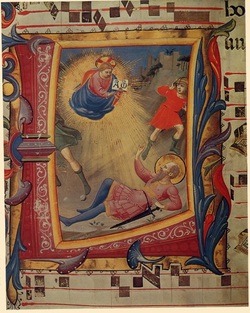
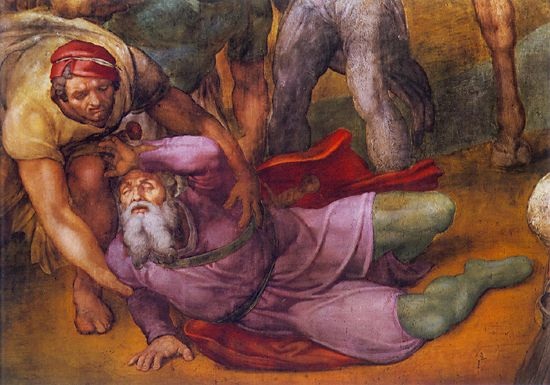
We have this day heard read out of the Acts of the Apostles how that the Apostle Paul, from being a persecutor of the Christians, was changed into a preacher of Christ.  Christ laid low the persecutor, that he might raise him up a teacher of his Church.  He smote and healed him; he slew and made him alive again.  For the Lord Christ is that Lamb that was himself slain by the wolves, and that now turneth the wolves into lambs.  Now was fulfilled in Paul that which was clearly spoken in prophecy by the patriarch Jacob, when he blessed his children, laying his hands indeed on them which then were, but looking forward to the things which were yet for to come.  Paul beareth witness of himself that he was of the tribe of Benjamin; and when Jacob blessed his sons, and came to bless Benjamin, he said: Benjamin shall ravin as a wolf.

What then?  Is Benjamin a wolf that shall ravin for ever? God forbid.  For as saith the Scripture: In the morning he shall devour the prey, and at night he shall divide the spoil.  This is exactly what was fulfilled in the Apostle Paul.  If it please you, we will now consider how in the morning he devoured the prey, and at night divided the spoil.  Here morning and evening are put for the beginning and the end.  So we may read, In the beginning he shall devour the prey, and at the end he shall divide the spoil.  First, then, in the beginning, he devoured the prey.  So it is written that he received letters from the chief priests and went forth, that wheresoever he should find any Christians, he might bring them bound unto the priests, that they might be punished.

He went breathing out threatenings and slaughter, yea truly, devouring the prey.  When also they stoned Stephen, the first Martyr that laid down his life for Christ's Name's sake, Saul was consenting unto his death, and, as though it contented him not to stone him, he kept the clothes of all them that did it, urging them on more than if he had joined them.  So in the morning he devoured the prey.  How in the evening did he divide the spoil?  Struck down by the voice of Christ from heaven, ravining no more, he falleth upon his face, cast down to be raised up, smitten to be healed.
Picture

Eleison Comments CCCXLI (341)

1/24/2014

 
Picture
SEDEVACANTIST ANXIETY I

The words and deeds of Pope Francis since his election earlier last year have been so little Catholic and so outrageous, that the idea that recent popes have not really been Popes (”sedevacantism”) has been given a new lease of life. Notice that Pope Francis merely expresses more blatantly than his five predecessors the madness of Vatican II. The question remains whether any of the six Conciliar Popes (with the possible exception of John-Paul I) can really have been Vicars of Christ.

The question is not of prime importance. If they have not been Popes, still the Catholic Faith and morals by which I must “work out my salvation in fear and trembling” (Phil. II, 12) have not changed one iota. And if they have been Popes, still I cannot obey them whenever they have departed from that Faith and those morals, because “we ought to obey God rather than men” (Acts, V, 29). However I believe in offering answers to some of the sedevacantists’ arguments, because there are sedevacantists who seem to wish to make the vacant See of Rome into a dogma which Catholics must believe. In my opinion it is no such thing. “In things doubtful, liberty” (Augustine).

I think that the key to the problem of which sedevacantism is merely one expression is that Vatican II was a disaster without precedent in all the history of the Church of Jesus Christ, while at the same time it was the logical conclusion of a long decadence of the Catholic churchmen reaching back to the late Middle Ages. On the one hand the divine nature of the Catholic Church and the principles governing any of its crises, including the Conciliar crisis, cannot change. On the other hand the application of those principles must take into account the ever changing human circumstances within which those principles operate. The degree of human corruption today has no precedent.

Now two of the unchanging principles are that on the one hand the Church is indefectible because Our Lord promised that the gates of Hell would not prevail against it (Mt.XVI, 18). On the other hand Our Lord also asked if he would find faith on earth at his Second Coming (Lk. XVIII, 8), an important quotation because it clearly suggests that the Church will almost completely have defected at the end of the world, just as it seems to be almost completely defecting in 2014. For indeed if we are not today living through the end of the world, we are surely living through the dress rehearsal for that end of the world, as Our Lady of La Salette, the Venerable Holzhauser and Cardinal Billot all suggest.

Therefore today, as at world’s end, the defection can go very far. It cannot reach beyond the power of Almighty God to guarantee that his Church will never altogether disappear or fail, but it can reach as far as God will allow, in other words nothing need stop his Church from defecting almost completely. And just how far is that “almost completely”? God alone knows, and so time alone can tell, because none of us men are in the mind of God, and only the facts can reveal to us after the event the contents of the divine mind. But God does partly reveal his mind in Scripture.

Now as to the end of the world, many interpreters of Chapter XIII, 11-17 of the Apocalypse think that the lamb-like Second Beast serving the Antichrist is the authorities of the Church, because if those authorities resisted the Antichrist he could never prevail, as Scripture says he will. Then is it so extraordinary if in the dress rehearsal for the end of the world the Vicars of Christ talk and behave like enemies of Christ ? Against this necessary background, next week’s “Comments” will propose answers to some of the sedevacantists’ main arguments.

Kyrie eleison.


© 2011-2014 Richard N. Williamson. All Rights Reserved.

A non-exclusive license to print out, forward by email, and/or post this article to the Internet is granted to users who wish to do so provided that no changes are made to the content so reproduced or distributed, to include the retention of this notice with any and all reproductions of content as authorized hereby. Aside from this limited, non-exclusive license, no portion of this article may be reproduced in any other form or by any other electronic or mechanical means without permission in writing from the publisher, except by a reviewer who may quote brief passages in a review, or except in cases where rights to content reproduced herein are retained by its original author(s) or other rights holder(s), and further reproduction is subject to permission otherwise granted thereby.


Remedies against Temptations

1/24/2014

 
Picture
by St Alphonsus

Let us come now to the means which we have to employ in order to vanquish temptations. Spiritual masters prescribe a variety of means; but the most necessary, and the safest (of which only I will here speak), is to have immediate recourse to God with all humility and confidence, saying: Incline unto my aid, O God; O Lord, make haste to help me! This short prayer will enable us to overcome the assaults of all the devils of hell; for God is infinitely more powerful than all of them. Almighty God knows well that of ourselves we are unable to resist the temptations of the infernal powers; and on this account the most learned Cardinal Gotti remarks, “that whenever we are assailed, and in danger of being overcome, God is obliged to give us strength enough to resist as often as we call upon him for it.”

And how can we doubt of receiving help from Jesus Christ, after all the promises that he has made us in the Holy Scriptures? Come to Me, all you that labor and are heavy laden, and I will refresh you? Come to me, ye who are wearied in fighting against temptations, and I will restore your strength. Call upon Me in the day of trouble: I will deliver thee, and thou shalt honor Me. When thou seest thyself troubled by thine enemies, call upon me, and I will bring thee out of the danger, and thou shalt praise me. Then shalt thou call, and the Lord shall hear: thou shalt cry and He shall say, Here I am. Then shalt thou call upon the Lord for help, and he will hear thee: thou shalt cry out, Quick, O Lord, help me! and he will say to thee, Behold, here I am; I am present to help thee. Who hath called upon Him, and He despised him? And who, says the prophet , has ever called upon God, and God has despised him without giving him help? David felt sure of never falling a prey to his enemies, whilst he could have recourse to prayer; he says: Praising, I will call upon the Lord: and I shall be saved from my enemies? For he well knew that God is close to all who invoke his aid: The Lord is nigh unto all them that call upon Him? And St. Paul adds, that the Lord is by no means sparing, but lavish of graces towards all that pray to him: Rich unto all that call upon Him.

Oh, would to God that all men would have recourse to him whenever they are tempted to offend him; they would then certainly never commit sin! They unhappily fall, because, led away by the cravings of their vicious appetites, they prefer to lose God, the sovereign good, than to forego their wretched short-lived pleasures. Experience gives us manifest proofs that whoever calls on God in temptation does not fall; and whoever fails to call on him as surely falls: and this is especially true of temptations to impurity. Solomon himself said that he knew very well he could not be chaste, unless God gave him the grace to be so; and he therefore invoked him by prayer in the moment of temptation: And as I knew that I could not otherwise be continent, except God gave it, . . . I went to the Lord and besought Him. In temptations against purity (and the same holds good with regard to those against faith) we must take it as a rule never to strive to combat the temptation hand to hand; but we must endeavour immediately to get rid of it indirectly by making a good act of the love of God or of sorrow for our sins, or else by applying ourselves to some indifferent occupation calculated to distract us. At the very instant that we discover a thought of evil tendency, we must disown it immediately, and (so speak) close the door in its face, and deny it all entrance into the mind, without tarrying in the least to examine its object or errand. We must cast away these foul suggestions as quickly as we would shake off a hot spark from the fire.

If the impure temptation has already forced its way into the mind, and plainly pictures its object to the imagination, so as to stir the passions, then, according to the advice of St. Jerome, we must burst forth into these words: “O Lord, Thou art my helper.” As soon, says the saint, as we feel the sting of concupiscence, we must have recourse to God, and say: “O Lord, do Thou assist me;” we must invoke the most holy names of Jesus and Mary, which a wonderful possess efficacy in the suppression of temptations of this nature. St. Francis de Sales says, that no sooner do children spy a wolf than they instantly seek refuge in the arms of their father and mother; and there they remain out of all danger. Our conduct must be the same: we must flee without delay for succor to Jesus and Mary, by earnestly calling upon them. I repeat that we must instantly have recourse to them, without giving a moment's audience to the temptation,or disputing with it. It is related in the fourth paragraph of the Book of Sentences of the Fathers that one day St. Pacomius heard the devil boasting that he had frequently got the better of a certain monk on account of his lending ear to him, and not instantly turning to call upon God. He heard another devil, on the contrary, utter this complaint: As for me, I can do nothing with my monk, because he never fails to have recourse to God, and always defeats me.

Should the temptation, however, obstinately persist in attacking us, let us beware of becoming troubled or angry at it; for this might put in it the power of our enemy to overcome us. We must, on such occasions, make an act of humble resignation to the will of God, who thinks fit to allow us to be tormented by these abominable temptations; and we must say: O Lord, I deserve to be molested with these filthy suggestions, in punishment of my past sins; but Thou must help to free me. And as long as the temptation lasts, let us never cease calling on Jesus and Mary. It is also very profitable, in the like importunity of temptations, to renew our firm purpose to God of suffering every torment, and a thousand deaths, rather than offend him; and at the same time we must invoke his divine assistance. And even should the temptation be of such violence as to put us in imminent risk of consenting to it, we must then redouble our prayers, hasten into the presence of the Blessed Sacrament, cast ourselves at the feet of the crucifix, or of some image of our Blessed Lady, and there pray with increased fervor and cry out for help with groans and tears. God is certainly ready to hear all who pray to him; and it is from him alone, and not from our own exertions, that we must look for strength to resist; but sometimes Almighty God wills these struggles of us, and then he makes up for our weakness, and grants us the victory. It is an excellent practice also, in the moment of temptation, to make the sign of the cross on the forehead and breast. It is also of great service to discover the temptation to our spiritual director. St. Philip Neri used to say, that a temptation disclosed is half overcome.

Here it will be well to remark, what is unanimously admitted by all theologians, even of the rigorist school, that persons who have during a considerable period of time been leading a virtuous life, and live habitually in the fear of God, whenever they are in doubt, and are not certain whether they have given consent to a grievous sin, ought to be perfectly assured that they have not lost the divine grace; for it is morally impossible that the will, confirmed in its good purposes for a considerable lapse of time, should on a sudden undergo so total a change as at once to consent to a mortal sin without clearly knowing it; the reason of it is, that mortal sin is so horrible a monster that it cannot possible enter a soul by which it has long been held in abhorrence, without her being fully aware of it. We have proved this at length in our Moral Theology. St. Teresa said: No one is lost without knowing it; and no one is deceived with out the will to be deceived.

Wherefore with regard to certain souls of delicate conscience, and solidly rooted in virtue, but at the same time timid and molested with temptations (especially if they be against faith or chastity), the director will find it sometimes expedient to forbid them to discover them or make any mention of them; because, if they have to mention them they are led to consider how such thoughts got entrance into their minds, and whether they paused to dispute with them, or took any complacency in them, or gave any consent to them; and so, by this too great reflection, those evil imaginations make a still deeper impression on their minds, and disturb them the more. Whenever the confessor is morally certain that the penitent has not consented to these suggestions, the best way is to forbid him to speak any more about them. And I find that St. Jane Frances de Chantal acted precisely in this manner. She relates of herself, that she was for several years assailed by the most violent storms of temptation, but had never spoken of them in confession, since she was not conscious of ever having yielded to them; and in this she had only followed faithfully the rule received from her director. She says, “ I never had a full conviction of having consented.” These words give us to understand that the temptations did produce in her some agitation from scruples; but in spite of these, she resumed her tranquillity on the strength of the obedience imposed by her confessor, not to confess similar doubts. With this exception, it will be generally found an admirable means of quelling the violence of temptations to lay them open to our director, as we have said above.

But I repeat, the most efficacious and the most necessary of all remedies against temptations, is that remedy of all remedies, namely, to pray to God for help, and to continue praying as long as the temptation continues. Almighty God will frequently have decreed success, not to the first prayer, but to the second, third, or fourth. In short, we must be thoroughly persuaded that all our welfare depends on prayer: our amendment of life depends on prayer: our victory over temptations depends on prayer; on prayer depends our obtaining divine love, together with perfection, perseverance, and eternal salvation.

You might also like: Why God permits temptations


Saint for Today - St Timothy

1/24/2014

 
Picture
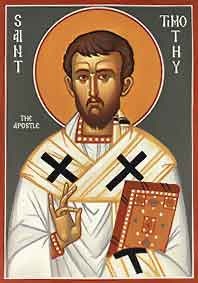
Timothy was born at Lystra, in Lycaonia.  His father was a Gentile and his mother a Jewess.  When the Apostle Paul came into those parts, Timothy was already a Christian.  The Apostle had heard much of his holy life, and was thereby induced to take him as the companion of his travels: but on account of the Jewish converts to the faith of Christ, who were aware that Timothy's father was a Gentile, he administered to him the rite of circumcision.  As soon as they both arrived at Ephesus, the Apostle ordained him bishop of that church.

The Apostle addressed two of his epistles to him, one from Laodicea, the other from Rome.  Thus confirmed in his pastoral office, he could not endure to see sacrifice which is due to God alone, offered to the images of devils; and finding that the people of Ephesus were sacrificing victims to Diana on her festival, he strove to make them stop their impiety, but they stoned him; the Christians rescued him, nearly dead, and carried him to a mountain near the town, where on the 24th day of January he fell asleep in the Lord.


Sermon by St. Augustine the Bishop

Today we keep our annual celebration of the triumph of the blessed Martyr Timothy, and the Church, while rejoicing in his glory, places him before us, that we may follow in his footsteps.  If we suffer with him, we shall be glorified with him.  There are two things to be considered in this glorious combat: namely the hard-hearted cruelty of the torturer, and the unconquered patience of the Martyr―the cruelty of the torturer, that we may detest it; the patience of the Martyr, that we may imitate it.  Hear what the Psalmist saith in reproof of wickedness: Be not emulous of evildoers, for they shall shortly wither away as grass.  But the Apostle teacheth patience with the wicked in the words: Patience is necessary for you, that ye may receive the promise.

Saint for Today - St Emerentiana

1/22/2014

 
Picture
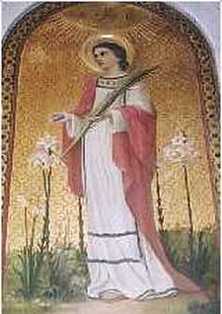
Emerentiana was a Roman maiden, and the foster-sister of the blessed Agnes.  While she was still a Catechumen, she was inspired by her faith and love to rebuke the fury of the idol-worshippers against the Christians, whereupon a mob assembled, and stoned her so severely that she was only able to drag herself to the grave of holy Agnes, where, while she prayed, she gave up her soul unto God, being baptized, not in water, but in her own blood, so freely shed for Christ.

Her feast is kept on 23 January. In the "Martyrologium Hieronymianum" she is mentioned under 16 September, with the statement: In coemeterio maiore. She is represented with stones in her lap, also with a palm or lily.

Saint for Today - St. Raymund of Pennaforte

1/22/2014

 
Picture
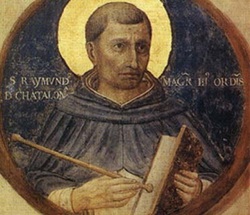
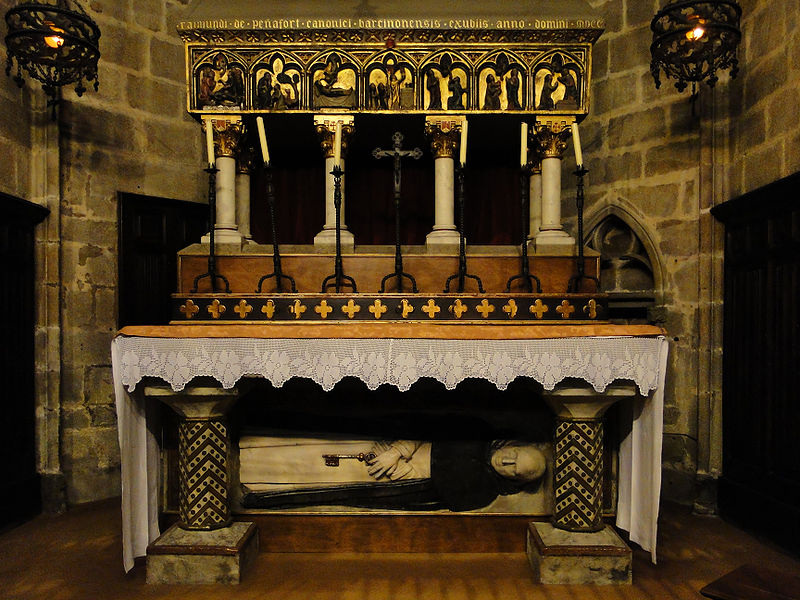
Blessed Raymund, born at Barcelona, of the noble family of Pennafort, was taught the rudiments of the Christian faith when still a boy; his uncommon gifts of mind and body seemed to indicate some great natural ability.  For while still young, he taught the humanities in his native city.  Later he went to Bologna, where he applied himself with much diligence to the exercises of piety, and to the study of canon and civil law.  He there received the doctor's cap, and interpreted the sacred canons to the admiration of all men.  His holiness attained such wide renown, that Berengarius, bishop of Barcelona, when returning to his diocese from Rome, visited Bologna on his way in order to see Raymund; and, after most earnest entreaties, induced him to accompany him to his native city.  He was soon made canon and provost of that church, and became a model to the clergy and people by his uprightness, modesty, learning, and meekness.  His tender devotion to the Virgin Mother of God was extraordinary, and he ever did his utmost to promote her devotion and honour.

When he was about forty-five years of age, he made his solemn profession in the Order of Friars Preachers, and drilled himself like a recruit, in the exercise of every virtue, but, above all, in charity to the poor, and mainly to the captives taken by the infidels.  It was by his exhortation that St. Peter Nolasco (who was his penitent) was induced to devote all his riches to this most pious work.  The most blessed Virgin appeared to Peter, as also to blessed Raymund and to James I, King of Aragon, telling them, that it would be most pleasing to herself and her only Son, if in their honour an Order of religious men were founded, whose mission would be to deliver captives from the tyranny of the infidels.  Whereupon, after deliberating together, they founded the Order of our Lady of Mercy for the Ransom of Captives; and blessed Raymund drew up certain rules of life, well adapted to the vocation of that order.  Some years after, he obtained their approbation from Gregory the Ninth, and made St. Peter to whom he gave the habit with his own hands, first general of the order.

He was summoned to Rome by Gregory IX, and appointed his Chaplain, Penitentiary, and Confessor.  It was by Gregory's orders that he collected, in the volume called the Decretals, the ordinances of the Roman Pontiffs, which up to that time were only to be found scattered among the records of various Councils and Churches.  He firmly refused the Archbishopric of Tarragona, which was offered to him by the Pope himself, and having been chosen Master General of the whole order of Friars Preachers, he discharged the duties of that office in holiness for two years, and then resigned it.  It was by his advice that James, King of Aragon, established the Office of the Holy Inquisition in his dominions.  He was distinguished by many miracles, of which the chief  was that, when returning to Barcelona from the Island of Majorca, he spread his cloak upon the sea, and passed over the waters upon it, accomplishing the whole distance of an hundred and sixty miles in six hours, and finally entering his convent through closed doors.  He attained the age of nearly an hundred years, and fell asleep in the Lord in the year of salvation 1275.  His name was enrolled by Clement VIII among those of the Saints.

Picture
The Tomb of St. Raymund of Pennaforte

Saint for Today - Sts. Vincent and Anastasius

1/22/2014

 
Picture
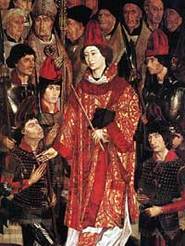
Vincent was born at Huesca in Granada in Spain.  He was early turned to study, and learned sacred letters from Valerius, Bishop of Saragossa.  He was accustomed to deliver discourses for this Prelate, who, owing to an impediment in his speech, was not able to preach himself.  This coming to the ears of Dacian, Prefect of the province under Diocletian and Maximian, he caused Vincent to be arrested at Saragossa, and brought before him at Valencia in bonds.  The saint was scourged, and afterward tormented on the rack, in presence of numerous spectators, but neither torture, threats, nor fair words could bend his resolution.  He was then laid on a grating over hot coals, his flesh mangled with iron hooks, and white-hot plates of metal applied to the wounds.  The still breathing remains were taken back to a prison, and laid on broken potsherds, that the agony of his naked body might prevent his sleeping from exhaustion.
As he lay in his dark cell, a glorious light suddenly filled the prison, to the astonishment of all who saw it.  The gaoler informed Dacian, who caused the martyr to be brought out and cared for in a soft bed, hoping that though he had failed to move him by cruelty, he might seduce him by pretended kindness.  But the indomitable soul of Vincent, armed with faith and hope in Christ Jesus, remained unconquered even to the end, and triumphing over the fire, the steel, and the cruelty of the tormentors, passed away to receive the victorious crown or martyrdom in heaven on the 22nd day of January.

Picture
His body was thrown out unburied.  A raven perched upon it and kept off with his beak, claws, and wings both the other birds and a wolf, which came to prey on it.  Dacian then had it thrown into the sea, but by the will of God it was washed up again, and the Christians took and buried it.

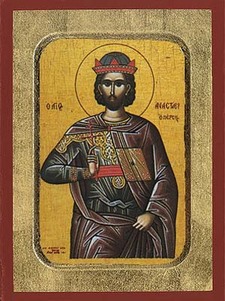
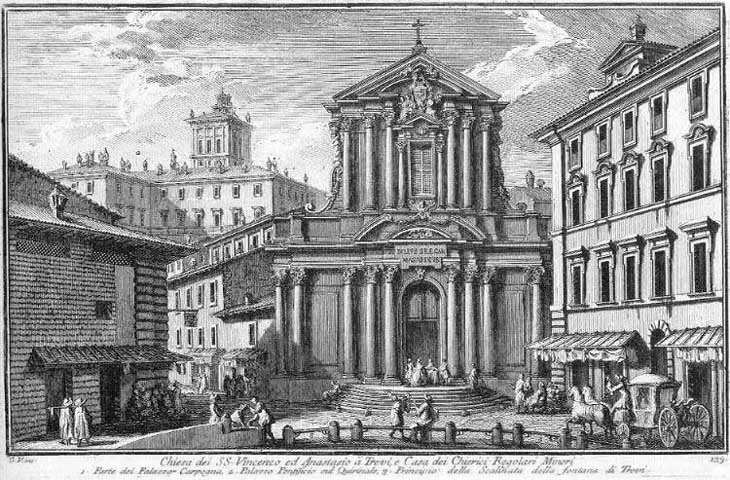
Anastasius was a Persian monk who made a pilgrimage to the Holy Places at Jerusalem in the reign of the Emperor Heraclius, during which journey he endured bonds and stripes on account of his confession of Christ at Caesarea, in Palestine.  Soon after his return, he was arrested by the Persians for the same cause, and, after enduring divers torments, he and seventy other Christians were beheaded by order of King Chosroes.  His relics were first carried to Jerusalem, to the monastery in which he had made his monastic profession, and afterwards to Rome, where they were laid in the monastery of Saints Vincent and Anastasius.

Picture
The Church of Ss. Vincent and Anastasius, Rome

Saint for Today - St. Agnes

1/21/2014

 
Picture
The Lesson is taken from the Treatise on Virgins by St. Ambrose the Bishop


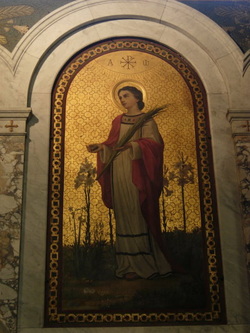
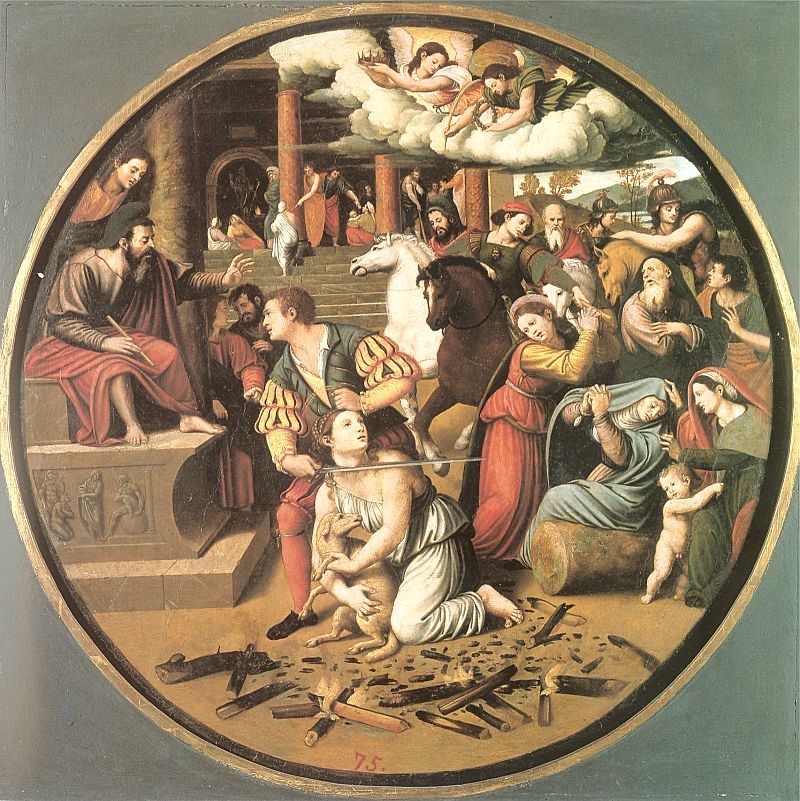
This is a virgin's birthday; let us then follow the example of her chastity.  It is a Martyr's birthday; let us then offer sacrifices.  It is the birthday of the holy Agnes; let men then be filled with wonder, little ones with hope, married women with awe, and the unmarried with emulation.  But how shall I set forth the glory of her whose very name is an utterance of praise?  It seemeth to me that this being, holy beyond her years, and strong beyond human nature, received the name of Agnes, not as an earthly designation, but as a revelation from God of what she was to be.  For this name Agnes is from the Greek, and being interpreted, signifieth Pure.  So that this saintly maiden is known by the very title of Chastity: and when I have added thereto the word Martyr, I have said enough.  She needeth not the praise which we could utter, but do not.  None is more praiseworthy than she for whose praise all mouths are fitted.  As many as name her, so many praise her, by the noble title of martyr.

We learn by tradition that this holy martyr testified in the thirteenth year of her age.  We will pass by the foul cruelty which did not spare her tender years, to contemplate the great power of her faith, whereby she overcame the weakness of childhood, and witnessed a good confession.  Her little body was hardly big enough to give play to the instruments of their cruelty, but if they could scare sheath their swords in her slight frame, they found in her that which laughed the power of the sword to scorn.  She had no fear when she found herself grasped by the bloody hands of the executioners.  She was unmoved when they dragged her with clanging chains.  Hardly entered on life, she stood fully prepared to die.  She quailed not when the weapons of the angry soldiery were pointed at her breast.  If they forced her against her will to approach the altars of devils, she could stretch forth her hands to Christ amid the very flames which consumed the idolatrous offerings, and mark on the heathen shrine the victorious Cross of the Lord.  She was ready to submit her neck and hands to the iron shackles, but they were too big to clasp her slender limbs.  Behold a strange martyr!  She is not grown of stature to fight the battle, but she is ripe for the triumph; too weak to run in the race, and yet clearly entitled to the prize; unable from her age to be aught but a learner, she is found a teacher.

She went to the place of execution a virgin, with more willing and joyful footsteps than she would have gone with to the nuptial chamber as a bride.  The spectators were all in tears, and she alone did not weep.  They beheld her with wonder, laying down that life of which she had hardly begun to taste the sweets, as freely as though she had drained it to the dregs and was weary of its burden.  All men were amazed when they saw her whose years had not made her her own mistress, arise as a witness for the Deity.  Consider how many threats her murderer used to excite her fears, how many arguments to shake her resolution, how many promises to bribe her to accept his offers of marriage.  But she answered him: It is an insult to him whom I have wedded to expect me to comply.  He that first chose me, his will I be.  Headsmen, why waitest thou?  Perish the body which draweth the admiration of eyes from which would turn away.  She stood, prayed, and then bent her neck for the stroke.  Now mightest thou have seen the murderer trembling as though he himself were the criminal, and the executioner's hand shake, and the faces of them that stood by turn white at the sight of her position, and all the while herself remain without fear.  This one victim brought God a double offering, that of her purity, and that of her faith.  She preserved virginity and achieved martyrdom.

Picture

Sanctity of life is needed for Holy Orders

1/20/2014

 
Picture

Sanctity required to enter Holy Orders.
By St. Alphonsus


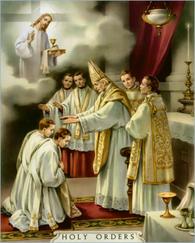
It must be observed that as we are very much exposed to be lost when to please our relatives we do not follow the divine vocation, so we also endanger our salvation when not to displease them we embrace the ecclesiastical state without being called to it by God. Now, a true vocation to this sublime dignity is distinguished by three signs, namely the requisite knowledge, the intention of applying ones self only to God s service, and positive goodness of life. We shall here speak only of this last condition.

The Council of Trent has prescribed to bishops to raise to Holy Orders only those whose irreproachable conduct has been proved. This is a rule that Canon Law had already established. Although this is directly understood of the external that the should proof bishop have in regard to the irreproachable conduct of the aspirants to the priesthood, yet one cannot doubt that the Council requires not only external irreproachableness, but even with greater reason, interior irreproachableness, without which the former would be illusory. The Council also adds that those only are to be admitted to Holy Orders who show themselves worthy by a wise maturity. We, moreover, know that the Council prescribes for this end the keeping of the interstices, that is, of an interval of time between the different degrees of Holy Orders

St. Thomas gives a reason for such a regulation: it is this, that in receiving Holy Orders one is destined to the most sublime ministry, that of serving Jesus Christ in the Sacrament of the Altar. Hence the angelic Doctor adds that the sanctity of ecclesiastics ought to surpass that of the religious. He elsewhere explains that sanctity is required not only in those who are ordained, but also in the subject who presents himself to be admitted to Holy Orders, and he shows the difference that exists in this respect between the religious and the ecclesiastical state. For in religion one purifies one self of one's vices, whilst to receive Holy Orders it is necessary that one has already led a pure and holy life.1 The holy Doctor also says in another place that the candidates for Holy Orders to be raised above the faithful ought simple by their virtue as well as by the dignity of their functions.2 And this merit he requires before ordination, for he calls it necessary not only in order to exercise well the ecclesiastical functions, but also to be worthily admitted among the number of the ministers of Jesus Christ. He finally concludes with these words: “In the reception of the Sacrament of Holy Orders, the candidates receive a more abundant outpouring of grace in order thus to be in a position to advance to a higher perfection.” By these last words, “to advance to a higher perfection,”3 the saint declares that the grace of the sacrament, far from being useless, will dispose the subject by an increase of strength to obtain still greater merits; but he expresses, at the same time, how it is for the candidate necessary to prepare himself in a state of grace that is sufficient in order that he may be judged worthy of entering the sanctuary.

In my Moral Theology I have given on this point a long dissertation to establish that those cannot be excused from mortal sin who without having been sufficiently tried by a holy life receive a Holy Order; since they raise themselves to this sublime state without a divine vocation; for one cannot regard those as having been called by God who have not yet succeeded in over coming a bad habit, especially the habit of offending against chastity. And whenever among those one might be found who is disposed by repentance to receive the Sacrament of Penance, he would nevertheless not be in a condition to receive Holy Orders, for in his case there must be more holiness of life manifested during a long trial. Otherwise the candidate would not be exempt from mortal sin on account of the grave presumption that he wished to intrude into the holy ministry without a vocation. Hence St. Anselm says: “Those who thus thrust themselves into Holy Orders and have in view only their own interests are robbers who arrogate to themselves the grace of God; instead of benediction they would receive God's malediction.” As Bishop Abelly remarks they would expose themselves to the great danger of being lost forever:“Whoever deliberately and without troubling himself whether or not he had a vocation would thrust himself into the priesthood, would without doubt plainly expose himself to eternal perdition.” So to holds the same opinion when he asserts, in speaking of the Sacrament of Holy Orders, that positive sanctity in the candidate is of divine precept: “Assuredly,”he says, “this sanctity is not essential to the sacrament, though it is altogether necessary by a divine precept. . . . Now, the sanctity that should characterize the candidates to Holy Orders does not consist in the general disposition required for the reception of the other sacraments, and sufficient in order that the sacrament may not be impeded. For, in the Sacrament of Holy Orders, one receives not only grace, but one is raised to a much more sublime state. Hence in the candidates there must be great purity of life and perfect virtue.”4 Thomas Sanchez, Holzmann, the school of Salamanca, are also of the same opinion. Thus, what I have advanced is not only the opinion of one theologian, but it is the common teaching based upon what is taught by St. Thomas.

If any one receive Holy Orders without having led the requisite good life, not only would he himself commit a mortal sin, but also the bishop who confers them upon him without having been morally certain, by sufficient proofs of the good conduct of the candidate. The confessor also would be guilty of mortal sin because he gives absolution to one who, addicted to a bad habit, wishes to be ordained without having given evidence during a considerable time of a positively good life. Finally, parents also sin grievously because,though knowing the wicked conduct of their son, they yet try to induce him to take Holy Orders in order that afterwards he may become the support of the family.

1 Summa 2. 2, q. 189, a. I.

2 Ut, sicut illi, qui Ordinem suscipiunt, super plebem constituuntur gradu Ordinis, ita et superiores sint merito sanctitatis.

3 Suppl. q. 35, a. i.

4 In Sent. d. 25, q. i, a. 4.

Taken from St. Alphonsus: The Holy Eucharist,  'Practice of the Love of Jesus Christ'  Ch VII P.382

Many hours are spent in scanning and proof reading articles, please support this labor of love.
I have shewed you all things, how that so labouring you ought to support the weak, and to remember the word of the Lord Jesus, how he said: It is a more blessed thing to give, rather than to receive. Acts 20:35


Saint for Today - Sts Fabian and Sebastian

1/20/2014

 
Picture
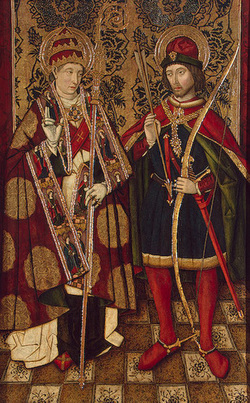
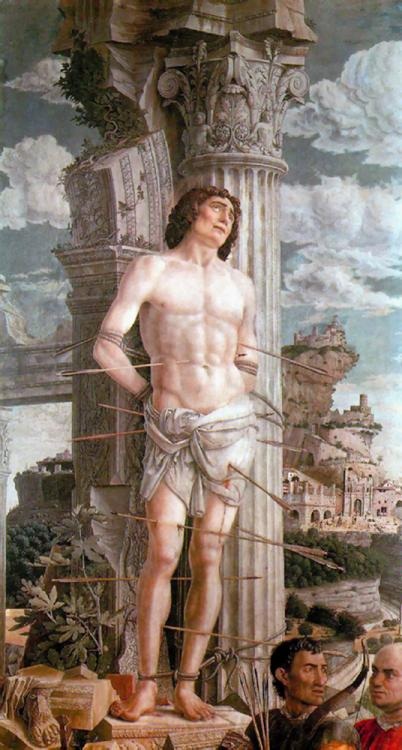
Fabian was a Roman, and sat as Pope from the reign of the Emperor Maximian till that of Decius.  He appointed a deacon to each of the seven districts of Rome to look after the poor.  He likewise appointed the same number of subdeacons to collect the acts of the Martyrs from the records kept by the seven district notaries.  It was by him that it was ordained that every Maundy Thursday the old Chrism should be burnt and new consecrated.  He was crowned with martyrdom upon the 20th of January, in the persecution of Decius, and buried in the cemetery of St. Callistus on the Appian Way, having sat in the throne of Peter fifteen years and four days.  He held five Advent ordinations, in which he ordained twenty-two priests, seven deacons, and eleven bishops for divers Sees.

The father of Sebastian was of Narbonne, and his mother a Milanese.  He was a great favourite of the Emperor Diocletian, both on account of his noble birth  and his personal bravery, and was by him appointed captain of the first company of the Praetorian Guards.  He was in secret a Christian, and often supported the others both by good offices and money.  When some shewed signs of yielding under persecution, he so successfully exhorted them, that, for Jesus Christ's sake, many offered themselves to the tormentors.  Among  these were the brothers Mark and Marcellian who were imprisoned at Rome in the house of Nicostratus.  The wife of Nicostratus himself, named Zoe, had lost her voice, but it was restored to her at the prayer of Sebastian.  These facts becoming known to Diocletian, he sent for Sebastian, and after violently rebuking him, used every means to turn him from his faith in Christ.  But as neither promises nor threats availed, he ordered him to be tied to a post and shot to death with arrows.

Sebastian was treated accordingly, and left for dead, but in the night the holy widow Irene sent for the body in order to bury it, and then found that he was still alive, and nursed him in her own house.  As soon as his health was restored, he went out to meet Diocletian, and boldly rebuked him for his wickedness.  The Emperor was first thunderstruck at the sight of a man whom he believed to been some time dead, but afterwards, frenzied with rage at the reproaches of Sebastian, ordered him to be beaten to death with rods, under which torment the martyr yielded his blessed soul to God.  His body was thrown into a sewer, but he appeared in sleep to Lucina, and made known to her where it was, and where he would have it buried.  She accordingly found it and laid it in those Catacombs, over which a famous Church hath since been built, called St. Sebastian's-without-the-Walls.


Picture
<<Previous
Forward>>


    archbishop lefebvre
    Click to see more

    Enter your email address for daily posts:

    Delivered by FeedBurner

    Archives

    December 2014
    October 2014
    September 2014
    August 2014
    July 2014
    June 2014
    May 2014
    April 2014
    March 2014
    February 2014
    January 2014
    December 2013
    November 2013
    October 2013
    September 2013
    August 2013
    July 2013
    June 2013
    May 2013

    Categories

    All
    Apologetics
    Archbishop Lefebvre
    Bishop Williamson
    Blessed Sacrament
    Catechism
    Catholic History
    Chalk Talks
    Chastisement
    Devotions
    Easter
    Eleison Comments
    Eleison Comments
    Eleison Comments Italian
    Encyclicals
    Espanol Eleison Comments
    Families
    Fatima
    Feast Days
    For Fathers (Dads)
    For Moms
    Fortitude
    Holy Ghost
    Holy Name
    Holy Souls
    Holy Week
    Home Schooling
    Lent
    Liberalism
    Litanies
    Liturgy
    Marriage
    Martyrology
    Martyrs
    Mass
    Meditations Of Abl
    Modesty
    News
    New World Order
    Obedience
    Our Lady
    Our Lady Of Quito
    Our Lord
    Pentecost
    Pioneer Priests
    Prayers
    Sacramentals
    Sacraments
    Sacred Heart
    Saint Of The Day
    Saints For April
    Saints For August
    Saints For December
    Saints For February
    Saints For January
    Saints For July
    Saints For June
    Saints For March
    Saints For May
    Saints For November
    Saints For October
    Saints For September
    Scandal
    Scapular
    Sermons
    Sspx
    St Benedict
    St Joseph
    St Michael
    St Michael
    Sundays Of The Year
    Temptations
    The Church
    The Last Things
    The Mass
    The Pope
    The Rosary
    The Saints
    The Virtues
    Tradcat Comments
    Truth Society

    Picture
    Click to see inside the store
    Picture
    k d
    Counter Site
    While Archbishop Lefebvre Blog is provided free of charge, there are administrative and technical costs associated with making it available to subscribers worldwide and with operating this site. Contributions to offset these costs are appreciated, and may be made via the button below

    Archbishop Lefebvre

    Promote Your Page Too
Powered by Create your own unique website with customizable templates.