ArchbishopLefebvre.com
Links
  • Archbishop Lefebvre
    • Biography of Archbishop Lefebvre
    • Who is he?
    • In his own words
  • Sermons
    • Sunday Sermons
  • Letters
    • Archbishop Lefebvre >
      • To Friends and Benefactors
      • Other Letters
    • Bishop Williamson >
      • Friends and Benefactors
      • Eleison Comments >
        • Italiano
        • Espanol
      • To SSPX Priests
  • Blog
  • Books
    • E-Books
    • Free Catholic Books
    • Archbishop Lefebvre
    • Bibles
    • Blessed Sacrament
    • Children Books
    • Childrens Saints
    • DVDs
    • Hell
    • Purgatory
    • Our Lady
    • Sacred Heart
    • Missals
    • Missale Romanum
    • Summa Theologica
    • Saints
  • Catholic Faith
    • Catechisms
    • Catholic Art
    • Chant
    • Dogmas of the Catholic Church
    • Encyclicals
    • Sermons
    • History >
      • HughesVol1index
    • Liturgy
    • Sacraments
    • Prayers >
      • Blessings
    • Way of the Cross
  • SSPX Crisis
    • sspx Archbishop Lefebvre
    • monks nuns
    • SSPX Bishop Fellay
    • SSPX Bishop Tissier
    • ex-sspx Bishop Williamson
    • ex-sspx chazal
    • sspx couture
    • sspx fox
    • ex-sspx fuchs
    • ex-sspx girouard
    • ex-sspx hewko
    • sspx laisney
    • sspx ockerse
    • ex-sspx pfeiffer
    • sspx themann
    • Fr. Ringrose
  • Links
    • Other Sites
    • Donate
    • Facebook
    • Twitter
    • You Tube
  • TradCat Items
    • Beeswax Candles
    • Chapel Veils
    • Prayer Cards - Our Lady
    • Prayer Cards - Espanol
    • Protected Scapulars
    • Scapulars
    • Unbreakable Rosaries
  • Crisis in Church
    • Declaration of the 2006 Chapter (SSPX)
    • Fr Hewko to SSPX Superiors
    • History of the Archbishop and Rome
    • Vatican II more important than Nicea!
    • The Archbishop and Religious Liberty
    • The right to resist an abuse of power
    • How Are Catholics To Respond To The Present Crisis

St Hildergard - September 17th

9/17/2013

 
Picture
From Wikipedia

Saint Hildegard of Bingen, O.S.B. (German: Hildegard von Bingen; Latin: Hildegardis Bingensis) (1098 – 17 September 1179), also known as Saint Hildegard, and Sibyl of the Rhine, was a German writer, composer, philosopher, Christian mystic, Benedictine abbess, visionary, and polymath. Elected a magistra by her fellow nuns in 1136, she founded the monasteries of Rupertsberg in 1150 and Eibingen in 1165. One of her works as a composer, the Ordo Virtutum, is an early example of liturgical drama and arguably the oldest surviving morality play.

She wrote theological, botanical and medicinal texts, as well as letters, liturgical songs, and poems, while supervising brilliant miniature illuminations.

Although the history of her formal recognition as a saint is complicated, she has been recognized as a saint by parts of the Roman Catholic Church for centuries. On 7 October 2012, Pope Benedict XVI named her a Doctor of the Church.


"The time is coming when princes and peoples will reject the authority of the Pope. Some countries will prefer their own Church rulers to the Pope. The German Empire will be divided. Church property will be secularised. Priests will be persecuted. After the birth of Antichrist heretics will preach their false doctrines undisturbed, resulting in Christians having doubts about their holy Catholic faith."

"At that period when Antichrist shall be born, there will be many wars and right order shall be destroyed on earth. Heresy will be rampant and the heretics will preach their errors openly without restraint. Even among Christians doubt and scepticism will be entertained concerning the beliefs of Catholicism

"Toward the end of the world, mankind will be purified through sufferings. This will be true especially of the clergy, who will be robbed of all property. When the clergy has adopted a simple manner of living, conditions will improve.

At this time as a punishment for their sins Christians especially will attempt armed resistance to those who at that time are persecuting them, sensing no concern for the death of their bodies.

"A powerful wind will rise in the North carrying heavy fog and the densest dust by divine command and it will fill their throats and eyes so they will cease their savagery and be stricken with great fear.

Then within the Christian people the Holy Godhead will accomplish signs and wonders as if accomplished them at the time of Moses with the pillar of cloud and as Michael the archangel did when he fought the heathen for the sake of the Christians. Because of Michael's help Gods faithful children will march under his protection. They will decimate their foes and achieve victory through Gods power. As a result of this a large number of heathens will join Christians in true faith and they will say  'The God of the Christians is true God because such wondrous works have been accomplished among the Christians.' St Hildergard

The Holy Stigmata of St Francis

9/17/2013

 
Picture
Commentaries of St. Bonaventure the Bishop

Francis being indeed a faithful servant and minister of Christ, about the space of two years before he gave back his spirit to heaven, withdrew himself into an high mountain apart, even that mountain which is called Mount Alverno, and began to fast for forty days to the honour of the Archangel Michael.  To think of the things above gave him sweeter comfort than beforetime he was wont, and the hot longing for heaven was kindled in him, so that he began to feel that the gifts from above were poured forth upon him in such fulness as he had never felt before.  The burning of his desire made his heart rise towards God like the heart of a seraph, and his tender answering love yearned to be changed into the likeness of him who hath so loved us that he was content to bear the Cross.  And it was so that one morning early, about the time of the Feast of the Exaltation of the Holy Cross, he was praying upon the side of the mountain, and there appeared to him as it had been one of the Seraphim, having six wings, glorious and fiery, flying to him from heaven.  It came therefore very swiftly, and stood in the air, hard by the man of God.  He beheld then the appearance thereof that it was not winged only, but crucified also.  His hands and feet were stretched forth and nailed to a Cross.  Twain of his wings were lifted up and joined one to the other over his head, and twain were stretched forth to fly withal, and with twain he wrapped around his body.  When Francis saw it, he was sore amazed, and his soul was filled with sorrow and gladness, for the eyes of him that appeared were full of strange love and tenderness, so that he conceived great rejoicing thereat, but the nailing to the Cross was so exceedingly dreadful, that as he saw it, a sword of sorrow pierced his soul.

Then he whom he beheld with his bodily eyes, began to speak silently unto him in his heart, and he understood that albeit the deathless Seraphim cannot suffer or faint, this vision was nevertheless therefore set before him, that he might know that as a friend of Christ he was to be all changed into the likeness of Christ Jesus crucified, not by the martyrdom of the body, but by the fervour of the soul.  Then they held together some sweet converse, as of a man with his friend, and the vision passed from him, but his heart was kindled inwardly with the fire of the Seraphim, and his body was outwardly changed into the likeness of him who was crucified, even as wax is softened by the fire and taketh the impression of the seal.  From thenceforth there were in his hands and feet the marks of the nails.  The heads of the nails were seen in the palms of his hands and on the insteps of his feet, and the points came out on the backs of his hands and the soles of his feet.  In his right side also was a long raw wound, as though he had been pierced with a spear, from which wound his holy blood oftentimes ran and stained his shirt and breeches.

Thereafter Francis was a new creature, famous for a new and awful sign.  The holy marks of the Lord Jesus, whereon living man for twelve centuries had not been allowed to look, were his adornment.  He came down from the mount bearing in himself the form of Jesus Crucified, not pourtrayed upon tables of stone or wood by the hand of any earthly craftsman, but drawn upon his flesh by the finger of the living God.  The dying Seraph knew well that it is good to keep close the secret of a king, and knowing the secret of his King, he strove as far as in him lay to keep the sacred marks hidden from men.  Nevertheless, forasmuch as it is the will of the Lord God for his own glory to make manifest the greatness of his own works, he openly shewed forth divers wonders through these wounds which he had himself made in secret, so that the hidden and wondrous power of the marks might become known by the fame of the miracles. - The foregoing marvellous but thoroughly witnessed facts, which were already spoken of in Papal documents with especial praise and joy, were made, by the pleasure of Pope Benedict XI, the subject of a yearly memorial, which was afterwards extended by Paul V to the whole Church, in the hope of fanning in the hearts of the faithful the love of Christ Crucified.

Saints for Today - Sts. Euphemia, Lucy and Geminian

9/16/2013

 
Picture
Euphemia, Lucy, and Geminian were all crowned with Martyrdom in the persecution under Diocletian, upon the same day, though not in the same place.  Euphemia was a maiden of Chalcedon, who suffered divers tortures under the Proconsul Priscus.  She endured unflinchingly the rods, the rack, the wheels, and the fire, and in the end was thrown to wild beasts.  These all licked her feet, save one, which gave her holy body such a bite, that she forthwith resigned her guileless spirit to God. 

Lucy was a widow at Rome, who was accused by her own son Eutropius, for that she had for many years worshipped Christ.  She was put into a vessel of hot pitch and lead, but came forth unhurt.  As she was being haled through the city loaded with iron and lead, the sight of her faith and unwavering testification turned to Christ the nobleman Geminian.  He was one of many whom she had brought to the faith, and she had him for a comrade in her glorious martyrdom, for he was divers ways tormented, and then beheaded.  Their bodies were given honourable burial by the Christian lady Maxima.

Saint for Today - St Cyprian

9/16/2013

 
Picture
Cornelius was a Roman who held the Popedom during the reign of the Emperors Gallus and Volusian.  He, and that most holy Lady Lucina, took the bodies of the Apostles Peter and Paul out of the Catacombs and put them in more convenient places.  Lucina laid the body of Paul in a farm of her own upon the road to Ostia, hard by the place where he had received the sword-stroke.  Cornelius placed that of the Prince of the Apostles hard by where he had been crucified.  When this was told to the Emperors, and likewise that Cornelius was the means of making many Christians, he was banished to Civitavecchia, where Cyprian, the holy Bishop of Carthage, comforted him by letters.

They continued thus to write often one to the other, till the Emperors took in bad part these exchanges of Christian love, and sent for Cornelius to Rome.  There they commanded him to be lashed with scourges loaded with lead as though he were a traitor, and then to be carried to offer sacrifice before the image of Mars.  He firmly refused to commit this great wickedness, and was forthwith beheaded, upon the 14th day of September.  The blessed Lucina, with the help of the clergy, buried his body in the sand-pit on her own farm, near the Cemetery of Callistus.  He lived as Pope about two years.

The Seven Sorrows of Our Lady

9/15/2013

 
Picture
Sermon by St. Bernard the Abbot

The Martyrdom of the Virgin is set before us, not only in the prophecy of Simeon, but also in the story itself of the Lord's Passion.  The holy old man said of the Child Jesus: Behold, this Child is set for the fall and the rising again of many  in Israel; and for a sign which shall be spoken against; yea (said he unto Mary), a sword shall pierce through thine own soul also.  Even so, O Blessed Mother!  The sword did indeed pierce through thy soul! for nought could pierce the Body of thy Son, nor pierce thy soul likewise.  Yea, and when this Jesus of thine had given up the ghost, and the bloody spear could torture him no more, thy soul winced as it pierced his dead side―his own Soul might leave him, but thine could not.

The sword of sorrow pierced through thy soul, so that we may truly call thee more than martyr, in whom the love, that made thee suffer along with thy Son, wrung thy heart more bitterly than any pang of bodily pain could do.  Did not that word of his indeed pierce through thy soul, sharper than any two-edged sword, even to the dividing asunder of soul and spirit: Woman, behold thy son!  O what a change to thee!  Thou art given John for Jesus, the servant for his Lord, the disciple for his Master, the son of Zebedee for the Son of God, a mere man for Very God.  O how keenly must the hearing of those words have pierced through thy most loving soul, when even our hearts, stony, iron, as they are, are wrung at the memory thereof only!

Marvel not, my brethren, that Mary should be called a Martyr in spirit.  He indeed may marvel who remembereth not what Paul saith, naming the greater sins of the Gentiles, that they were without natural affection.  Far other were the bowels of Mary, and far other may those of her servants be!  But some man perchance will say: Did she not hope that he was soon to rise again?  Yea, she most faithfully hoped it.  And did she still mourn because he was crucified?  Yea, bitterly.  But who art thou, my brother, or whence hast thou such wisdom, to marvel less that the Son of Mary suffered than that Mary suffered with him?  He could die in the Body, and could not she die with him in her heart?  His was the deed of that Love, greater than which hath no man, her's, of a love, like to which hath no man, save he.

St Notburga - September 14th

9/14/2013

 
Picture
Patroness of servants and peasants, b. c. 1265 at Rattenberg on the died 16th September, 1313. She was cook in the family of Count Henry of Rothenburg, and used to give food to the poor. But Ottilia, her mistress, ordered her to feed the swine with whatever food was left. She, therefore, saved some of her own food, especially on Fridays, and brought it to the poor. One day, according to legend, her master met her, and commanded her to show him what she was carrying. She obeyed, but instead of the food he saw only shavings, and the wine he found to be vinegar. Hereupon Ottilia dismissed her, but soon fell dangerously ill, and Notburga remained to nurse her and prepared her for death.

Notburga then entered the service of a peasant in the town of Eben, on condition that she be permitted to go to church evenings before Sundays and festivals. One evening her master urged her to continue working in the field. Throwing her sickle into the air she said: "Let my sickle be judge between me and you," and the sickle remained suspended in the air. Meantime Count Henry of Rothenburg was visited with great reverses which he ascribed to the dismissal of Notburga. He engaged her again and thenceforth all went well in his household. Shortly before her death she told her master to place her corpse on a wagon drawn by two oxen, and to bury her wherever the oxen would stand still. The oxen drew the wagon to the chapel of St. Rupert near Eben, where she was buried. Her ancient cult was ratified on 27 March, 1862, and her feast is celebrated on 14 September. She is generally represented with an ear of corn, or flowers and a sickle in her hand; sometimes with a sickle suspended in the air.

The Exaltation of the Holy Cross

9/14/2013

 
Picture
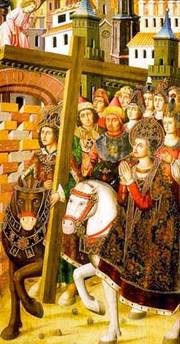
Chosroës, King of Persia, having, in the last days of the reign of the Emperor Phocas, overrun Egypt and Africa, took Jerusalem, where he slaughtered thousands of Christians and carried off to Persia the Cross of the Lord, which Helen had put upon Mount Calvary.  Heraclius, the successor of Phocas, moved by the thought of the hardships and horrid outrages of war, sought for peace, but Chosroës, drunken with conquest, would not allow of it even upon unfair terms.  Heraclius therefore, being set in this uttermost strait, earnestly sought help from God by constant fasting and prayer, and through his good inspiration gathered an army, joined battle with the enemy, and prevailed against three of Chosroës his chief captains, and three armies.

Chosroës was broken by these defeats, and when in his flight, he was about crossing the Tigris, he proclaimed his son Medarses partner in his kingdom.  Chosroës' eldest son Siroës took this slight to heart, and formed a plot to murder his father and brother, which plot he brought to effect soon after they had come home.  Then he got the kingdom from Heraclius upon certain terms, whereof the first was that he should give back the Cross of the Lord Christ.  The Cross therefore was received back after that it had been fourteen years in the power of the Persians, and Heraclius came to Jerusalem and bore it with solemn pomp unto the Mount whereunto the Saviour had borne it.

This event was marked by a famous miracle.  Heraclius, who was adorned with gold and jewels, stayed perforce at the gateway which leadeth unto Mount Calvary, and the harder he strove to go forward, the harder he seemed to be held back, whereat both himself and all they that stood by were sore amazed.  Then spake Zacharias, Patriarch of Jerusalem, saying: See,  O Emperor, that it be not that in carrying the Cross attired in the guise of a Conqueror thou shewest too little of the poverty and lowliness of Jesus Christ.  Then Heraclius cast away his princely raiment and took off his shoes from his feet, and in the garb of a countryman easily finished his journey, and set up the Cross once more in the same place upon Calvary whence the Persians had carried it away.  That the Cross had been put by Heraclius in the same place wherein it had first been planted by the Saviour caused the yearly Feast of the Exaltation of the Holy Cross to become the more famous thenceforward.


Sermon of St. Leo the Pope

Dearly beloved, when we look to Christ lifted up on the Cross, the eyes of faith see more than what the wicked saw, unto whom it was said through Moses: And thy Life shall hang in doubt before thee, and thou shalt fear day and night, and shalt have none assurance of thy Life.  They saw in the Crucified nothing but the work of their own wickedness.  As it is written: They feared greatly.  But their faith was not unto faith, which giveth life by justification, but unto the torture of their own bad conscience.  But our understanding is enlightened by the Spirit of Truth.  And so with pure and open hearts we can see the glory of the Cross shining over heaven and earth, and discern by inward sight what the Lord meant when his passion was nigh at hand, and he said: Now is the judgment of this world; now shall the prince of this world be cast out; and I, if I be lifted up from the earth, will draw all men unto me.


O how wonderful is the power of the Cross!  O how unutterable is the glory of the Passion, wherein standeth the Lord's judgment-seat, and the judgment of this world, and the might of the Crucified!  Verily, O Lord, thou hast drawn all men and all things unto thee!  Albeit thou didst spread out thine hands all the day unto an unbelieving and gainsaying people, yet the world was made to feel and own thy Majesty!  Verily, O Lord, thou hast drawn all things unto thee!  For the senseless elements gave one wild cry of horror at the iniquity of Jewry; the lights of the firmament were darkened; day was turned into night; earth quaked with strange tremblings; and thus all God's works refused to serve the guilty.  Verily, O Lord, thou hast drawn all things unto thee!  For the veil of the Temple was rent in twain from top to bottom, and thus the Holy of Holies denied itself as a sanctuary for the ministration of unworthy priests, that the shadow might be changed for the substance, prophecy for realization, and the Law for the Gospel.

Verily, O Lord, thou hast drawn all things unto thee!  What was once veiled under types and shadows in the one Jewish Temple, is now hailed by the love of all peoples in full and open worship everywhere.  There is now a higher order of Levites, a more honourable rank of Elders, a priesthood with an holier anointing.  Thy Cross is for all men a well of blessings and a cause of thanksgiving.  Thereby for them that believe in thee, weakness is turned into strength, shame into glory, and death into life.  The changing ordinance of divers carnal sacrifices is gone; the one oblation of thy Body and Blood fulfilleth them all.  For thou art the true paschal Lamb that takest away the sins of the world.  Thou art thyself the accomplishment of all mysteries, so that as now there is one Sacrifice in place of many victims, so there shall be one kingdom composed of all peoples.

St. Maurilius - September 13th

9/13/2013

 
Picture
The native place of St. Maurilius was Milan, and his teacher was St. Martin, who had founded a monastery near that city, wherein he lived. After this holy man had been banished from Milan by the Arians, and had become Bishop of Tours, Maurilius went to him to be instructed in virtue and wisdom. When he had made sufficient progress, St. Martin ordained him priest, after which Maurilius repaired to Angers to preach the Gospel, as at that time, a great number of the inhabitants were pagans. While on this way thither, he saw the temple of an idol, standing near the river. Pitying the blindness of the people, he besought God to destroy this temple; when, behold, fire falls from heaven, the temple is overthrown, the idol burned to ashes! Maurilius, having had all the rubbish carried away, assisted by some pious Christians, built a church upon the same spot, together with a monastery in which he took up his abode with a number of devout men, whom he governed as Abbot. During this time he converted an almost countless number of pagans, as well in the city as out of it, by zealous preaching and the miracles he performed on the sick, the possessed and the blind.

Meanwhile the Bishop of Angers died, and St. Martin, who went thither to choose a successor, took Maurilius with him. The clergy and people were assembled, and the election was about to begin, when suddenly a white dove was seen which, after having fluttered through the church for some time, at length descended upon the shoulder of St. Maurilius. All looked upon this event as a sign that God had chosen this holy man as Bishop, and hence they unanimously declared that they desired no other. He was therefore consecrated bishop by St. Martin, to the inexpressible comfort of the people, although he himself shed many tears at being obliged to accept the dignity.

As Bishop, his virtues shone still more brightly; for he had more opportunities to practise them in the world than in the convent and his exalted station imparted to them an additional lustre. He fasted with great rigor, and on three days of the week he partook only of bread and salt. He never tasted wine, and during Lent, seldom left his residence; "for," said he, "Lent is a time of solitude, during which we ought to contemplate the passion and death of Christ." He was unwearied in instructing his flock and in converting the heathen.

One day, while he was standing before the Altar to perform the holy sacrifice, a woman requested him to administer to her sick son the holy sacrament of Confirmation. Maurilius, not thinking that the lad was in danger, continued Mass, but before he had finished it, the child was dead. The holy man was exceedingly grieved at this accident, and as if having committed great sin, he sentenced himself to a severe penance. He secretly left the city, and hastened over hill and dale, until having arrived at the sea, he went on board of a ship which was setting sail for England. During the voyage, the keys of the holy relics which he had taken with him, fell into the sea, and he solemnly declared that he would not return to his diocese, until he should again possess them, which, as he believed, would never happen.

At length he arrived in England, where, without making himself known, he took service with a nobleman as gardener. It was his intention to do penance for his sin by the hard labors of this occupation during winter and summer. The inhabitants of Angers were meanwhile greatly dismayed at the disappearance of their highly esteemed bishop, and sent several persons in search of him. Seven whole years had elapsed, when, by divine revelation they found him. Their good angel guided them in such a manner, that they found their holy bishop coming from his garden with a load of vegetables for his master. They immediately recognized him, and besought him, with tears in their eyes, to return to his see, and watch over the spiritual welfare of his flock. St. Maurilius, who thought that they had long since elected another bishop, was greatly disturbed on beholding them. He could not deny his identity, but endeavored to evade their wishes by making different pretexts, and finally declared that he could not return under any circumstances, as he had solemnly vowed that he would not see Angers again until, the keys were found which had fallen out of his hand into the sea.

"If this is the only obstacle to your return, we are able to remove it," said the delegates; "for on the voyage, we caught a fish, in whose stomach we found the keys." Showing them to him, they persuaded him to regard the finding of them as an unmistakable proof that God desired his return. Maurilius made no further resistance, but taking leave of the gentleman whom he had served, he returned to his see. It must also be stated that, shortly before the arrival of the delegates, while St. Maurilius was weeping bitterly over his sins, an angel had appeared to him and given him the assurance of their entire remission, which filled his heart with inexpressible joy. It would be difficult to describe the rejoicings of the inhabitants of the entire diocese on the return of their holy bishop. The Saint, however, first went to the place where the abovementioned lad had been buried seven years before. Having said his prayers with the utmost confidence in the power of God, he awakened the child from death, as is testified by St. Gregory of Tours and others. Those present had never so clearly comprehended how pious and holy a man God had bestowed upon them in their bishop, as at the moment of that startling event. Maurilius gave the lad the name of Renatus, which means "born again," and instructed him so carefully in all that pertains to a Christian life, that he afterwards became the successor of his holy teacher.

The remainder of his life the Saint passed in his habitual austerity, and in great zeal for the salvation of souls. When he had reached his ninetieth year, God revealed to him the hour of his departure. Preparing himself with the greatest solicitude, he ordered his grave to be dug, and after a short illness, gave up his soul to his Creator. At his funeral, besides other miracles which took place, two persons who had been blind from birth received their sight, and a man who had been paralyzed thirty-one years, regained the use of his limbs, on kissing the coffin in which the relics of the Saint reposed. Well worth considering are the words which the holy man spoke shortly before his death to those around him: "Ponder well," said he, "that your souls are bought at a great price: the precious blood of Jesus Christ."

Holy Name of Mary

9/12/2013

 
Picture
Sermon by St. Bernard the Abbot

It is said: And the Virgin's name was Mary.  Let us speak a few words upon this name, which signifieth, being interpreted, Star of the Sea, and suits very well the Maiden Mother, who may very meetly be likened unto a star.  A star giveth forth her rays without any harm to herself, and the Virgin brought forth her Son without any hurt to her virginity.  The light of a star taketh nothing away from the Vírginity of Mary.  She is that noble star which was to come out of Jacob, whose brightness still sheds  lustre upon all the earth, whose rays are most brilliant in heaven, and shine even unto hell, lighting up earth midway, and warming souls rather than bodies, fostering good and scaring away evil.  She, I say, is a clear and shining star, twinkling with excellencies, and resplendent with example, needfully set to look down upon the surface of this great and wide sea.

O thou, whosoever thou art, that knowest thyself to be here not so much walking upon firm ground, as battered to and fro by the gales and storms of this life's ocean, if thou wouldest not be overwhelmed by the tempest, keep thine eyes fixed upon this star's clear shining.  If the hurricanes of temptation rise against thee, or thou art running upon the rocks of trouble, look to the star, call on Mary.  If the waves of pride, or ambition, or slander, or envy toss thee, look to the star, call on Mary.  If the billows of anger or avarice, or the enticements of the flesh beat against thy soul's bark, look to Mary.  If the enormity of thy sins trouble thee, if the foulness of thy conscience confound thee, if the dread of judgment appal thee, if thou begin to slip into the deep of despondency, into the pit of despair, think of Mary.

In danger, in difficulty, or in doubt, think on Mary, call on Mary.  Let her not be away from thy mouth or from thine heart, and that thou mayest not lack the succour of her prayers, turn not aside from the example of her conversation.  If thou follow her, thou wilt never go astray.  If thou pray to her, thou wilt never have need to despair.  If thou keep her in mind, thou wilt never fall.  If she lead thee, thou wilt never be weary.  If she help thee, thou wilt reach home safe at the last―and so thou wilt prove in thyself how meetly it is said: And the Virgin's name was Mary. - Particular honours were already paid to this worshipful name in divers parts of the Christian world, but the Bishop of Rome, Innocent XI, ordered this Feast in honour of it to be held every year throughout the whole Church, as an everlasting thanksgiving for the great blessing that, under her protection, the brutal Sultan of the Turks, who was trampling upon the necks of the Christian population, was thoroughly beaten before the walls of Vienna in Austria.

Sermon by St. Peter Chrysologus

Dearly beloved brethren, ye have this day heard how an Angel treated with a woman touching the regeneration of mankind.  Ye have heard how it was arranged that man should return to life by the same mean whereby he had fallen into death.  The Angel treateth, treateth with Mary concerning salvation, because an angel had treated with Eve concerning destruction.  Ye have heard how an Angel set about to raise with unspeakable building a temple of the Divine Majesty out of the dust of the earth.  Ye have heard how by a mystery which cannot be understood, God got a place on earth and man a place in heaven.  Ye have heard how by a working hitherto unheard of, God and man are joined together in one Body.  Ye have heard how at the message of an Angel, the weak nature whereof our flesh is sharer, became strong to bear the whole glory of the Godhead.


Then, lest the frail clay of humanity should break down under the weight of God's work, and in Mary the tender stem should snap, which was about to bear the fruit of all mankind, the Angel's first words were a preventive against fear.  And the Angel said unto her: Fear not, Mary.  Even before the matter is revealed, the exalted station of this Virgin is made clear by her very name, for the name Mary is an Hebrew word, and signifieth Lady.  The Angel therefore greeteth her as Lady, that the Mother of the Lord may lay aside the fearfulness of his handmaiden, whom the will of her own Offspring had made to be born and to be called a Lady.  Fear not, Mary, for thou hast found grace.  He that hath found grace, need fear no more.  Thou hast found grace.

Blessed is she who alone among mankind, and first among mankind deserved to hear: Thou hast found grace.  And how much grace?  Even as the Angel had said: Full!  Full of grace.  Full indeed!  Grace like a bountiful shower drenched and soaked her whole being.  For thou hast found grace with God.  As he saith this, even the Angel doth marvel.  He marvelleth that a woman should merit eternal life, that all men should merit it through her.  The Angel marvelleth that the whole Godhead, he to whom the entire universe is small, should enter the narrow womb of a virgin.  So he delayeth.  He calleth her virgin.  That was her right.  He haileth her as full of grace.  Then, with great trepidation he delivereth his message, scarcely able to phrase it so that it could be understood.

Saints for Today - St Protus and Hyacinth

9/11/2013

 
Picture
Protus and Hyacinth were brethren, eunuchs of the blessed Virgin Eugenia, and were baptized along with her by Bishop Helenus.  They gave themselves to the study of God's Word, and dwelt for a while in wonderful lowliness and holiness of life in a monastery in Egypt.  However, they afterwards followed the holy Virgin Eugenia to Rome, in the reign of the Emperor Gallienus, and were arrested in that city for professing the Christian faith.  By no means could they be brought to leave the Christian religion and to worship the gods, and they were therefore severely scourged  and beheaded, upon the 11th day of September.

<<Previous
Forward>>


    archbishop lefebvre
    Click to see more

    Enter your email address for daily posts:

    Delivered by FeedBurner

    Archives

    December 2014
    October 2014
    September 2014
    August 2014
    July 2014
    June 2014
    May 2014
    April 2014
    March 2014
    February 2014
    January 2014
    December 2013
    November 2013
    October 2013
    September 2013
    August 2013
    July 2013
    June 2013
    May 2013

    Categories

    All
    Apologetics
    Archbishop Lefebvre
    Bishop Williamson
    Blessed Sacrament
    Catechism
    Catholic History
    Chalk Talks
    Chastisement
    Devotions
    Easter
    Eleison Comments
    Eleison Comments
    Eleison Comments Italian
    Encyclicals
    Espanol Eleison Comments
    Families
    Fatima
    Feast Days
    For Fathers (Dads)
    For Moms
    Fortitude
    Holy Ghost
    Holy Name
    Holy Souls
    Holy Week
    Home Schooling
    Lent
    Liberalism
    Litanies
    Liturgy
    Marriage
    Martyrology
    Martyrs
    Mass
    Meditations Of Abl
    Modesty
    News
    New World Order
    Obedience
    Our Lady
    Our Lady Of Quito
    Our Lord
    Pentecost
    Pioneer Priests
    Prayers
    Sacramentals
    Sacraments
    Sacred Heart
    Saint Of The Day
    Saints For April
    Saints For August
    Saints For December
    Saints For February
    Saints For January
    Saints For July
    Saints For June
    Saints For March
    Saints For May
    Saints For November
    Saints For October
    Saints For September
    Scandal
    Scapular
    Sermons
    Sspx
    St Benedict
    St Joseph
    St Michael
    St Michael
    Sundays Of The Year
    Temptations
    The Church
    The Last Things
    The Mass
    The Pope
    The Rosary
    The Saints
    The Virtues
    Tradcat Comments
    Truth Society

    Picture
    Click to see inside the store
    Picture
    k d
    Counter Site
    While Archbishop Lefebvre Blog is provided free of charge, there are administrative and technical costs associated with making it available to subscribers worldwide and with operating this site. Contributions to offset these costs are appreciated, and may be made via the button below

    Archbishop Lefebvre

    Promote Your Page Too
Powered by Create your own unique website with customizable templates.