ArchbishopLefebvre.com
Links
  • Archbishop Lefebvre
    • Biography of Archbishop Lefebvre
    • Who is he?
    • In his own words
  • Sermons
    • Sunday Sermons
  • Letters
    • Archbishop Lefebvre >
      • To Friends and Benefactors
      • Other Letters
    • Bishop Williamson >
      • Friends and Benefactors
      • Eleison Comments >
        • Italiano
        • Espanol
      • To SSPX Priests
  • Blog
  • Books
    • E-Books
    • Free Catholic Books
    • Archbishop Lefebvre
    • Bibles
    • Blessed Sacrament
    • Children Books
    • Childrens Saints
    • DVDs
    • Hell
    • Purgatory
    • Our Lady
    • Sacred Heart
    • Missals
    • Missale Romanum
    • Summa Theologica
    • Saints
  • Catholic Faith
    • Catechisms
    • Catholic Art
    • Chant
    • Dogmas of the Catholic Church
    • Encyclicals
    • Sermons
    • History >
      • HughesVol1index
    • Liturgy
    • Sacraments
    • Prayers >
      • Blessings
    • Way of the Cross
  • SSPX Crisis
    • sspx Archbishop Lefebvre
    • monks nuns
    • SSPX Bishop Fellay
    • SSPX Bishop Tissier
    • ex-sspx Bishop Williamson
    • ex-sspx chazal
    • sspx couture
    • sspx fox
    • ex-sspx fuchs
    • ex-sspx girouard
    • ex-sspx hewko
    • sspx laisney
    • sspx ockerse
    • ex-sspx pfeiffer
    • sspx themann
    • Fr. Ringrose
  • Links
    • Other Sites
    • Donate
    • Facebook
    • Twitter
    • You Tube
  • TradCat Items
    • Beeswax Candles
    • Chapel Veils
    • Prayer Cards - Our Lady
    • Prayer Cards - Espanol
    • Protected Scapulars
    • Scapulars
    • Unbreakable Rosaries
  • Crisis in Church
    • Declaration of the 2006 Chapter (SSPX)
    • Fr Hewko to SSPX Superiors
    • History of the Archbishop and Rome
    • Vatican II more important than Nicea!
    • The Archbishop and Religious Liberty
    • The right to resist an abuse of power
    • How Are Catholics To Respond To The Present Crisis

Saint for Today - St Ephraem

6/18/2014

 
Picture
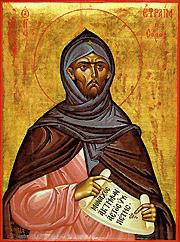
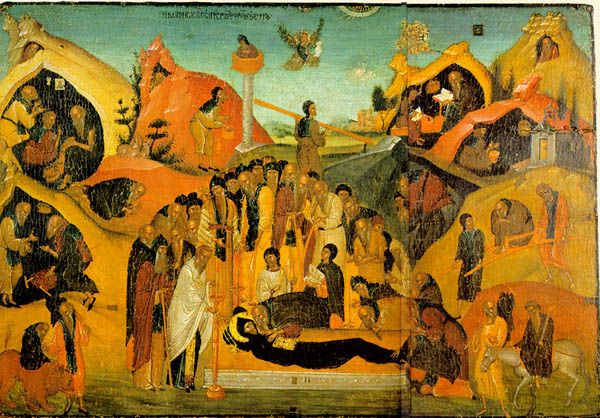
Ephraem was of Syrian descent, and son of a citizen of Nisibis.  While yet a young man he went to the holy bishop James, by whom he was baptized, and he soon made such progress in holiness and learning as to be appointed master of a flourishing school at Nisibis, a city of Mesopotamia.  After the death of the bishop James, Nisibis was captured by the Persians, and Ephraem went to Edessa.  Here he settled first on the mountain among the monks, and then, that he might avoid the great numbers of men who flocked to him, he adopted the eremitical life.  He was ordained deacon of the Church of Edessa, but refused the priesthood out of humility.  He was conspicuous with the splendour of every virtue and strove to acquire piety and religion by professing true wisdom.  He placed all his hope in God alone, despised all human and transitory things, and always longed for the divine and eternal.

When, led by the Spirit of God, he went to Caesarea in Cappadocia, there he saw Basil, that mouthpiece of the Church, and both enjoyed mutual companionship in a suitable manner.  In order to refute the countless errors which were rife at that time, and which were troubling the Church of God, and in order to expound zealously the divine mysteries of our Lord Jesus Christ, he wrote many studies in Syrian, almost all of which have been translated into Greek.  St. Jerome  beareth witness that he attained such fame, that his writings were read publicly in certain churches after the reading from the Scriptures.

His works taken as a whole, so infused with the bright light of learning, brought it about that this holy man, while yet alive, was held in great honour, and was even considered a Doctor of the Church.  He also composed songs in verse, in honour of the most blessed Virgin Mary, and of the Saints, and for this reason he was appropriately named by the Syrians the Harp of the Holy Ghost.  He was noted for his great and tender devotion towards the immaculate Virgin.  He died, rich in merits, at Edessa in Mesopotamia on the 18th day of June in the reign of Valens.  Pope Benedict XV, at the instance of many Cardinals of the Holy Roman Church, Patriarchs, Archbishops, Bishops, Abbots, and religious communities, declared him by a decree of the Congregation of Sacred Rites to be a Doctor of the universal Church.
Picture
The death of St. Ephraem Syrus at Edessa
June 16th - St John Francis Regis

6/16/2014

 
Picture
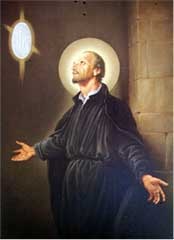
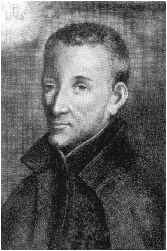
Born in Fontcouverte, France, on January 31, 1597,Jean-François Régis was the son of a rich merchant. He studied at the Jesuit college of Béziers, joined the order in 1615, and was ordained in 1631. He was assigned to missionary work in southeastern France and became renowned for his fervor, preaching ability, and as a confessor.

He brought thousands back to their faith, and everywhere he went he was followed by large crowds. He also ministered to the sick in hospitals and to prisoners, organized groups to help the needy, and founded a refuge for prostitutes called “Daughters of Refuge.” He performed numerous miracles, but humbly commented, “Every time that God converts a hardened sinner He is working a far greater miracle.”

In September 1640, John had a premonition of his death and spent the next three days in retreat, making a general confession. He continued on with his missionary work, however, and in December preached tirelessly in a remote mountain village throughout the Christmas season, despite the fact that he had developed pleurisy and pneumonia. He eventually collapsed after leaving the pulpit and died four days later, his last words being “Jesus, my Savior, I recommend my soul to You.”

On the occasion of a juridical deposition regarding two miracles St. John had performed, a man who had lodged with him declared before two bishops: “His whole behavior breathed sanctity. Men could neither see nor hear him without being inflamed with the love of God. He celebrated the divine mysteries with such devotion that he seemed like an angel at the altar. I have observed him in familiar intercourse become silent and recollected, and all on fire: then speaking of God with a fervor and rapidity that proved his heart to be carried away with an impulse from heaven.”

St. John’s tomb at La Louvesc became the site of many miracles, and remains to this day a popular site of pilgrimage.


Saint of the Day - St. Basil the Great

6/14/2014

 
Picture
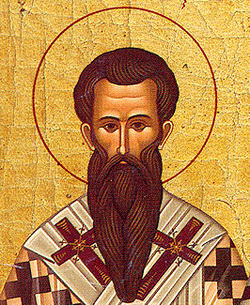
St. Basil the Great, bishop, confessor, and doctor of the Church, renowned for his learning and wisdom and gifted with every virtue, who during the reign of Emperor Valens wonderfully displayed his talents as he defended the Church with great constancy against the Arians and Macedonians. His feast, is appropriately kept on the 14th of June, the day on which he was consecrated bishop.

Basil ranks among the greatest figures in church history and the rather extravagant panegyric by Gregory of Nazianzus has been all but equalled by a host of other eulogists. Physically delicate and occupying his exalted position but a few years, Basil did magnificent and enduring work in an age of more violent world convulsions than Christianity has since experienced. (Cf. Newman, The Church of the Fathers). By personal virtue he attained distinction in an age of saints; and his purity, his monastic fervour, his stern simplicity, his friendship for the poor became traditional in the history of Christian asceticism. In fact, the impress of his genius was stamped indelibly on the Oriental conception of religious life. In his hands the great metropolitan see of Caesarea took shape as the sort of model of the Christian diocese; there was hardly any detail of episcopal activity in which he failed to mark out guiding lines and to give splendid example. Not the least of his glories is the fact that toward the officials of the State he maintained that fearless dignity and independence which later history has shown to be an indispensable condition of healthy life in the Catholic episcopate.

Some difficulty has arisen out of the correspondence of St. Basil with the Roman See. That he was in communion with the Western bishops and that he wrote repeatedly to Rome asking that steps be taken to assist the Eastern Church in her struggle with schismatics and heretics is undoubted; but the disappointing result of his appeals drew from him certain words which require explanation. Evidently he was deeply chagrined that Pope Damasus on the one hand hesitated to condemn Marcellus and the Eustathians, and on the other preferred Paulinus to Meletius in whose right to the See of Antioch St. Basil most firmly believed. At the best it must be admitted that St. Basil criticized the pope freely in a private letter to Eusebius of Samosata (Ep. ccxxxix) and that he was indignant as well as hurt at the failure of his attempt to obtain help from the West. Later on, however, he must have recognized that in some respects he had been hasty; in any event, his strong emphasis of the influence which the Roman See could exercise over the Eastern bishops, and his abstaining from a charge of anything like usurpation are great facts that stand out obviously in the story of the disagreement. With regard to the question of his association with the Semi-Arians, Philostorgius speaks of him as championing the Semi-Arian cause, and Newman says he seems unavoidably to have Arianized the first thirty years of his life. The explanation of this, as well as of the disagreement with the Holy See, must be sought in a careful study of the times, with due reference to the unsettled and changeable condition of theological distinctions, the lack of anything like a final pronouncement by the Church's defining power, the "lingering imperfections of the Saints" (Newman), the substantial orthodoxy of many of the so-called Semi-Arians, and above all the great plan which Basil was steadily pursuing of effecting unity in a disturbed and divided Christendom.

St Basil is included in the 33 Doctors of the Church Book below

The 33 Doctors of the Church

The 33 Doctors of the Church

The 33 Doctors of the Church. Here are 33 chapters about the greatest minds and greatest Saints the Catholic Church has ever produced. Written in a down-to-earth style, The 33 Doctors of the Church is a book that will be loved and appreciated by everyone. This monumental study could easily become 33 small books. But here it is in one compelling volume! Includes St. Athanasius, the defender of the doctrine of Christ's divinity, who was banished 5 times from his diocese for fidelity to Catholic teaching. In a moment of weakness, Pope Liberius even signed his condemnation! Impr. 715 pgs, PB


Saint of the Day - St. Anthony of Padua

6/12/2014

 
Picture
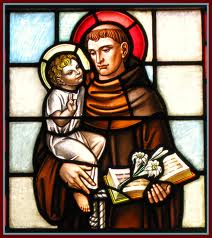
Anthony was born of decent parents at Lisbon in Portugal. They gave him a godly training, and while he was still a young man, he joined an Institute of Canons Regular. However, when the bodies of the five holy martyred Friars Minor, who had just suffered in Morocco for Christ's sake, were brought to Coïmbra, the desire to be himself a martyr took a strong hold upon him, and he left the Canons Regular and became a Franciscan. The same yearning led him to attempt to go among the Saracens, but he fell sick on the way, and being obliged to turn back, the ship in which he had embarked for Spain was driven by stress of weather to Sicily.

From Sicily he came to Assisi to attend the General Chapter of his Order, and thence withdrew himself to the Hermitage of Monte Paolo near Bologna, where he gave himself up for a long while to consideration of the things of God, to fastings, and to watchings. Being afterward ordained Priest, and sent to preach the Gospel, his wisdom and fluency were very marked, and drew on him such admiration of men, that the Pope, once hearing him preach, called him The Ark of the Covenant. One of his chief points was to expend all his strength in attacking heresies, whence he gained the name of the Heretics' everlasting Hammer.

He was the first of his Order who, on account of his excellent gift of teaching, publicly lectured at Bologna on the interpretation of Holy Scripture, and directed the studies of his brethren. He travelled through many provinces. The year before his death he came to Padua, where he left some remarkable records of his holy life. After having undergone much toil for the glory of God, full of good works and miracles, he fell asleep in the Lord upon the 13th day of June, in the year of salvation 1231. Pope Gregory IX enrolled his name among those of the Holy Confessors, and Pius XII, having consulted the Congregation of Sacred Rites, declared him a Doctor of the universal Church.

A Homily by St. Augustine the Bishop
on Mathhew Chap. 5, 13-19
Lib. 1 de Sermone Domini in monte, cap. 6


The Lord would have us understand how that men do lose their power of savouring others with righteousness when they are willing to place their eternal welfare in jeopardy for the sake of any temporal advantage, like as attainment of ease or luxury, or escape from suffering or toil. For that which is eternal, unlike things of this world, can neither be bestowed by men, nor by them taken away. Hence, when he asketh: If the salt have lost his savour, wherewith shall it be salted? he would have us understand the question to be: If ye, by whom mankind is preserved from corruption, be willing to lose the kingdom of heaven so as to escape trials or persecutions in this world, who is there to preserve you from corruption, seeing ye are they that God hath chosen to preserve all others from corruption?

Those that should be the salt of the earth, but have lost their savour, are thenceforth good for nothing, but to be cast out, and to be trodden under foot of men. But no one that suffereth persecution is truly said to be trodden under foot of men. Rather, that one is truly trodden under foot of men who through fear of persecution hath lost the savour of righteousness. For no one can be trodden upon, unless he be beneath him which treadeth upon him. And certainly no one who hath his heart in heaven, no matter how grievously he doth suffer in his body on earth, is rightly said to be beneath anyone who misuseth him.

Ye are the light of the world. And we are to understand the word World in the same sense as the word Earth when he spoke above of the salt of the earth, that is, not that earth whereupon we walk with our bodily feet, but the men which dwell upon the earth; in other words, sinners, for the sweetening and correction of whose corruption, the Lord hath sent his Apostles, as it were, as so much salt. And so by the world we are to understand, not the heaven and the earth, but the men who are in the world and love the world, for the enlightening of whom the Apostles have been sent. A city that is set on a hill cannot be hid: that is, what is founded upon the heights of righteousness, whereof the mountain upon which the Lord gave this discourse was itself a figure, is magnificent in the eyes of all men.


Saint for Today - St Norbert

6/6/2014

 
Picture
Norbert, born of parents of the highest rank, thoroughly educated in his youth in worldly knowledge, and a member of the Imperial court, turned his back upon the glory of the world, and chose rather to enlist himself as a soldier of the Church.  Being ordained Priest, he laid aside all soft and showy raiment, clad himself in a coat of skins, and made the preaching of the Word of God the one object of his life.  He had the right to rich revenues of the Church; but these he renounced: and to an ample fortune from his father; but this he gave to the poor.  He ate only once a day, and that in the evening, and then his meal was of the fare of Lent.  His life was one of singular hardness, and he was used even in the depth of winter to go out with bare feet and ragged garments.  Hence came that mighty power of his words and deeds, whereby he was enabled to turn countless heretics to the true faith, sinners to repentance, and enemies to peace and brotherly love.

Being one while at Laon, the Bishop besought him not to leave his diocese, and he therefore made choice of a wilderness at the place called Prémontré, whither he withdrew himself with thirteen disciples, and thus founded the Order of the Premonstratensian Canons, whereof he, by the will of God, received the Rule, in a vision, from St. Augustine.  When, however, the fame of his holy life became every day more and more noised abroad, and great numbers sought to become his disciples, and the Order had been approved by Honorius II, and other Popes, many more monasteries were built by him, and the Institute wonderfully extended.

Being called to Antwerp, he there gave the death-blow to the shameful heresy of Tanchelin.  He was remarkable for the spirit of prophecy and for the gift of miracles.  He was created (albeit he would rather not have had it so) Archbishop of Magdeburg, and as such he was a strong upholder of the discipline of the Church, especially contending against the marriage of the clergy.  At a Council held at Rheims he as a great help to Innocent II, and went with some other Bishops to Rome, where they stamped out the schism of Pierleone.  It was at last at Magdeburg that this man of God, full of good works and of the Holy Ghost, fell asleep in the Lord, on the 6th day of June, in the year of salvation 1134.

Saint for Today - St Boniface

6/5/2014

 
Picture
Boniface, originally called Winfrid,, was born in England towards the end of the seventh century.  After entering a monastery and becoming a priest, he shewed great skill in winning souls through preaching.  Burning with zeal to spread the faith, he preached the Gospel among the Frisians.  Then he returned to England, where he ruled his monastery for two years in a most holy manner.  Having resigned the office of Superior, he went to Rome, where he received from Gregory II the name of Boniface and the commission to proclaim Christ to the peoples of Thuringia and Saxony.  With holy Willibrord, he returned to the Frisians and preached the Gospel with great fruit.  Soon he was summoned to Rome and invested with the episcopal dignity; after which, he set out once more for Germany.  There he rid Hesse and Thuringia of almost the last vestiges of idolatry.  He was made apostolic delegate and Archbishop of Mainz, and he built many churches, and administered them either personally or through his disciples.  At length, he went back once again to the Frisians, who had lapsed into idolatry, to preach the Gospel to them.  There, with Eobanus his fellow bishop and many others, he was killed in a bloody massacre near the River Born and received the crown of martyrdom.  His body lieth in the monastery of Fulda.

Saint for Today - St Francis Caracciolo

6/4/2014

 
Picture
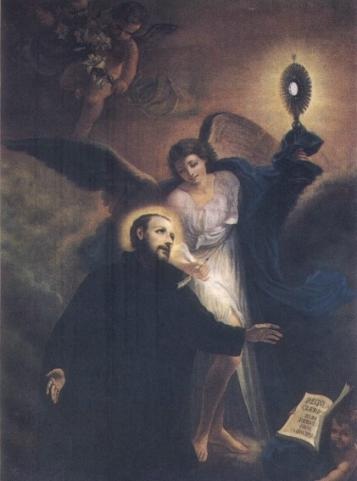
Francis, whose worldly name was Ascanio, was one of the noble family of Caracciolo.  He was born in the town of Santa María della Villa, in the Abruzzi.  From his earliest years he shewed great marks of godliness.  When he was a young man he had a severe illness, and on his recovery determined to serve God only, and bade farewell to the world.  He betook himself to Naples, where he was ordained Priest, enrolled himself in a devout guild, and gave himself up altogether to seek after God, and to gain souls for him, in which work he shewed himself an unwearied comforter to such prisoners as were condemned to death.  It came to pass that those two great servants of God, John Augustine Adorno and Fabrizio Caracciolo, wrote a letter to a certain person, wherein they exhorted him to found a new religious Institute.  This letter came by a mistake to be delivered to Francis Caracciolo.  The newness of the idea and the strange ways of God's Providence took possession of his mind, and he joyfully added himself to their company.  They withdrew themselves to the wilderness of the Camaldolese hermits and there concerted the Rule of the New Order.  Thence they went together to Rome, and obtained the confirmation of their work from Sixtus V, who was pleased that they should be called the Clerks Regular Minor, since they add to the three accustomed vows a fourth, binding themselves not to seek preferment in the Church.

Ascanio Caracciolo, moved by a special love and devotion he had to the holy Francis of Assisi, took, when he made his solemn profession, the name of Francis.  After two years, John Adorno departed this life, and Francis, against his own will, was made Head of the Order.  In this office he shone a burning light of grace.  Devoted to the prosperity of the Institute, he earnestly sought the blessing of God upon it, by constant prayer, by tears, and by stern treatment of his own body.  In this work, he thrice travelled into Spain in the guise of a pilgrim, and begging his bread from door to door.  In these his journeys he suffered very great hardships, and was most wonderfully holpen of the Almighty, especially one while when he was on shipboard and the ship nigh to perish, but for the work of his prayers.  He toiled hard in those countries to attain his wishes, but through the widespread fame of his holy life, and the noble generosity of the Most Catholic Kings Philip II and Philip III, he overcame with his brave perseverance the opposition of all that withstood him, and founded several houses of his Order.  This he was able to do in Italy also.

He was a great pattern of lowliness, so that when he came to Rome he betook himself to an almshouse, and chose a leper for his familiar friend.  Paul V offered him divers honours in the Church, but he firmly refused them all.  He preserved his purity unspotted, and when certain shameless women set themselves to attack his chastity, he took the occasion to gain over their souls for Christ.  Toward God's great mystery of the Eucharist he was drawn with passionate tenderness, and would pass almost whole nights without sleep, simply adoring it.  This godly custom he established in his Order, to be kept up therein for ever, the peculiar mark thereof.  He was a great encourager of the worship of the Maiden Mother of God.  He was hot with strong love for his neighbour.  He was gifted with prophecy, and the discerning of spirits.  In the forty-fourth year of his age he was continuing long in prayer in the Holy House of Loreto, when it was made known to him that the end of his earthly life was at hand.  He straightway took his way to the Abruzzi, and was there seized with illness while he was with the disciples of St. Philip Neri, in the town of Agnone.  He received with great devotion the Sacraments of the Church, and then, upon the 4th day of June, being the Eve of the Feast of the Body of Christ, in the year 1608, he very peacefully fell asleep in the Lord.  His sacred body was carried to Naples, and there honourably buried in the Church of St. Mary Major, where he had laid the first foundations of his Order.  As he became distinguished for miracles Pope Clement XIV enrolled his name, with solemn pomp, among those of the Blessed, and Pope Pius VII, in the year 1807, finding his mighty works continue, added it to the list of the Saints.

Picture

Saint for Today - St Marcellinus and Companions

6/2/2014

 
PictureSt. Erasmus (left) with St. Maurice
Peter was an exorcist, whom, in the reign of the Emperor Diocletian, Serenus the Judge cast into prison at Rome because he confessed the Christian faith.  He there set free Paulina, the daughter of Artemius, the keeper of the prison, from an evil spirit which tormented her.  Upon this, Artemius and his wife and all their house, with their neighbours who had run together to see the strange thing, would fain be made friends with Jesus Christ.  Peter therefore brought them to Marcellinus, the Priest, who baptized them all.  When Serenus heard of it, he called Peter and Marcellinus before him, and sharply rebuked them, adding to his bitter words threats and terrors, unless they would deny Christ.  Marcellinus answered him with Christian boldness, whereupon he caused him to be buffeted, separated him from Peter and shut him up naked in a prison strewn with broken glass, without either food or light.  Peter also he straitly confined.  But when both of them were found to wax faithfuller and braver in their bonds, they were beheaded, unshaken in their testimony, and confessing Jesus Christ gloriously by their blood.  Erasmus was a Bishop in Campánia who, in the reign of the Emperors Diocletian and Maximian was beaten with clubs and whips loaded with lead, and afterwards anointed with melted pitch, sulphur, and lead, and boiling resin, wax, and oil.  From all this he came forth whole and sound; which wonder turned many to believe in Christ.  He was remanded again to prison, and straitly bound in heavy iron fetters, and from these he was wondrously delivered by an angel.  At last, at Formi, Maximian caused him to be subjected to divers torments, and in the end being clad in a coat of red-hot brass the power of God made him to be more than conqueror in this thing also, and to grasp the palm-branch of a glorious testimony, whereby he strengthened many in the faith and turned many to it.

Picture

Saint of the Day: Sts. Peter and Paul

6/29/2013

 
Picture
The Lesson is taken from a Sermon by St. Leo the Pope

Dearly beloved, in the joy of each and every holy feast the whole world may have a share.  For there is but one love of God, and whatsoever is solemnly called to memory, if it hath been done for the salvation of all, must needs be worth the honour of a joyful memorial at the hands of all.  Nevertheless, this feast which we are keeping today, besides that world-wide worship which it doth of right get throughout all the earth, deserveth from this our City of Rome an outburst of gladness altogether special and our own.  For in this place it was that the two chiefest of the Apostles did so right gloriously finish their race.  And upon this day whereon they lifted up that their last testimony, let it be that the memory thereof receiveth in this place the chiefest of all its jubilant  celebrations.  O Rome! these twain are the men who brought the light of the Gospel of Christ to shine upon thee!  These are they by whom thou, from being the teacher of lies, wast turned into a learner of the truth.

These twain are thy fathers; they truly are thy shepherds!  These twain are they who laid foundations for thee (that thou mightest upbuild the kingdom of heaven) better and happier than did the Romulus (from whom thou art named), when he first planned thine earthly ramparts; which same he polluted with his brother's blood.  These twain are they who have set on thine head this day thy glorious crown, so that thou art become an holy nation, a chosen people, a city both priestly and kingly, whom the sacred throne of blessed Peter hath exalted till thou art become the Lady of the world, unto whom the world-wide love for God hath conceded a broader lordship than is the possession of any mere earthly empire.  Thou wast once waxen great by victories until thy power was spread haughtily over land sea, but thy power was narrower then, which the toils of war had won for thee, than that thou now hast which hath been laid at thy feet by the peace of Christ.

It was convenient for the doing of the work which God had decreed, that the whole multitude of kingdoms should be bound together under one rule, and that so the universal preaching of the Gospel should find easier entry unto all people, since all were governed by the empire of one city.  But this City, knowing not him who had been pleased to make her great, used her lordship over almost all nations to make herself the minister of all their falsehoods; and seemed to herself exceedingly godly because there was no false god whom she rejected.  But the tighter that Satan had bound her, the more wondrous was the work of Christ in setting her free.


HELP SUPPORT OUR WEBSITE WITH PURCHASES
FROM OUR BOOK AND GIFT STORE


Download AVG Internet Security Free Trial

Saint of the Day: St Iranaeus

6/28/2013

 
Picture
Irenaeus was born in proconsular Asia, not far from the city of Smyrna.  There he had already as a boy entrusted himself to the teaching of Polycarp, disciple of John the Evangelist, and bishop of Smyrna.  Under such an excellent master, he made remarkable progress in learning and in the precepts of the Christian religion.  When Polycarp was taken up to heaven by a glorious martyrdom, although Irenaeus was eminently versed in sacred letters, nevertheless, he burned with an incredible zeal to learn what articles of belief the others who were instructed by the Apostles had received, to be preserved in the deposit of faith.  For this reason he brought together as many of those men as he could, and whatever things he heard from them, he carefully retained in his mind.  Thus he could advantageously bring them to bear in the future against those heresies, which he saw were being diffused more widely day by day to the great detriment of the Christian people, and he diligently planned thoroughly to confute them.  Then, having set out for Gaul, he was appointed as a priest of the church of Lyons by Pothinus the bishop.  And this office he discharged in such a manner, labouring both by word and by teaching, that (according to the testimony of the holy Martyrs who, when Marcus Aurelius was emperor, were engaged in a vigorous combat for the true religion) he distinguished himself as an imitator of the testament of Christ.

These very Martyrs, together with the clergy of Lyons, began to be anxious concerning the peace of the churches of Asia, which the faction of the Montanists had disturbed.  And so they selected Irenaeus, whose person they considered of the greatest importance, as the one before all others whom they should send to Rome to Pope Eleutherius to ask, that, with the condemnation of the new dissidents by the authority of the Apostolic See, the cause of the dissensions might be removed.  Already the bishop Pothinus had died a martyr and Irenaeus succeeded him.  He applied himself so well to the duties of a bishop, that in a short time he saw not only all the citizens of Lyons, but also many of the inhabitants of other cities in Gaul cast aside their superstitions and errors, and enroll themselves in the Christian army.  Meanwhile, a dispute had arisen concerning the date of the celebration of Easter.  As the bishops of Asia were disagreeing with nearly all their fellow-bishops, the Roman Pontiff Victor had cut them off from the communion of the faithful.  Irenaeus, however, who was zealous for peace, admonished him in a becoming manner, and urged, by examples of the practice of previous Pontiffs, that he should not suffer so many Churches to be cut off from Catholic unity, on account of a rite which they said they had received from their ancestors.

He wrote many works, which are mentioned by Eusebius of Caesarea and by St. Jerome, a great part of which have perished through the ravages of time.  There are extant five books of his against heresies, written down about the year 180, while Eleutherius was still ruling the Christian commonwealth.  In the third book, the man of God, instructed by those who, it is certain, had been hearers of the Apostles, gives to the Roman Church and to the succession of her bishops a testimony surpassing all others in weight and brilliancy, when he calleth her the faithful, perpetual, and most assured guardian of divine tradition.  For he said, that with this Church it is necessary that the whole Church (that is, those in all places who are of the faithful) should agree, because of its more powerful preeminence.  At length with almost countless others, whom he had himself brought over to the true faith and its practice, being crowned with martyrdom he passed to heaven in the year of salvation 202.  At that time Septimius Severus Augustus had commanded that all those who wished to remain constantly steadfast in the practice of the Christian religion should be condemned to the most cruel torments and to death.  The supreme Pontiff Benedict XV extended the feast of St. Irenaeus to the universal Church.

<<Previous
Forward>>


    archbishop lefebvre
    Click to see more

    Enter your email address for daily posts:

    Delivered by FeedBurner

    Archives

    December 2014
    October 2014
    September 2014
    August 2014
    July 2014
    June 2014
    May 2014
    April 2014
    March 2014
    February 2014
    January 2014
    December 2013
    November 2013
    October 2013
    September 2013
    August 2013
    July 2013
    June 2013
    May 2013

    Categories

    All
    Apologetics
    Archbishop Lefebvre
    Bishop Williamson
    Blessed Sacrament
    Catechism
    Catholic History
    Chalk Talks
    Chastisement
    Devotions
    Easter
    Eleison Comments
    Eleison Comments
    Eleison Comments Italian
    Encyclicals
    Espanol Eleison Comments
    Families
    Fatima
    Feast Days
    For Fathers (Dads)
    For Moms
    Fortitude
    Holy Ghost
    Holy Name
    Holy Souls
    Holy Week
    Home Schooling
    Lent
    Liberalism
    Litanies
    Liturgy
    Marriage
    Martyrology
    Martyrs
    Mass
    Meditations Of Abl
    Modesty
    News
    New World Order
    Obedience
    Our Lady
    Our Lady Of Quito
    Our Lord
    Pentecost
    Pioneer Priests
    Prayers
    Sacramentals
    Sacraments
    Sacred Heart
    Saint Of The Day
    Saints For April
    Saints For August
    Saints For December
    Saints For February
    Saints For January
    Saints For July
    Saints For June
    Saints For March
    Saints For May
    Saints For November
    Saints For October
    Saints For September
    Scandal
    Scapular
    Sermons
    Sspx
    St Benedict
    St Joseph
    St Michael
    St Michael
    Sundays Of The Year
    Temptations
    The Church
    The Last Things
    The Mass
    The Pope
    The Rosary
    The Saints
    The Virtues
    Tradcat Comments
    Truth Society

    Picture
    Click to see inside the store
    Picture
    k d
    Counter Site
    While Archbishop Lefebvre Blog is provided free of charge, there are administrative and technical costs associated with making it available to subscribers worldwide and with operating this site. Contributions to offset these costs are appreciated, and may be made via the button below

    Archbishop Lefebvre

    Promote Your Page Too
Powered by Create your own unique website with customizable templates.