ArchbishopLefebvre.com
Links
  • Archbishop Lefebvre
    • Biography of Archbishop Lefebvre
    • Who is he?
    • In his own words
  • Sermons
    • Sunday Sermons
  • Letters
    • Archbishop Lefebvre >
      • To Friends and Benefactors
      • Other Letters
    • Bishop Williamson >
      • Friends and Benefactors
      • Eleison Comments >
        • Italiano
        • Espanol
      • To SSPX Priests
  • Blog
  • Books
    • E-Books
    • Free Catholic Books
    • Archbishop Lefebvre
    • Bibles
    • Blessed Sacrament
    • Children Books
    • Childrens Saints
    • DVDs
    • Hell
    • Purgatory
    • Our Lady
    • Sacred Heart
    • Missals
    • Missale Romanum
    • Summa Theologica
    • Saints
  • Catholic Faith
    • Catechisms
    • Catholic Art
    • Chant
    • Dogmas of the Catholic Church
    • Encyclicals
    • Sermons
    • History >
      • HughesVol1index
    • Liturgy
    • Sacraments
    • Prayers >
      • Blessings
    • Way of the Cross
  • SSPX Crisis
    • sspx Archbishop Lefebvre
    • monks nuns
    • SSPX Bishop Fellay
    • SSPX Bishop Tissier
    • ex-sspx Bishop Williamson
    • ex-sspx chazal
    • sspx couture
    • sspx fox
    • ex-sspx fuchs
    • ex-sspx girouard
    • ex-sspx hewko
    • sspx laisney
    • sspx ockerse
    • ex-sspx pfeiffer
    • sspx themann
    • Fr. Ringrose
  • Links
    • Other Sites
    • Donate
    • Facebook
    • Twitter
    • You Tube
  • TradCat Items
    • Beeswax Candles
    • Chapel Veils
    • Prayer Cards - Our Lady
    • Prayer Cards - Espanol
    • Protected Scapulars
    • Scapulars
    • Unbreakable Rosaries
  • Crisis in Church
    • Declaration of the 2006 Chapter (SSPX)
    • Fr Hewko to SSPX Superiors
    • History of the Archbishop and Rome
    • Vatican II more important than Nicea!
    • The Archbishop and Religious Liberty
    • The right to resist an abuse of power
    • How Are Catholics To Respond To The Present Crisis

The Eucharistic Heart I

6/5/2013

 
Picture
Meditations of Blessed Peter Julian Eymard
Imprimatur + Daniel Mannix Oct 27,1944

Cor meum ibi cunctis diebus.

My heart shall be there always.

(3 Kings ix, 3.)

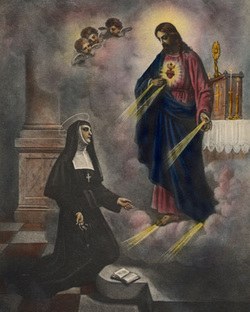
SAINT PAUL expressed a wish to the Ephesians that, through the grace of the Father, from Whom proceeds every gift, they should know the charity of Jesus Christ for men, "which surpasseth all knowledge." He could not wish them anything holier, or better, or more important. To know the charity of Jesus Christ, to be filled with the fullness of it, that is the reign of God in man. And that reign is the fruit of devotion to the Heart of Jesus, living—and loving us—in the Most Blessed Sacrament. This devotion is the sovereign worship of love. It is the soul and centre of all religion; for religion is merely the law, the virtue, and the perfection of love; and the Sacred Heart is the grace, the model, and the life of it. Let us study this love close to the fire where it consumes itself for us.

Devotion to, the Sacred Heart has a twofold object:

It honours first with adoration and public worship the Heart of flesh of Jesus Christ.

And secondly the infinite love with which this heart has burned for us since its creation, and with which still consumed on our altars.

Of all the noble faculties of the human body, the noblest is the heart. It is placed in the centre of the body like a king in the centre of his dominions. Immediately surrounding it are its most important members, which are, so to speak, its ministers. It sets them in motion and makes them function by imparting to them the vital warmth of which it is the reservoir. It is the fountain-head from which there gushes forth with impetuosity the blood that flows into all the parts of the body, and bathes and refreshes them. Weakened by this function, the blood returns from the extremities of the body to the heart to rekindle its ardour and receive a new supply of life-giving energy.

What is true of the human heart in general is also true of the adorable Heart of Jesus Christ. It is the noblest part of the body of the Man-God, united hypostatically to the Word and deserving thereby the supreme worship of adoration which is due God alone. It important that in our veneration we should not separate the Heart of Jesus from the divinity of the Man-God; for it is united to the divinity with indissoluble bonds, and the worship we pay to the Heart has not its final end in that Heart, but In the adorable Person Who possesses it and Who has united it to Himself forever

Whence it follows that we may direct to this divine Heart the prayers, praises and adorations we offer to God Himself. And it also follows that they are mistaken who, on hearing the words "The Heart of Jesus," think only of the material organ and look on this Heart only as a lifeless and loveless member, much as they would on a holy relic. They are again mistaken who imagine that this devotion divides Jesus Christ and restricts to His Heart alone a worship that ought to be offered to His whole Person. They overlook the fact that to honour the Heart of Jesus is not to ignore 'the rest of the divine body of the God-Man; for when we honour His Heart, we mean to praise all the actions and the whole life of Jesus Christ, which are but an outpouring of His Heart.

Just as it is in the sun that are formed and from it that issue forth the warm rays which fertilise the earth and give life to everything that lives, so it is from the heart that come forth the strong and gentle impulses which carry vital warmth and vigour into all the members. If the heart weakens, the whole body weakens with it. If the heart suffers, all the members suffer with it, nothing functions well, and the organic system soon stops working. The function of the Heart of Jesus was then to quicken, to strengthen, and to sustain all His members, all His organs, and all His senses by its constant action; so that it was the principle of the actions, affections, virtues and of the whole life of the Word made flesh.

For the heart, according to the opinion of ancient philosophers, is the seat of love; and since the prime motive of the whole life of Jesus was love, we must look upon His Heart as the source of all His mysteries and virtues. "Just as it is natural for fire to burn," says Saint Thomas, "so it is natural for the heart to love; and because the heart is the primary organ of feeling in man, it is fitting that the act which is commanded by the first of all the commandments should be felt by the heart."

Just as the eyes see and the ears hear, so the heart loves. It is the organ of the soul in the production of affection and love. In the vernacular, heart and love are interchangeable terms; heart means love, and vice versa. The Heart of Jesus was, therefore, the organ of His love. It co-operated with His love; it was the principle and seat of it. It experienced all the impressions of love that can touch a human heart, with this difference, however, that since the soul of Jesus Christ loved with an unparalleled and infinite love, His Heart is a real furnace of love for God and for us. From it are constantly darting forth the most ardent and purest flames of divine love. This love inflamed His Heart from the first moment of His conception until His last breath and, since His Resurrection, has not ceased nor will ever cease doing so. His Heart made and is daily making countless acts of love, a single one of which gives more glory to God than all the acts of love of the angels and saints. Of all material creatures, His Heart is then the one that contributes the most to the glory of the Creator and that is the most deserving of the love and worship of angels and men.

Everything that pertains to the Person of the Son of God is infinitely worthy of veneration. The least portion of His body, the tiniest drop of His blood is deserving of the adoration of heaven and earth. The most worthless things become worthy of the veneration by mere contact with His flesh, as was the case with the Cross, the nails, the thorns, the sponge, the lance and all the instruments of His death. How much greater veneration, therefore, ought we to offer then His Heart, the excellence of which is founded on the nobleness of the functions it performs, on the perfection of the sentiments it gives rise to, and of the actions it inspires! For if Jesus was born in a stable, lived as a poor man at Nazareth, and died for our sake, we owe it to His Heart; it is in the sanctuary of His Heart that were formed all the heroic resolutions and all the plans which inspired His life. His Heart must therefore be honoured as the Crib in which the faithful soul sees Jesus being born into the world, poor and forsaken; as the pulpit from which the Lord Jesus preaches His commandment to her: "Learn of Me that I am meek and humble of heart"; as the Cross on which she sees Him die; as the tomb from which she sees Him rise glorious and immortal; and as the everlasting Gospel by which she is taught to imitate all the virtues of which this Heart is the accomplished model.

A soul devoted to the Sacred Heart will, however apply himself in a special manner to the practice of divine love, because this Heart is above all the seat and the symbol of this love. And since the Most Blessed Sacrament is the sensible and permanent token of divine love, it is there the soul will find the Heart of Jesus from His Eucharistic Heart she will learn to love.

Continued..........


The Way of Divine Love - Large Edition

The Way of Divine Love - Large Edition

Twentieth century revelations of the Sacred Heart of Jesus to a young Spanish nun. Undoubtedly TAN's most inspiring and influential book. Makes lasting devotees. In print since 1949. Impr. 532 pgs, PB


If God Is Loving, Why Is There Evil?

5/21/2013

 
Picture
If God is loving, just, and all-powerful, why does He permit moral evil, or sin?Because God is Love, He asks the freely given love of man, and not a compelled love. Because He is just, He will not deprive man of the free will which is in accordance with his rational nature. Nor is this against the omnipotence of God, for even His power does not extend to contradictory things.

Man cannot be free to love and serve God, without being free to reject Him and rebel against Him. We cannot have it both ways. Even God, if He wants men to be free, cannot take from them the power to choose evil.

If He enforces goodness, He takes away freedom. If He leaves freedom, He must permit evil, even though He forbids it. It is man's dignity that he is master of his own destiny instead of having to develop just like a tree which necessarily obeys natural law.

Men, as a matter of fact, misused their freedom, and sin and brutality resulted. But it was impossible to give man the gift of freedom and the dignity of being master of his own destiny without risking the permission of such failures

What Is Meant By A New Heaven And Earth?

5/20/2013

 
Picture
Even were the present universe left as it is, every soul that goes out of this life must see a new heavens and a new earth, if only because it will see things from a completely different aspect.

Science tells us that the atoms and molecules of even the most rigid objects are in motion and at an incalculable speed. If the soul could get a truly scientific vision of the dance of atoms and molecules, and of the very stars, it would certainly see the universe under a very new aspect. But the change to come should not only be attributed to the changed condition of the soul.

There will be a change in the actual scheme of earth and the heavens. There will be a new order, and a perfect adaptation of all things to a new end. Christ will be the organizer, as He has organized the Church and humanity. It is quite possible that all may be spiritualized and submitted to the elect, the elect to Christ, and Christ to God.

Thus, St. Paul himself says that all creation waits for the manifestation of the children of God. Exactly what will occur, of course, is a mystery which God has not deigned to reveal. But He has revealed the fact that Christ will come again in some glorious way to judge mankind. And we Catholics accept that fact on the authority of God's word.

Will Heaven Pass Away as Our Lord said?

5/20/2013

 
Picture
No. Our Lord was referring to the heavens, not to heaven as a state of eternal happiness.

The visible universe as we see it now is in a state of transition. At least in its present formation it will pass away sooner or later, even by merely natural processes. But apart from this, the final coming of Christ will mean a shock to the existing visible order of things, and a vast change in it. Through all such changes, however, the doctrine of Christ remains unchangeably true, and all that He has taught will most certainly be verified.

Did Christ Have Brothers And Sisters?

5/19/2013

 
Picture
Objection...I think the brothers and sisters referred to as his brethren were the children of Joseph and Mary after Jesus was born.

There is no reason to think otherwise.There is every reason to think otherwise.

  1. Firstly, the so-called brethren of Jesus are depicted by the Gospel texts as older than He Himself, criticizing and advising Him, and jealous of His popularity.
  2. Secondly, when the offer was made to Mary that she should become the Mother of the Messiah, she said, "How shall this be done, because I know not man." Almighty God provided miraculously that she should become the Mother without sacrificing her virginity. She was not likely to sacrifice it later on for other children so much less than the very Son of God. As that Son was the only-begotten of His Eternal Father, so He would be the only-begotten of His earthly Mother.
  3. Thirdly, Jesus alone in the Gospels is called the Son of Mary; and never once is she called the Mother of the brethren of the Lord.
  4. Fourthly, the only four brethren mentioned by name are James and Joseph, Simon and Jude. Now St. John tells us that there stood by the Cross of Jesus His Mother, and His Mother's sister, Mary of Cleophas. And this latter is referred to by St. Matthew as the mother of James and Joseph. Again, if you look up the first words of St. Jude's Epistle you will find him saying, "Jude, the servant of Jesus Christ, and brother of James." Why did he make that distinction? Finally, if James and Joseph, Simon and Jude, were direct children of Mary, and if there were yet other brethren and sisters of Jesus in your sense of the word, why did Jesus commit His Mother to the care of St. John after His death, so that John took her as his own mother thenceforth? That would not be necessary if she had other children to look after her.

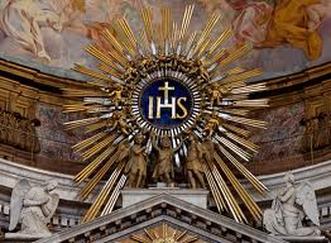
What Does The Symbol IHS Mean?

5/18/2013

 
Picture
I've seen the acronym IHS all over the place--on altar cloths, holy cards, vestments, and prayerbooks -- but I have no idea what it stands for. A friend signs his letters "IHS" and says it means "In His Service." What's the scoop?

IHS is the anglicized rendering of the first three Greek letters in Jesus' name. In the early Church, especially during the time of the Roman persecution, this became a popular way of writing Jesus' name as a sort of code. Since then it has become a universally-used insignia and shows up on all types of Catholic religious art and accoutrements. After a few centuries, when the monogram was integrated into the general Latin usage of the Church, many were unacquainted with the original meaning and wrongly believed it meant, in Latin, Iesus Hominum Salvator (Jesus, Savior of Humanity), Iesus Hierosolyma Salvator (Jesus, Savior of Jerusalem), and even the exquisitely banal English version your friend favors, In His Service.

Sermon at Lille November 1976

5/12/2013

 
Archbishop Lefebvre

Sermon at Lille 1976

My Dear Brethren,

Before addressing a few words of exhortation to you, I should like first to dispel some misunderstandings. And to begin with, about this very gathering.

You can see from the simplicity of this ceremony that we made no preparations for a ceremony which would have gathered a crowd like the one in this hall. I thought I should be saying Holy Mass on the 29 August as it had been arranged, before a few hundreds of the faithful of the Lille region, as I have done often in France, Europe, and even America, with no fuss.

Yet all of a sudden this date, 29 August, through press, radio and television, has become a kind of demonstration, resembling, so they say, a challenge. Not at all: this demonstration is not a challenge. This demonstration is what you wanted, dear Catholic brethren, who have come from long distances. Why? To manifest your Catholic faith; to manifest your belief; to manifest your desire to pray and to sanctify yourselves as did your fathers in faith, as did generations and gen­erations before you. That is the real object of this ceremony, during which we desire to pray, pray with all our heart, adore Our Lord Je­sus Christ Who in a few moments will come down on this altar and will renew the sacrifice of the Cross which we so much need.

I should like also to dispel another misunderstanding. Here I beg your pardon, but I have to say it: it was not I who called myself head of the traditionalists. You know who did that not long ago in solemn and memorable circumstances in Rome. Mgr. Lefebvre was said to be the head of the traditionalists. I do not want to be head of the tra­ditionalists, nor am I. Why? Because I also am a simple Catholic. A priest and a bishop, certainly; but in the very conditions in which you find yourselves, reacting in the same way to the destruction of the Church, to the destruction of our faith, to the ruins piling up before our eyes.

Having the same reaction, I thought it my duty to form priests, the true priests that the Church needs. I formed those priests in a "Saint Pius X Society," which was recognized by the Church. All I was doing was what all bishops have done for centuries and centuries. That is all I did—something I have been doing for thirty years of my priestly life. It was on that account that I was made a bishop, an Apostolic Delegate in Africa, a member of the central pre-conciliar commission, an assistant at the papal throne. What better proof could I have wanted that Rome considered my work profitable for the Church and for the good of souls? And now when I am doing the same thing, a work exactly like what I have been doing for thirty years, all of a sudden I am suspended 'a divinis', and perhaps I shall soon be excommu­nicated, separated from the Church, a renegade, or what have you! How can that be? Is what I have been doing for thirty years liable also to suspension a divinis?

I think, on the contrary, that if then I had been forming seminarians as they are being formed now in the new seminaries I should have been excommunicated. If then I had taught the catechism which is being taught in the schools I should have been called a heretic. And if I had said Mass as it is now said I should have been called suspect of heresy and out of the Church. It is beyond my understanding. It means some­thing has changed in the Church; and it is about that that I wish to speak.

The union desired by these Liberal Catholics, a union between the Church and the Revolution and subversion is, for the Church, an adul­terous union, adulterous. And that adulterous union can produce only bastards. And who are those bastards? They are our rites: the rite of Mass is a bastard rite, the sacraments are bastard sacraments—we no longer know if they are sacraments which give grace or which do not give grace. We no longer know if this Mass gives the Body and Blood of Our Lord Jesus Christ or if it does not give them. The priests coming out of the seminaries do not themselves know what they are. In Rome it was the Archbishop of Cincinnati who said: "Why are there no more vocations? Because the Church no longer knows what a priest is." How then can She still form priests if She does not know what a priest is? The priests coming out of the seminaries are bastard priests. They do not know what they are. They do not know that they were made to go up to the altar to offer the sacrifice of Our Lord Jesus Christ, to give Jesus Christ to souls, and to call souls to Jesus Christ. That is what a priest is. Our young men here know that very well. Their whole life is going to be consecrated to that, to love, adore, and serve Our Lord Jesus Christ in the Holy Eucharist.

The adulterous union of the Church with the Revolution is consoli­dated with dialogue. When the Church entered into dialogue it was to convert. Our Lord said: "Go, teach all nations, convert them." But He did not say to hold dialogue with them so as not to convert them, so as to try to put us on the same footing with them.

Error and truth are not compatible. We must see if we have charity towards others, as the Gospel says: he who has charity is one who serves others. But those who have charity should give Our Lord, they should give the riches they possess to others and not just converse with them and enter into dialogue on an equal footing. Truth and error are not on the same footing. That would be putting God and the Devil on the same footing, for the Devil is the father of lies, the father of error.

We must therefore be missionaries.

We must preach the Gospel, convert souls to Jesus Christ and not engage in dialogue with them in an effort to adopt their principles. That is what this bastard Mass and these bastard rites are doing to us, for we wanted dialogue with the Protestants and the Protestants said to us: "We will not have your Mass; we will not have it because it contains things incompatible with our Protestant faith. So change the Mass and we shall be able to pray with you. We can have intercommunion. We can receive your sacraments. You can come to our churches and we can come to yours; then it will be all finished and we shall have unity." We shall have unity in confusion, in bastardy. That we do not want. The Church has never wanted it. We love the Protestants; we want to con­vert them. But it is not loving them to let them think they have the same religion as the Catholic religion.

There will be no peace on this earth except in the reign of Our Lord Jesus Christ. The nations are at war—every day we have page after page of the newspapers about it, we have it on radio and television. Now because of a change of Prime Minister they are asking what can be done to improve the economic situation, what will strengthen the currency, what will bring prosperity to industry, and so on. All the papers in the world are full of it. But even from an economic point of view Our Lord Jesus Christ must reign, because the reign of Our Lord Jesus Christ is the reign of the principles of love, indeed of the commandments of God which give society its balance, which make justice and peace reign in society. It is only when society has order, justice, and peace that the economy can prevail and revive. That is easily seen. Take the Argentine Republic as an example. What state was it in just two or three months ago? Complete anarchy, brigands killing right and left, industries totally ruined, factory owners seized and held to ransom, and so on. An incred­ible revolution, and that in a country so beautiful, so balanced, and so congenial as the Argentine Republic, a Republic which could be extra­ordinarily prosperous and enormously wealthy. Now there is a govern­ment of principle, with authority, which brings back order into life and stops the brigands murdering; and lo and behold! the economy is reviv­ing, workers have employment, and they can return to their homes knowing that no one is going to knock them on the head because they will not strike when they do not wish to strike. That is the reign of Our Lord Jesus Christ that we want; and we profess our faith, saying that Our Lord Jesus Christ is God.

I have just been talking to you about principles, I might say political principles, which one may have, the political principles of the Church. She has principles, political principles, principles for society, for She considers that society is created by God, like the family. The family has its laws: there are father, mother, and child; and each has a law and a position in the family. Similarly in civil society. The Church considers that it is a creature of God, and that this creature of God also has its laws so that it can develop normally and give all its members the fullest possibility for their own development. Of course we want governments to observe these laws. I took that example, but I might have taken another, for, as you know, I do not write my speeches—a pity, perhaps —but I do not think about them well in advance. So, trying to give an example of Christian order, of the notion people have of Christian order which brings things back to peace and justice, with the hierarchy which is necessary in a society, I quoted this example because it is re­cent and known to everybody, and also because the situation was really frightful, the Argentine being in a state of anarchy, with assassinations and abductions—a situation on the brink of the abyss, on the verge of total anarchy..............

Luther's Mass Part 3 of 3

5/11/2013


LUTHER DENIES TRANSUBSTANTIATION AND THE REAL PRESENCE AS TAUGHT BY THE CATHOLIC CHURCH. For Luther the substance of bread remains. Consequently, in the words of his disciple Melanchton, who strongly opposed the adoration of the Blessed Sacrament, "Christ instituted the Eucharist as a memorial of His Passion. To adore It is therefore idolatry".

It follows that Communion is to be taken in the hand and under both species, which reinforces the denial of the presence of Our Lord's Body and Blood; it is thus normal to consider the Eucharist as incomplete under a single species.

Once again we note the strange resemblance between the present renewal and Luther's Reform. Every recent promulgation on the Eucharist tends towards a lessening of respect, a retreat from adoration: Communion in the hand and its distribution by lay men and lay women; the reduced number of genuflexions, which many priests have discontinued altogether; the use of ordinary vessels and ordinary bread, all of these innovations have diminished belief in the Real Presence as taught by the Catholic Church.

One cannot but conclude that, principles being inseparable from practice ("lex orandi, lex credendi"), the fact that the Liturgy of the present day imitates Luther's reforms leads inevitably towards the adoption of the very principles propounded by Luther. The experience of the six years which have followed the promulgation of the Novus Ordo is sufficient proof. The consequences, of this so-called ecumenical effort, have been nothing short of catastrophic, primarily in the area of faith, and especially in terms of the perversion of the Priesthood and the serious decline in vocations, in the scandalous divisions created among Catholics the world over, and indeed in the Church's relations with Protestants and Orthodox Christians.

Protestant concepts on the essential questions of the Church, the Priesthood, the Sacrifice and the Eucharist are irrevocably opposed to those of the Catholic Church. It was for no idle purpose that the Council of Trent was convened, and that the Church's Magisterium has spoken so frequently on these very questions for more than four centuries since Trent.

It is impossible in psychological, pastoral and theological terms for Catholics to abandon a Liturgy which has always been the true expression and sustenance of their Faith, and to adopt in its place new rites conceived by heretics without exposing this Faith to the most serious peril. One cannot imitate Protestantism indefinitely without becoming Protestant.

How many of the faithful, how many young priests, how many bishops even have lost their Faith since the adoption of the new liturgical Reforms? One cannot expect to offend both Faith and nature and not expect that these in turn should reap their own vengeance.

In order to grasp the striking analogy between the two Reforms, it is well worth reading contemporary accounts of the early Evangelical Masses. Leon Christiani's descriptions remain vivid:

"During the night of December 24/25 1521, large crowds began arriving at the parish church... The evangelical Mass was about to begin; Karlstadt goes to the pulpit; he is to preach on the Eucharist. He claims that Communion under both species is obligatory and that prior Confession is not required. Faith alone matters. Karlstadt approaches the altar in secular dress, recites the Confiteor, and begins the Mass proper in the usual manner, up to the Gospel. The Offertory and the Elevation, that is those parts which express the idea of the Sacrifice, are omitted. After the Consecration comes the Communion. Many of the congregation have not been to Confession and many have not fasted, not even from alcohol. They approach the Communion table with the others. Karlstadt distributed the hosts and offers the chalice. The communicants receive the consecrated bread in the hand and casually drink from the chalice. A host falls to the ground and Karlstadt beckons to a lay person to pick it up. The layman demurs, and Karlstadt allows it to remain where it is for the time being, cautioning the congregation, however, not to step on it." (Christiani, p. 281-83)

That same Christmas day another priest in the same district gave communion under both species to about fifty persons, of whom only five had gone to Confession. The rest had received a general absolution, their penance being the recommendation to resist sin.

The very next day - December 26 - Karlstadt announced his engagement to Anna de Mochau. Numerous priests followed suit.

In the meantime, Zwilling, having left his monastery, was preaching at Eilenberg. He had discarded the habit and was now bearded. Dressed in lay clothes, he fulminated against privately celebrated Masses. On New Year's Day, he distributed Communion under both species. The hosts were passed from hand to hand. Several were pocketed by the communicants. One lady, while receiving, allowed fragments to drop to the ground. No one appeared to notice. The faithful helped themselves generously to the chalice.

On 29 February 1522, Zwilling married Catherine Falki. By this time there had occurred a rash of marriages of priests and monks. The monasteries were beginning to empty. Those monks who remained removed all altars save one, destroyed statues and images and even the Holy Oils.

Among the clergy, Anarchy reigned. Each priest celebrated Mass in his own fashion. It was resolved finally to prescribe a new Liturgy with a view of restoring order and consolidating the Reforms.

The order of Mass was set to include the Introit, the Gloria, the Epistle, the Gospel and the Sanctus, followed by a sermon. The Offertory and the Canon were both abolished. Henceforth the priest was to simply narrate the institution of the Lord's Supper, reciting aloud in German the words of the Consecration, and distributing Communion under both species. The Agnus Dei, the Communion prayer and the Benedicamus Domino were sung to end the Mass. (Christiani, p 281-85).

One of the preoccupations of Luther at this time was the institution of a repertory of appropriate hymns. With considerable difficulty he was able to enlist the efforts of lyricists. The Saints feast days were abolished. Generally, however, Luther attempted to minimise out-and-out abolitions. He directed his efforts to retaining as many of the ancient ceremonies as possible, seeking rather to orient their significance toward the spirit of his Reforms.

Thus for a time the Mass retained in large measure its external appearances. The churches retained the same decor and the same rites, with modifications but directed towards the faithful, for henceforth much more attention was to be paid to the faithful than formerly, in order that they, might be conscious of a more active role in the Liturgy: thus, they were to participate in the singing and in the prayers of the Mass. And, gradually, Latin gave way definitively to the German vernacular.

Even the Consecration was sung in German, in these words: "Our Lord on the night He was betrayed took bread, rendered thanks, broke it and gave it to His disciples, saying: Take you and eat of this for this is My Body given up for you. Do this, as often as you shall do it, in memory of Me. In like manner, when the supper was done, taking also the chalice saying; Take you and drink of this for this is the chalice of the new covenant, of My Blood which is shed for you for the forgiveness of sins. Do this, as often as you shall drink of this chalice, in memory of Me."

Thus were added to the Consecration of the bread the words "which is given up for you", and deleted from the Consecration of the wine, the words "the mystery of faith" and "for many".

Do these considerations on the Evangelical Mass not reflect our very feelings towards the reformed liturgy since the Council?

All of these changes which comprise the new Liturgy of the Mass are truly of perilous consequence, especially for younger priests. Not having been nourished with the doctrines of the Sacrifice, of the Real Presence, of Transubstantiation, these no longer have any significance for young priests who, as a result, soon lose the intention to perform what the Church performs. Consequently, they no longer celebrate valid Masses.

Older priests, on the other hand, even when they celebrate according to the Novus Ordo, may still have the Faith of all time. For years they have celebrated Mass according to the Tridentine rite, and in accordance with the intentions of that rite, we can assume that their Masses are valid. To the degree, however, that these intentions disappear, even their Masses may become invalid.

It was intended that Catholics and Protestants draw closer together, but it is evident that Catholics have become Protestants, rather than the reverse.

When five cardinals and fifteen bishops participated recently in a "Council of Youth" at Taizé in France, how were young people to distinguish between Catholicism and Protestantism? Some received Communion from Catholics, others from Protestants.

Recently Cardinal Willebrands, in his capacity as the Holy See's Envoy to the World Council of Churches at Geneva, declared solemnly that we shall have to rehabilitate Martin Luther!

And what has become of the Sacrament of Penance with the introduction of general absolution? Is it truly a pastoral improvement to teach the faithful that, having been granted general absolution, they may receive Communion provided, should they be in the state of mortal sin, that they take the opportunity to go to Confession within the following six months, or year? Who will suggest that this is indeed a pastoral improvement? What concept of mortal sin are the faithful to retain from this argument?

The Sacrament of Confirmation is in a similar situation. A common rite today is to pronounce simply "I sign you with the Sign of the Cross. Receive the Holy Spirit." In administering Confirmation, the bishop must indicate precisely the special sacramental grace whereby he confers the Holy Ghost. There is no Confirmation if he does not say, "I confirm you in the name of the Father..."

Bishops frequently reproach me, and remind me, that I confer the Sacrament where I am not authorised. To them I answer that I confirm because the faithful fear that their children have not received the grace of Confirmation, because they have a serious doubt as to the validity of the Sacrament conferred in their Churches. Therefore, in order that they might at least be secure in their knowledge of the validity of the sacramental grace, they ask that I confirm their children. And I respond to their plea because it appears to me that I may not refuse those who request that their confirmation be valid, even if it may not be licit. We are clearly at a time when divine natural and supernatural law takes precedence over positive Church law when the latter is opposed to the former, when in reality it should he the channel leading to it.

We are living in an age of extraordinary crisis, and we cannot accept its Reforms. Where are the good fruits of these Reforms, of the Liturgical Reform, the Reform of the seminaries, the Reform of the religious congregations? What have all of these General Chapters yielded; what has become of their congregations? The religious life has all but disappeared: there are no more novices, no more vocations!

Archbishop Bernardin of Cincinnati recognised the problem clearly when he declared to the Synod of Bishops in Rome, "In our countries" - he was speaking for English-speaking countries of the world - "there are no more vocations because the priest has lost his sense of identity," It is essential, therefore, that we remain loyal to Tradition, for without Tradition there is no grace, no continuity in the Church. If we abandon Tradition, we contribute to the destruction of the Church.

I have had occasion to say to the Cardinals, "Do you not see that the Council's Declaration on Religious Freedom is a contradiction? Whereas the Introduction states that the CounciI leaves untouched traditional Catholic doctrine, the body of the document is entirely opposed to Tradition: it is opposed to what has been taught by Popes Gregory XVI, Pius IX, and Leo XIII."

We are now faced with a grave choice: either we agree with the Council's Declaration on Religious Freedom, and thus oppose the teachings of the Popes, or we agree with the teachings of the popes, and thus disagree with Vatican ii's Declaration on Religious Freedom. It is impossible to subscribe to both. I have made my choice: I choose Tradition. I cling to Tradition over novelty which is merely an expression of Liberalism, the very Liberalism condemned by the Holy See for a century and a half. Now this Liberalism has penetrated the Church through the Council, and its catchwords remain the same; liberty, equality and fraternity.

The spirit of Liberalism permeates the Church today, though its catchwords are thinly veiled: liberty is religious freedom; fraternity is ecumenism; equality is collegiality. These are the three principles of Liberalism, the legacy of the 18th century philosophers and of the French Revolution.

The Church today is approaching its own destruction because these principles are absolutely contrary to nature and to faith. There is no true equality possible, and Pope Leo XIII in his encyclical on freedom clearly explained why.

And fraternity! If there is no Father where shall we find fraternity? If there is no Father, there is no God, how then shall we be brothers? Are we to embrace the enemies of the Church, the Communists, the Buddhists, the Masons?

And now we have word that there is no excommunication for Catholics who become Freemasons. Freemasonry nearly destroyed Portugal; Freemasonry was with Allende in Chile, and is now in South Vietnam. Freemasons see it as important to destroy Catholic States. Thus it was during the First World War in Austria, thus it was in Hungary and in Poland. Freemasonry seeks to destroy the Catholic nations. What is in store for Spain and Italy and other countries in the near future? Why does the Church feel compelled to open her arms to the enemies of the Church?

Now we are bound to pray, to redouble our prayers! We are witnessing an assault by Satan against the Church, as has never been seen. We must pray to Our Lady, the Blessed Virgin Mary, to come to our assistance, for we can have no idea what horrors tomorrow may bring. It is not possible for God to tolerate indefinitely these blasphemies, these sacrileges which are committed against His Glory and Majesty! One need only reflect on the horror of abortion, on rampant divorce, on the ruin of moral law and of truth itself. It is inconceivable that all of this can continue without God punishing the world by some terrible chastisement.

This is why we must beg God's mercy for ourselves and for all mankind, and we must struggle, we must fight. We must fight fearlessly to maintain Tradition, to maintain, above all, the Liturgy of the Holy Mass, because it is the very foundation of the Church, indeed of Christian civilisation. Were the true Mass no longer to be celebrated in the Church, the Church would disappear.

We must, therefore, preserve this Liturgy, this Sacrifice. Our churches were built for this Mass and for no other: for the Sacrifice of the Mass, and not for a supper, a meal, a memorial or a Communion. Our ancestors built magnificent cathedrals and churches, not for a meal or a simple memorial, but for the Sacrifice of Our Lord Jesus Christ which continues upon our altars.

I count on you for your prayers for my seminarians, that they may become true priests, priests who have the faith, in order that they may administer the true Sacraments and celebrate the true Holy Sacrifice of the Mass. Thank you.

Women, want a Spouse always faithful?

5/11/2013


Men's dress worn by women 5 of 5

5/11/2013

 
  We have said that those to whom the present Notification is addressed are invited to take serious alarm at the problem in hand.  Accordingly they know what they have to say, starting with little girls on their mother's knee.

They know that without exaggerating or turning into fanatics, they will need to strictly limit how far they tolerate women dressing like men, as a general rule.

They know they must never be so weak as to let anyone believe that they turn a blind eye to a custom which is slipping downhill and undermining the moral standing of all institutions.

They, the priests, know that the line they have to take in the confessional, while not holding women dressing like men to be automatically a grave fault, must be sharp and decisive.13

Everybody will kindly give thought to the need for a united line of action, reinforced on every side by the cooperation of all men of good will and all enlightened minds, so as to create a true dam to hold back the flood.

Those of you responsible for souls in whatever capacity understand how useful it is to have for allies in this defensive campaign men of the arts, the media and the crafts.  The position taken by fashion design houses, their brilliant designers and the clothing industry, is of crucial importance in this whole question.  Artistic sense, refinement and good taste meeting together can find suitable but dignified solution as to the dress for women to wear when they must use a motorcycle or engage in this or that exercise or work.  What matters is to preserve modesty together with the eternal sense of femininity, that femininity which more than anything else all children will continue to associate with the face of their mother.14

We do not deny that modern life sets problems and makes requirements unknown to our grandparents.  But we state that there are values more needing to be protected than fleeting experiences, and that for anybody of intelligence there are always good sense and good taste enough to find acceptable and dignified solutions to problems as they come up.

Out of charity we are fighting against the flattening out of mankind, against the attack upon those differences on which rests the complementarity of man and woman.

When we see a woman in trousers, we should think not so much of her as of all mankind, of what it will be when women will have masculinized themselves for good.  Nobody stands to gain by helping to bring about a future age of vagueness, ambiguity, imperfection and, in a word, monstrosities.15

This letter of Ours is not addressed to the public, but to those responsible for souls, for education, for Catholic associations.  Let them do their duty, & let them not be sentries caught asleep at their post while evil crept in.

Giuseppe Cardinal Siri

Archbishop of Genoa

13.    How much wisdom and balance in all these apparently severe conclusions of the Cardinal!
14.    In other words, the femininity of the mother, not of Eve.
15.    In 1997 (how much more 2013) we see all around us the age of monstrosities which in 1960 Cardinal Siri was doing his best to prevent.  In the Cardinal's own country, Italy, the birth-rate has been pushed lowest in all of Europe!  Italian youth is devastated.  The Cardinal was not listened to then.  Will he be listened to now?


<<Previous
Forward>>


    archbishop lefebvre
    Click to see more

    Enter your email address for daily posts:

    Delivered by FeedBurner

    Archives

    December 2014
    October 2014
    September 2014
    August 2014
    July 2014
    June 2014
    May 2014
    April 2014
    March 2014
    February 2014
    January 2014
    December 2013
    November 2013
    October 2013
    September 2013
    August 2013
    July 2013
    June 2013
    May 2013

    Categories

    All
    Apologetics
    Archbishop Lefebvre
    Bishop Williamson
    Blessed Sacrament
    Catechism
    Catholic History
    Chalk Talks
    Chastisement
    Devotions
    Easter
    Eleison Comments
    Eleison Comments
    Eleison Comments Italian
    Encyclicals
    Espanol Eleison Comments
    Families
    Fatima
    Feast Days
    For Fathers (Dads)
    For Moms
    Fortitude
    Holy Ghost
    Holy Name
    Holy Souls
    Holy Week
    Home Schooling
    Lent
    Liberalism
    Litanies
    Liturgy
    Marriage
    Martyrology
    Martyrs
    Mass
    Meditations Of Abl
    Modesty
    News
    New World Order
    Obedience
    Our Lady
    Our Lady Of Quito
    Our Lord
    Pentecost
    Pioneer Priests
    Prayers
    Sacramentals
    Sacraments
    Sacred Heart
    Saint Of The Day
    Saints For April
    Saints For August
    Saints For December
    Saints For February
    Saints For January
    Saints For July
    Saints For June
    Saints For March
    Saints For May
    Saints For November
    Saints For October
    Saints For September
    Scandal
    Scapular
    Sermons
    Sspx
    St Benedict
    St Joseph
    St Michael
    St Michael
    Sundays Of The Year
    Temptations
    The Church
    The Last Things
    The Mass
    The Pope
    The Rosary
    The Saints
    The Virtues
    Tradcat Comments
    Truth Society

    Picture
    Click to see inside the store
    Picture
    k d
    Counter Site
    While Archbishop Lefebvre Blog is provided free of charge, there are administrative and technical costs associated with making it available to subscribers worldwide and with operating this site. Contributions to offset these costs are appreciated, and may be made via the button below

    Archbishop Lefebvre

    Promote Your Page Too
Powered by Create your own unique website with customizable templates.