ArchbishopLefebvre.com
Links
  • Archbishop Lefebvre
    • Biography of Archbishop Lefebvre
    • Who is he?
    • In his own words
  • Sermons
    • Sunday Sermons
  • Letters
    • Archbishop Lefebvre >
      • To Friends and Benefactors
      • Other Letters
    • Bishop Williamson >
      • Friends and Benefactors
      • Eleison Comments >
        • Italiano
        • Espanol
      • To SSPX Priests
  • Blog
  • Books
    • E-Books
    • Free Catholic Books
    • Archbishop Lefebvre
    • Bibles
    • Blessed Sacrament
    • Children Books
    • Childrens Saints
    • DVDs
    • Hell
    • Purgatory
    • Our Lady
    • Sacred Heart
    • Missals
    • Missale Romanum
    • Summa Theologica
    • Saints
  • Catholic Faith
    • Catechisms
    • Catholic Art
    • Chant
    • Dogmas of the Catholic Church
    • Encyclicals
    • Sermons
    • History >
      • HughesVol1index
    • Liturgy
    • Sacraments
    • Prayers >
      • Blessings
    • Way of the Cross
  • SSPX Crisis
    • sspx Archbishop Lefebvre
    • monks nuns
    • SSPX Bishop Fellay
    • SSPX Bishop Tissier
    • ex-sspx Bishop Williamson
    • ex-sspx chazal
    • sspx couture
    • sspx fox
    • ex-sspx fuchs
    • ex-sspx girouard
    • ex-sspx hewko
    • sspx laisney
    • sspx ockerse
    • ex-sspx pfeiffer
    • sspx themann
    • Fr. Ringrose
  • Links
    • Other Sites
    • Donate
    • Facebook
    • Twitter
    • You Tube
  • TradCat Items
    • Beeswax Candles
    • Chapel Veils
    • Prayer Cards - Our Lady
    • Prayer Cards - Espanol
    • Protected Scapulars
    • Scapulars
    • Unbreakable Rosaries
  • Crisis in Church
    • Declaration of the 2006 Chapter (SSPX)
    • Fr Hewko to SSPX Superiors
    • History of the Archbishop and Rome
    • Vatican II more important than Nicea!
    • The Archbishop and Religious Liberty
    • The right to resist an abuse of power
    • How Are Catholics To Respond To The Present Crisis

Saint for Today - St Agatha

2/4/2014

 
Picture
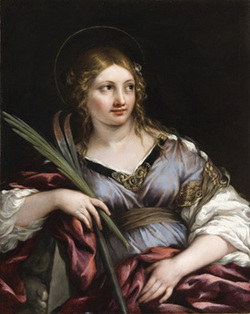
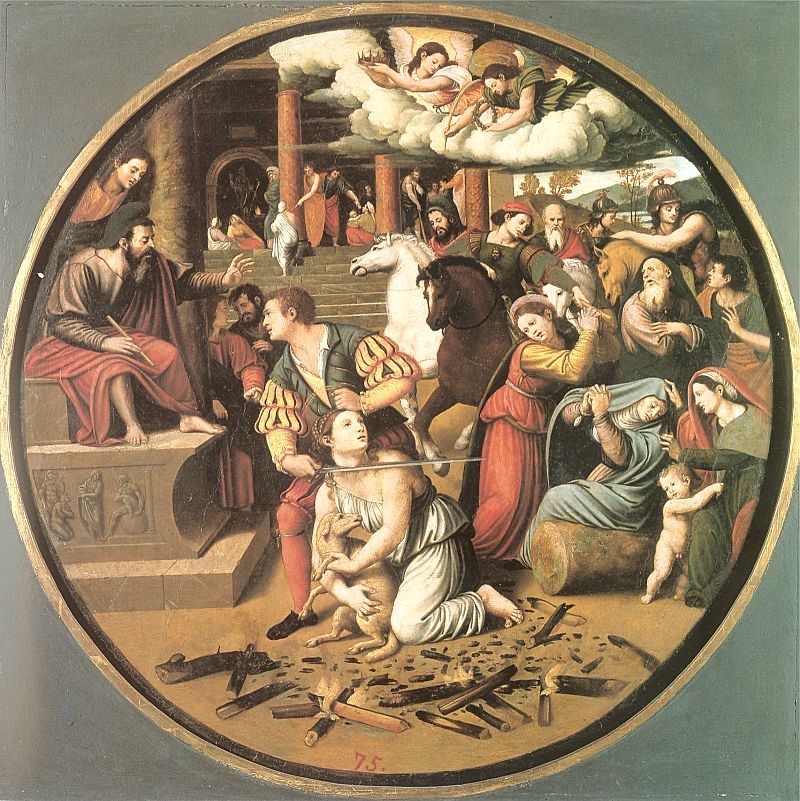
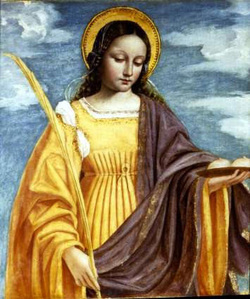
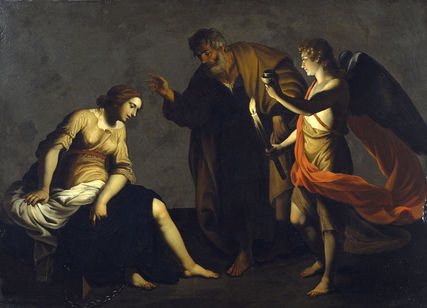
The Maiden Agatha was a Sicilian of noble birth.  The citizens of Palermo and Catania dispute as to which city had the honour of being her birthplace.  It was at Catania that, during the persecution under the Emperor Decius, she won the crown of a glorious martyrdom.  She was equally celebrated for her beauty and her chastity, and Quintianus, Governor of Sicily, conceived a passion for her.  He tried every sort of device to overcome her modesty, and when he found it impossible to make her consent to his wishes, he caused her to be arrested on a charge of Christian superstition, and handed over to a woman named Aphrodisia to be corrupted.  The company, however, of this woman had no effect in shaking her constancy in the Christian worship, nor her settled determination to preserve her purity.  Aphrodisia therefore reported to Quintianus that she was only throwing away her pains on Agatha.  He ordered her to be brought before him.  Thou, said he, art the daughter of a noble family―dost thou feel no shame in living the degraded and slavish life of a Christian?  Agatha answered him, "The lowliness and bondage of a Christian are far nobler than the estate and pride of a king."

Then the Governor, being incensed against her, gave her the alternative of either sacrificing to the gods, or being submitted to the torture; and as she remained firm in the faith, she was buffeted and sent back to prison.  The next day she was brought forth, and, because her resolution was still unshaken, she was stretched on the rack and tortured with pieces of white-hot metal.  Then her breasts were cut off.  When Agatha received this injury she cried out to Quintianus, "Cruel tyrant, art thou not ashamed to do this to me, having thyself suckled at a mother's breast?"  She was remanded again to prison and put in irons.  That night an old man, who called himself an Apostle of Christ, came to her, and healed her wounds.  The following day she was brought for the last time before the Governor.  Her constancy was unmoved, and she was rolled on sharp potsherds and live embers.

At that time the whole city was shaken with a great earthquake, and two of the Governor's dearest friends, Silvinus and Falconius, were killed by falling walls.  The townspeople were in an uproar, and Quintianus, in fear of a riot, ordered Agatha, who was half dead, to be carried back to prison quietly.  Then she made the following prayer: O Lord, who hast been my Keeper from my childhood, who hast taken from me all love for this present world, who hast strengthened me so that I am more than conqueror over the cruelty of the executioners, receive my spirit.  With these words she passed to heaven, finishing her testimony on the 5th day of February.  Her body was buried by the Christians.

Agatha is buried at the Badia di Sant'Agata, Catania. She is listed in the late 6th-century Martyrologium Hieronymianum associated with Jerome, and the Synaxarion, the calendar of the church of Carthage, ca. 530. Agatha also appears in one of the carmina of Venantius Fortunatus. Two early churches were dedicated to her in Rome, notably the Church of Sant'Agata dei Goti in via Mazzarino, a titular church with apse mosaics of ca. 460 and traces of a fresco cycle, overpainted by Gismondo Cerrini in 1630. In the 6th century the church was adapted to Arian Christianity, hence its name "Saint Agatha of Goths", and later reconsecrated by Gregory the Great, who confirmed her traditional sainthood. Agatha is also depicted in the mosaics of Sant' Apollinare Nuovo, Ravenna, where she appears, richly dressed, in the procession of female martyrs along the north wall. Her image forms an initial I in the Sacramentary of Gellone, from the end of the 8th century.

Agatha is the patron saint of bell-founders because of the shape of her severed breasts, and also of bakers, whose loaves were blessed at her feast day. More recently, she has been venerated as patron saint of breast cancer patients.

She is claimed as the patroness of Palermo. The year after her death, the stilling of an eruption of Mt. Etna was attributed to her intercession. As a result, apparently, people continued to ask her prayers for protection against fire.
Picture

Saint for Today - St Blaise

2/3/2014

 
Picture
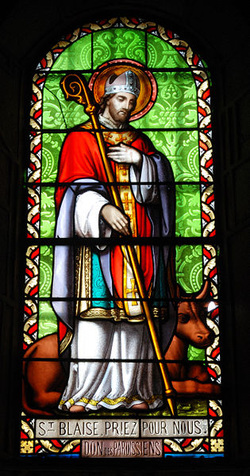
Blaise was chosen Bishop of the city of Sebaste in Armenia, in which place he enjoyed a great reputation for virtue.  When Diocletian began to make the Christians the objects of his insatiable cruelty, the Saint hid himself in a cave on Mount Argaeus, where he lay till he was found by some of the soldiers of Agricolaus the Governor, who were out hunting.  He was brought before the Governor, who commanded him to be thrown into irons.  While he was in prison, Blaise healed many of the sick, who were brought to him on account of his reputation of saintliness, and among others a boy who had been despaired of by the physicians, and who at the point of death, from a thorn which had become fixed in his throat.  Blaise appeared twice before the Governor, but neither cajolements nor threats could induce him to sacrifice to the gods.  He was first beaten with rods, and afterwards put on the rack, where his flesh was mangled with iron combs.  At last his head was cut off, whereby he finished a noble testimony to the faith which is in Christ our Lord.  He bore witness on the 3rd day of February.

Picture
The blessing of throats traces back to the 8th century.

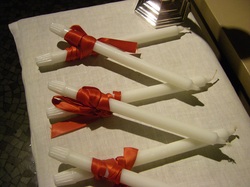
St. Blaise was bishop of Sebaste in Cappadocia, and was martyred by beheading about A.D. 316.  One day St Blaise met a poor woman whose only pig had been snatched up in the fangs of a wolf but at the command of the bishop the wolf restored the pig alive to its owner. The woman did not forget the favor, for later, when the bishop was languishing in prison, she brought him tapers to dispel the darkness and gloom. To this story may be attributed the practice of using lighted candles in bestowing the blessing of St. Blaise. While in prison he performed a wonderful cure on a boy who had a fishbone lodged in his throat and who was in danger of choking to death. From this account we have the longtime custom of invoking the Saint for all kinds of throat trouble.

Blessing of the candles


P: Our help is in the name of the Lord.

R. Who made heaven and earth.
P: The Lord be with you.
R. May He also be with you.
                                                                Let us pray.

God, almighty and all-mild, by thy Word alone thou created the manifold things in the world, and willed that that same Word by whom all things were made take flesh in order to redeem mankind; thou are great and immeasurable, awesome and praiseworthy, a worker of marvels. Hence in professing his faith in thee the glorious martyr and bishop, Blaise, did not fear any manner of torment but gladly accepted the palm of martyrdom. In virtue of which thou bestowed on him, among other gifts, the power to heal all ailments of the throat. And now we implore thy majesty that, overlooking our guilt and considering only his merits and intercession, it may please thee to bless + and sanctify + and impart thy grace to these candles. Let all men of faith whose necks are touched with them be healed of every malady of the throat, and being restored in health and good spirits let them return thanks to thee in your holy Church, and praise thy glorious name which is blessed forever; through Christ our Lord.

R. Amen.
                                                They are sprinkled with holy water.

Prayer:
After blessing the candles on the feast of St. Blaise, the priest holds two candles fastened like a cross to the throat of the person kneeling before him, and says:

By the intercession of St. Blaise, bishop and martyr, may God deliver you from every malady of the throat, and from every possible mishap; in the name of the Father, and of the Son, + and of the Holy Ghost.

R. Amen.


Saint for Today - St Ignatius of Antioch

2/1/2014

 
Picture
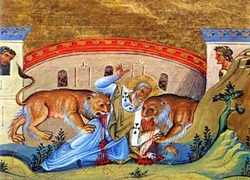
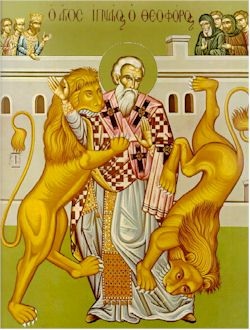
Ignatius was the third Bishop of Antioch after the Apostle Peter.  When Trajan stirred up his persecution, he was condemned to be devoured by wild beasts, and sent to Rome in chains.  When on his journey thither he arrived at Smyrna, where Polycarp, the disciple of John, was Bishop, he wrote an Epistle to the Ephesians, another to the Magnesians, a third to the Trallians, and a fourth to the Roman: and after leaving Smyrna, he addressed a further Epistle to the Philadelphians, and another to the Smyrnians, along with a private Epistle to Polycarp, to whose care he commended the Church of Antioch.  In this last he quoteth a passage regarding the Person of Christ from the Gospel, which I have recently translated.

It is fitting that, as we have made mention of a man of so much importance, we should also note briefly the Epistle which he addressed to the Romans.  I am on my way, saith he, from Syria to Rome, and am already fighting with beasts on sea and on land all the way.  I may say I am chained day and night to ten leopards, for indeed the soldiers, who have charge of me, are no better.  The more courteous I am to them, the worse they use me.  But still their wickedness is good schooling for me, though I know that my mere sufferings cannot in themselves gain me justification.  I earnestly wish for the beasts which are to devour me; at any rate, I pray they may put me out of pain quickly, and fly on me willingly, that I be not like some other Martyrs, whose bodies the animals have refused to touch.  If I find that they will not come on, I will run at them as quick as I can, to make them devour me.  Let me be, my little children: I know what is good for me.

I feel now that I am beginning to be Christ's disciple; I desire none of those things which are seen, if so be I may find Christ Jesus.  I care not that there come upon me fire, or cross, or wild beasts, or breaking of my bones, or sundering of my members, or destruction of my whole body, yea, or all the torments of the devil, if only so be I may win Christ.  When he was brought condemned to the theatre, and heard the roaring of the beasts which were to devour him, he felt so strong an eagerness to suffer, that he cried out: I am Christ's wheat, and so let the beasts' teeth be my mill, that I may be ground, and be found to make good bread.  He suffered in the eleventh year of Trajan.  What was left of his body lieth at Antioch, in the graveyard outside the gate which leadeth toward Daphne.

Picture

Saint for Today - St Martina

1/30/2014

 
Picture
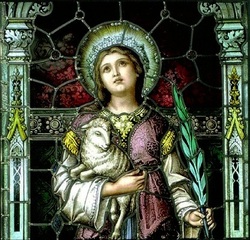
Martina was a maiden of a most illustrious Roman family, daughter of a Consul.  She lost her parents while still very young, and, being inflamed with Christian zeal, she distributed her wealth, whereof she had abundance, with great profusion among the poor.  Under the Emperor Alexander, she was commanded to sacrifice to the imaginary gods, and refused with much boldness to commit this great wickedness.  Upon this she was again and again scourged, and mangled with iron prongs and hooks, and pieces of broken pottery.  Her limbs were cut piece by piece with sharp swords, and boiling tallow poured upon the living trunk.  Lastly she was sent to be eaten publicly by the wild beasts in the amphitheatre, but by the will of God they would not touch her, and she was then thrown upon a burning pile, but still remained alive.

Some of her tormentors were so moved by the spectacle, that they repented, and, by the grace of God confessing the faith of Christ, through which she remained constant, were themselves tortured and beheaded.  Martina herself lay praying, with a brightness on her face, while a matter like milk oozed from her body along with the blood, emitting a soft, sweet smell.  She was as it were unconscious of an earthquake and most violent thunderstorm which arose and was raging, and while the lightning struck temples, and melted statues, she seemed in spirit rather to be seated above on a queenly throne, praising God in heaven among the Blessed.

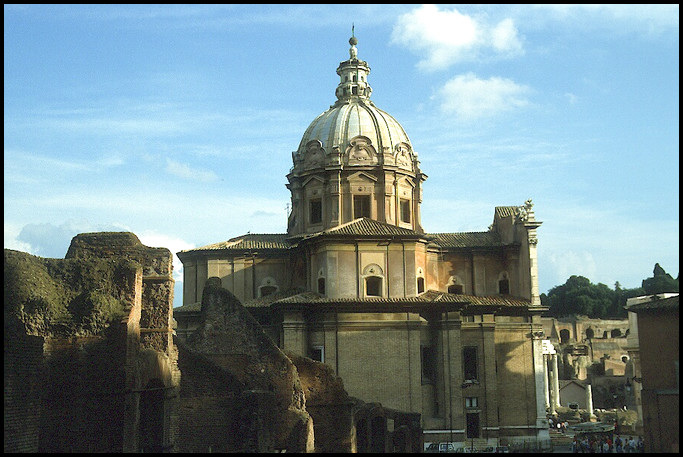
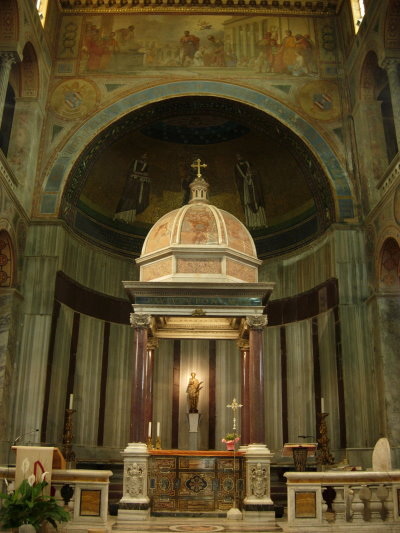
The judge being infuriated at what had taken place, and chiefly at her unbending firmness, ordered the head of the martyr to be cut off.  At the moment this was done, a peal which shook the city was heard, like a voice calling her home, and so great was the consternation, that it was made the means of conversion to many idolaters.  The holy body of Martina wherein she had suffered in the Pontificate of Urban I, was discovered in the time of Urban VIII, in the very old Church called after her, situated at the foot of the Capitoline Hill, near the Mamertine Prison, along with the bodies of the holy martyrs Concordius, Epiphanius, and others.  The Church was then altered and restored and handsomely decorated, and then the body was replaced in it, amid public rejoicings, with a solemn ceremony and procession.

Picture
The Church of Ss. Luke and Martina, Rome

January 28th - St Agnes V.M.

1/28/2014

 
Picture
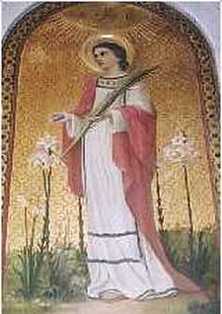
According to tradition, Saint Agnes was a member of the Roman nobility born c. 291 and raised in a Christian family. She suffered martyrdom at the age of twelve or thirteen during the reign of the Roman Emperor Diocletian, on 21 January 304.

Agnes, whose name means “chaste” in Greek, was a beautiful young girl of wealthy family and therefore had many suitors of high rank. Tradition holds that the young men, slighted by Agnes' resolute devotion to religious purity, submitted her name to the authorities as a follower of Christianity.

The Prefect Sempronius condemned her to be dragged naked through the streets to a brothel.  As she prayed, her hair grew and covered her body. It was also said that all of the men who attempted to rape her were immediately struck blind. The son of the prefect is struck dead, but revived after Agnes prayed for him, causing her release. There is then a trial from which Sempronius excuses himself, and another figure presides, sentencing her to death. When led out to die she was tied to a stake, but the bundle of wood would not burn, or the flames parted away from her, whereupon the officer in charge of the troops drew his sword and beheaded her, or, in some other texts, stabbed her in the throat. It is also said that the blood of Agnes poured to the stadium floor where other Christians soaked up the blood with cloths.

Agnes was buried beside the Via Nomentana in Rome. A few days after Agnes' death, her foster-sister, Saint Emerentiana, was found praying by her tomb; she claimed to be the daughter of Agnes' wet nurse, and was stoned to death after refusing to leave the place and reprimanding the pagans for killing her foster sister. Emerentiana was also later canonized. One night when the parents of the blessed Agnes were watching at her grave, she appeared to them in company with a band of virgins, and said to them: Father and Mother, weep not for me as though I am dead; for now these virgins and I live together in him whose love was my whole life upon earth.  Some years afterwards, Constance, the daughter of the Emperor Constantine, being sick of an incurable ulcer, betook herself to the said grave, although she was not yet a Christian, and as she lay by it and slept, she seemed to hear the voice of Agnes, saying to her: Constance, be of good courage: believe in Jesus Christ the Son of God, and he will make thee whole.  The Princess, being healed, was baptized, along with many others of the Emperor's family and household, and afterwards built over the grave of the blessed Agnes a Church named in her honour.

Picture
The Basilica of St. Agnes Outside The Walls, Rome

Saint for Today - St Emerentiana

1/22/2014

 
Picture
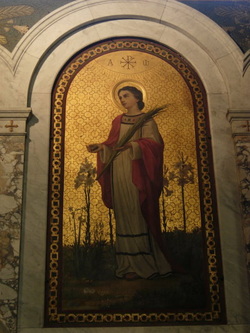
Emerentiana was a Roman maiden, and the foster-sister of the blessed Agnes.  While she was still a Catechumen, she was inspired by her faith and love to rebuke the fury of the idol-worshippers against the Christians, whereupon a mob assembled, and stoned her so severely that she was only able to drag herself to the grave of holy Agnes, where, while she prayed, she gave up her soul unto God, being baptized, not in water, but in her own blood, so freely shed for Christ.

Her feast is kept on 23 January. In the "Martyrologium Hieronymianum" she is mentioned under 16 September, with the statement: In coemeterio maiore. She is represented with stones in her lap, also with a palm or lily.

Saint for Today - Sts. Vincent and Anastasius

1/22/2014

 
Picture
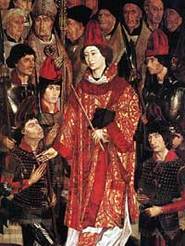
Vincent was born at Huesca in Granada in Spain.  He was early turned to study, and learned sacred letters from Valerius, Bishop of Saragossa.  He was accustomed to deliver discourses for this Prelate, who, owing to an impediment in his speech, was not able to preach himself.  This coming to the ears of Dacian, Prefect of the province under Diocletian and Maximian, he caused Vincent to be arrested at Saragossa, and brought before him at Valencia in bonds.  The saint was scourged, and afterward tormented on the rack, in presence of numerous spectators, but neither torture, threats, nor fair words could bend his resolution.  He was then laid on a grating over hot coals, his flesh mangled with iron hooks, and white-hot plates of metal applied to the wounds.  The still breathing remains were taken back to a prison, and laid on broken potsherds, that the agony of his naked body might prevent his sleeping from exhaustion.
As he lay in his dark cell, a glorious light suddenly filled the prison, to the astonishment of all who saw it.  The gaoler informed Dacian, who caused the martyr to be brought out and cared for in a soft bed, hoping that though he had failed to move him by cruelty, he might seduce him by pretended kindness.  But the indomitable soul of Vincent, armed with faith and hope in Christ Jesus, remained unconquered even to the end, and triumphing over the fire, the steel, and the cruelty of the tormentors, passed away to receive the victorious crown or martyrdom in heaven on the 22nd day of January.

Picture
His body was thrown out unburied.  A raven perched upon it and kept off with his beak, claws, and wings both the other birds and a wolf, which came to prey on it.  Dacian then had it thrown into the sea, but by the will of God it was washed up again, and the Christians took and buried it.

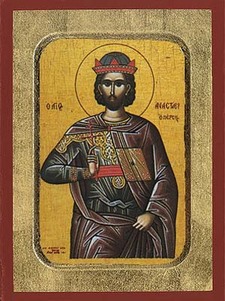
Anastasius was a Persian monk who made a pilgrimage to the Holy Places at Jerusalem in the reign of the Emperor Heraclius, during which journey he endured bonds and stripes on account of his confession of Christ at Caesarea, in Palestine.  Soon after his return, he was arrested by the Persians for the same cause, and, after enduring divers torments, he and seventy other Christians were beheaded by order of King Chosroes.  His relics were first carried to Jerusalem, to the monastery in which he had made his monastic profession, and afterwards to Rome, where they were laid in the monastery of Saints Vincent and Anastasius.

Picture
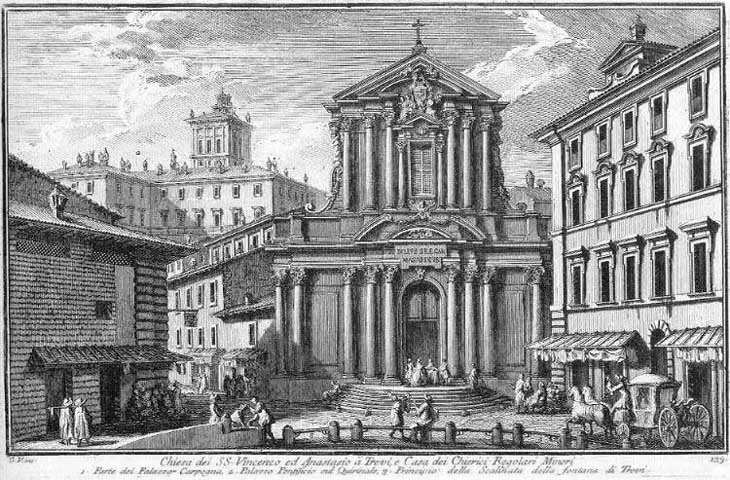
The Church of Ss. Vincent and Anastasius, Rome

Saint for Today - St. Agnes

1/21/2014

 
Picture
The Lesson is taken from the Treatise on Virgins by St. Ambrose the Bishop


This is a virgin's birthday; let us then follow the example of her chastity.  It is a Martyr's birthday; let us then offer sacrifices.  It is the birthday of the holy Agnes; let men then be filled with wonder, little ones with hope, married women with awe, and the unmarried with emulation.  But how shall I set forth the glory of her whose very name is an utterance of praise?  It seemeth to me that this being, holy beyond her years, and strong beyond human nature, received the name of Agnes, not as an earthly designation, but as a revelation from God of what she was to be.  For this name Agnes is from the Greek, and being interpreted, signifieth Pure.  So that this saintly maiden is known by the very title of Chastity: and when I have added thereto the word Martyr, I have said enough.  She needeth not the praise which we could utter, but do not.  None is more praiseworthy than she for whose praise all mouths are fitted.  As many as name her, so many praise her, by the noble title of martyr.

We learn by tradition that this holy martyr testified in the thirteenth year of her age.  We will pass by the foul cruelty which did not spare her tender years, to contemplate the great power of her faith, whereby she overcame the weakness of childhood, and witnessed a good confession.  Her little body was hardly big enough to give play to the instruments of their cruelty, but if they could scare sheath their swords in her slight frame, they found in her that which laughed the power of the sword to scorn.  She had no fear when she found herself grasped by the bloody hands of the executioners.  She was unmoved when they dragged her with clanging chains.  Hardly entered on life, she stood fully prepared to die.  She quailed not when the weapons of the angry soldiery were pointed at her breast.  If they forced her against her will to approach the altars of devils, she could stretch forth her hands to Christ amid the very flames which consumed the idolatrous offerings, and mark on the heathen shrine the victorious Cross of the Lord.  She was ready to submit her neck and hands to the iron shackles, but they were too big to clasp her slender limbs.  Behold a strange martyr!  She is not grown of stature to fight the battle, but she is ripe for the triumph; too weak to run in the race, and yet clearly entitled to the prize; unable from her age to be aught but a learner, she is found a teacher.

She went to the place of execution a virgin, with more willing and joyful footsteps than she would have gone with to the nuptial chamber as a bride.  The spectators were all in tears, and she alone did not weep.  They beheld her with wonder, laying down that life of which she had hardly begun to taste the sweets, as freely as though she had drained it to the dregs and was weary of its burden.  All men were amazed when they saw her whose years had not made her her own mistress, arise as a witness for the Deity.  Consider how many threats her murderer used to excite her fears, how many arguments to shake her resolution, how many promises to bribe her to accept his offers of marriage.  But she answered him: It is an insult to him whom I have wedded to expect me to comply.  He that first chose me, his will I be.  Headsmen, why waitest thou?  Perish the body which draweth the admiration of eyes from which would turn away.  She stood, prayed, and then bent her neck for the stroke.  Now mightest thou have seen the murderer trembling as though he himself were the criminal, and the executioner's hand shake, and the faces of them that stood by turn white at the sight of her position, and all the while herself remain without fear.  This one victim brought God a double offering, that of her purity, and that of her faith.  She preserved virginity and achieved martyrdom.

Picture

Saint for Today - Sts Fabian and Sebastian

1/20/2014

 
Picture
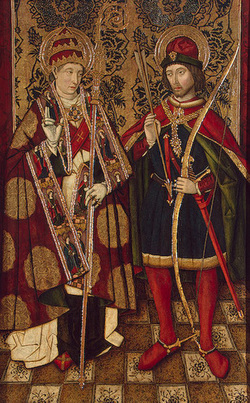
Fabian was a Roman, and sat as Pope from the reign of the Emperor Maximian till that of Decius.  He appointed a deacon to each of the seven districts of Rome to look after the poor.  He likewise appointed the same number of subdeacons to collect the acts of the Martyrs from the records kept by the seven district notaries.  It was by him that it was ordained that every Maundy Thursday the old Chrism should be burnt and new consecrated.  He was crowned with martyrdom upon the 20th of January, in the persecution of Decius, and buried in the cemetery of St. Callistus on the Appian Way, having sat in the throne of Peter fifteen years and four days.  He held five Advent ordinations, in which he ordained twenty-two priests, seven deacons, and eleven bishops for divers Sees.

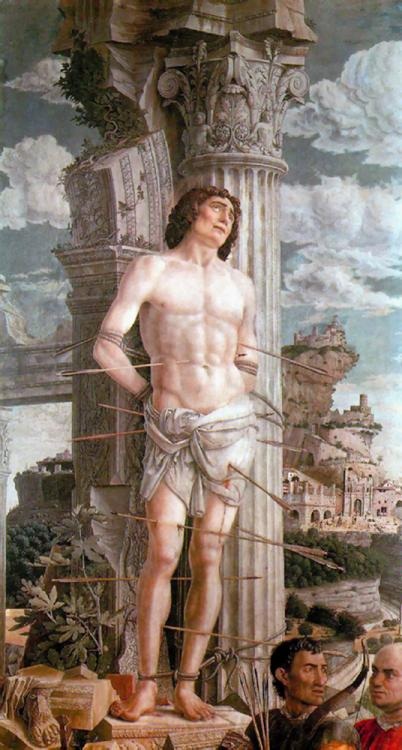
The father of Sebastian was of Narbonne, and his mother a Milanese.  He was a great favourite of the Emperor Diocletian, both on account of his noble birth  and his personal bravery, and was by him appointed captain of the first company of the Praetorian Guards.  He was in secret a Christian, and often supported the others both by good offices and money.  When some shewed signs of yielding under persecution, he so successfully exhorted them, that, for Jesus Christ's sake, many offered themselves to the tormentors.  Among  these were the brothers Mark and Marcellian who were imprisoned at Rome in the house of Nicostratus.  The wife of Nicostratus himself, named Zoe, had lost her voice, but it was restored to her at the prayer of Sebastian.  These facts becoming known to Diocletian, he sent for Sebastian, and after violently rebuking him, used every means to turn him from his faith in Christ.  But as neither promises nor threats availed, he ordered him to be tied to a post and shot to death with arrows.

Sebastian was treated accordingly, and left for dead, but in the night the holy widow Irene sent for the body in order to bury it, and then found that he was still alive, and nursed him in her own house.  As soon as his health was restored, he went out to meet Diocletian, and boldly rebuked him for his wickedness.  The Emperor was first thunderstruck at the sight of a man whom he believed to been some time dead, but afterwards, frenzied with rage at the reproaches of Sebastian, ordered him to be beaten to death with rods, under which torment the martyr yielded his blessed soul to God.  His body was thrown into a sewer, but he appeared in sleep to Lucina, and made known to her where it was, and where he would have it buried.  She accordingly found it and laid it in those Catacombs, over which a famous Church hath since been built, called St. Sebastian's-without-the-Walls.


Picture

January 19th - Sts Marius and Companions

1/18/2014

 
Picture
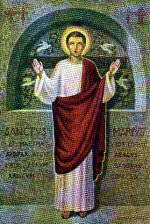
Marius was a Persian of high rank, who came to Rome in the reign of the Emperor Claudius, with his wife Martha, who was equally noble, and their two sons Audifax and Abachum, to pray at the graves of the Martyrs. Here they comforted the Christians who were in prison, and whom they relieved by their ministrations and alms, and buried the bodies of the Saints. For these acts they were all arrested, but no threats or terrors could move them to sacrifice to idols.

They were accordingly mangled with clubs, and drawn with ropes, after which they were burnt by applying plates of red-hot metal to their bodies, and their flesh partly torn off with metal hooks. Lastly their hands were all cut off, and they were fastened together by the neck, in which state they were driven through the city to the thirteenth mile-stone on the Cornelian Way, a place now called Santa Ninfa, where they were to die.

Martha addressed a moving exhortation to her husband and sons to hold out bravely to the last, for the love of Jesus Christ; and was then herself drowned. The other three martyrs were next beheaded in the same sand-pit. Their bodies were thrown into a fire. The lady Felicity of Rome collected the half-burnt remains, and caused them to be buried at her own farm.

<<Previous
Forward>>


    archbishop lefebvre
    Click to see more

    Enter your email address for daily posts:

    Delivered by FeedBurner

    Archives

    December 2014
    October 2014
    September 2014
    August 2014
    July 2014
    June 2014
    May 2014
    April 2014
    March 2014
    February 2014
    January 2014
    December 2013
    November 2013
    October 2013
    September 2013
    August 2013
    July 2013
    June 2013
    May 2013

    Categories

    All
    Apologetics
    Archbishop Lefebvre
    Bishop Williamson
    Blessed Sacrament
    Catechism
    Catholic History
    Chalk Talks
    Chastisement
    Devotions
    Easter
    Eleison Comments
    Eleison Comments
    Eleison Comments Italian
    Encyclicals
    Espanol Eleison Comments
    Families
    Fatima
    Feast Days
    For Fathers (Dads)
    For Moms
    Fortitude
    Holy Ghost
    Holy Name
    Holy Souls
    Holy Week
    Home Schooling
    Lent
    Liberalism
    Litanies
    Liturgy
    Marriage
    Martyrology
    Martyrs
    Mass
    Meditations Of Abl
    Modesty
    News
    New World Order
    Obedience
    Our Lady
    Our Lady Of Quito
    Our Lord
    Pentecost
    Pioneer Priests
    Prayers
    Sacramentals
    Sacraments
    Sacred Heart
    Saint Of The Day
    Saints For April
    Saints For August
    Saints For December
    Saints For February
    Saints For January
    Saints For July
    Saints For June
    Saints For March
    Saints For May
    Saints For November
    Saints For October
    Saints For September
    Scandal
    Scapular
    Sermons
    Sspx
    St Benedict
    St Joseph
    St Michael
    St Michael
    Sundays Of The Year
    Temptations
    The Church
    The Last Things
    The Mass
    The Pope
    The Rosary
    The Saints
    The Virtues
    Tradcat Comments
    Truth Society

    Picture
    Click to see inside the store
    Picture
    k d
    Counter Site
    While Archbishop Lefebvre Blog is provided free of charge, there are administrative and technical costs associated with making it available to subscribers worldwide and with operating this site. Contributions to offset these costs are appreciated, and may be made via the button below

    Archbishop Lefebvre

    Promote Your Page Too
Powered by Create your own unique website with customizable templates.