ArchbishopLefebvre.com
Links
  • Archbishop Lefebvre
    • Biography of Archbishop Lefebvre
    • Who is he?
    • In his own words
  • Sermons
    • Sunday Sermons
  • Letters
    • Archbishop Lefebvre >
      • To Friends and Benefactors
      • Other Letters
    • Bishop Williamson >
      • Friends and Benefactors
      • Eleison Comments >
        • Italiano
        • Espanol
      • To SSPX Priests
  • Blog
  • Books
    • E-Books
    • Free Catholic Books
    • Archbishop Lefebvre
    • Bibles
    • Blessed Sacrament
    • Children Books
    • Childrens Saints
    • DVDs
    • Hell
    • Purgatory
    • Our Lady
    • Sacred Heart
    • Missals
    • Missale Romanum
    • Summa Theologica
    • Saints
  • Catholic Faith
    • Catechisms
    • Catholic Art
    • Chant
    • Dogmas of the Catholic Church
    • Encyclicals
    • Sermons
    • History >
      • HughesVol1index
    • Liturgy
    • Sacraments
    • Prayers >
      • Blessings
    • Way of the Cross
  • SSPX Crisis
    • sspx Archbishop Lefebvre
    • monks nuns
    • SSPX Bishop Fellay
    • SSPX Bishop Tissier
    • ex-sspx Bishop Williamson
    • ex-sspx chazal
    • sspx couture
    • sspx fox
    • ex-sspx fuchs
    • ex-sspx girouard
    • ex-sspx hewko
    • sspx laisney
    • sspx ockerse
    • ex-sspx pfeiffer
    • sspx themann
    • Fr. Ringrose
  • Links
    • Other Sites
    • Donate
    • Facebook
    • Twitter
    • You Tube
  • TradCat Items
    • Beeswax Candles
    • Chapel Veils
    • Prayer Cards - Our Lady
    • Prayer Cards - Espanol
    • Protected Scapulars
    • Scapulars
    • Unbreakable Rosaries
  • Crisis in Church
    • Declaration of the 2006 Chapter (SSPX)
    • Fr Hewko to SSPX Superiors
    • History of the Archbishop and Rome
    • Vatican II more important than Nicea!
    • The Archbishop and Religious Liberty
    • The right to resist an abuse of power
    • How Are Catholics To Respond To The Present Crisis

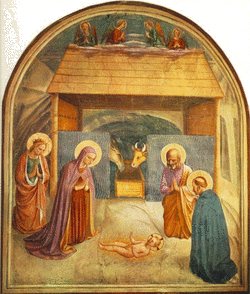
The Nativity of Our Lord Jesus Christ

12/25/2013

 
Picture
The Lesson is taken from a Sermon by St. Leo the Pope

Dearly beloved: Unto us is born this day a Saviour.  Therefore let us rejoice.  Sadness should find no place amongst those who keep the Birthday of Life.  For as of this day Life came unto us dying creatures, to take away the sting of death, and to bring the bright promise of joy eternal.  And no one is excluded from sharing in this our gladness.  For all mankind hath one and the same cause thereof, to wit, that our Lord, the Destroyer of sin and death, because he findeth no one free from condemnation, is come to set everyone free.  Rejoice, O saint, for thou drawest nearer thy crown!  Rejoice, O sinner, for thy Saviour offereth thee pardon!  Rejoice, O Jew, for Messiah is come.  Rejoice, O Gentile, for God calleth thee to life!  Now is come the fullness of time, fixed by the unsearchable counsel of God, when the Son of God took upon him the nature of man, that he might reconcile it to its Maker.  Now is come the time when the devil, the inventor of death, is met and beaten in that very flesh which hath been the field of his victory.

When the Almighty Lord entered this field of battle against the devil, he did so in great and wondrous fairness.  For against our cruel enemy he opposed not the armament of his uncreate Majesty, but the lowliness of our flesh.  He brought against him the very shape and the very nature of our mortality, with this difference only, that he was without sin.  For his birth is not like that of the ordinary run of men, of whom there is the saying: No one is clean from stain, not even the day-old babe.  In this birth alone no desires of the flesh had place.  In this birth alone no consequence of sin had part.  A Virgin of the kingly lineage of David was chosen to be the Mother who grew heavy with the sacred Child.  She was chosen to conceive this divine and human offspring in her body because already she had conceived him in her soul.  And that the unwonted events ordained by the counsel of God might cause her no alarm, she was taught them beforehand when the Angel announced that what was to be wrought in her was of the Holy Ghost, and that to become the Mother of God was not to forego her virgin modesty.

Wherefore, dearly beloved, let us give thanks to God the Father, through his Son, in the Holy Ghost: who for his great love, wherewith he loved us, hath had mercy on us; and even when we were dead in sins, hath quickened us together with Christ, that in him we might be a new creature, and a new workmanship.  Let us then put off the old man with his deeds.  And, having obtained a share in the Son-ship of Christ, let us renounce the deeds of the flesh.  Acknowledge, O Christian, thine own dignity, who hast been made partaker of the divine nature, and change not back my misdoing into thy former baseness.  Bethink thee whose Body it is whereof thou art made a member, and who is its Head.  Be mindful that he hath delivered us from the power of darkness, and translated us into God's light and God's kingdom.
Picture
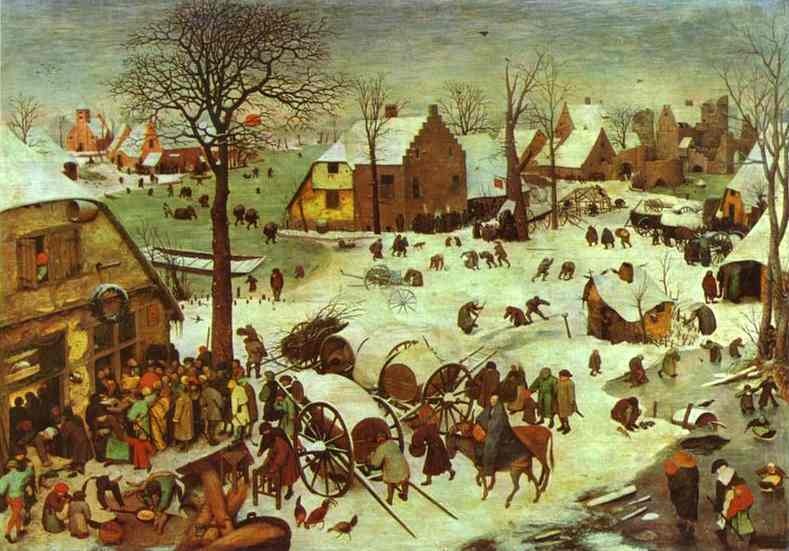
At that time: There went out a decree from Caesar Augustus that all the world should be taxed.

Sermon of St. Gregory Pope

By God's mercy we are to say three Masses today.  Hence there is not much time left for preaching on this passage of the Gospel.  Nonetheless the Feast of the Lord's Birthday constraineth me to speak a few words.  I will begin at once by asking why this numbering for taxation took place at the Lord's Birth, and why all the world was enrolled?  Was it not to make us mindful that one had now appeared in the flesh who would enroll his elect in the book of life?  And note, on the other hand, how the Prophet saith of the reprobate: Let them be wiped out of the book of the living, and not be written among the righteous.  Note also that the Lord was born in Bethlehem, which same signifieth the House of Bread, and thus was meetly the birthplace of him who hath said: I am the Living Bread which came down from heaven.  The place, then, where our Lord was born was already called the House of Bread because therein was he to appear who would feed the souls of the the faithful unto life eternal.  Not in his Mother's house was he born, but away from home.  And this should make us mindful that our mortality, in which he was born, was not the home of him who is begotten of the Father before all worlds.
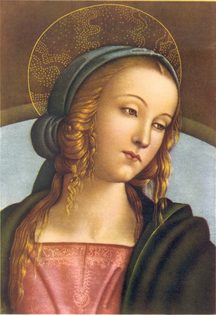
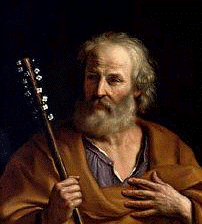
Vigil of Christmas

12/24/2013

 
Picture
When as Mary the Mother of Jesus was espoused to Joseph, before they came together, she was found with child, of the Holy Ghost.

Sermon of St Jerome

Why was the Lord conceived of a virgin espoused rather than of one who was not?  First, that Mary's genealogy might be reckoned from that of Joseph.  Secondly, lest she be stoned by the Jews as an adulteress.  Thirdly, that she might have a guardian on their flight into Egypt.  To these, the Martyr Ignatius hath added a fourth reason; namely, that the birth might take place unknown to the devil, who would thus suppose that Mary had conceived by Joseph.

Before they came together, she was found with child, of the Holy Ghost.  That is, she was found by Joseph, not by anyone else, for already he had almost an husband's privilege to know all that concerned her.  But from the words, Before they came together, it doth not follow that they ever did come together.  The Scripture is concerned only to shew that up to this time they had not so done.

Then Joseph her husband, being a just man, and not willing to make her a public example, was minded to put her away privily.  If any man be joined to an harlot, he becometh one body with her; and according to the law, they that be privy to a crime are held to be guilty.  How then can it be that Joseph is described as a just man, at the very time he was compounding the criminality of his espoused?  These words be none other than a testimony to the virginity of Mary; for Joseph knew her to be chaste; wherefore he marvelled at all that had come to pass, and hid in silence that of which he knew not the mystery.

Picture
Let us pray. O God, who makest us glad with the yearly Expectation of the birth of thine only Son Jesus Christ: grant that as we joyfully receive him for our Redeemer, so we may with sure confidence behold him when he shall come to be our Judge. Who liveth and reigneth with thee, in the unity of the Holy Ghost, ever one God, world without end. R. Amen.

December 23rd - St Victoria

12/23/2013

 
Picture
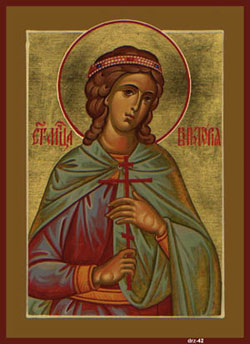
Beautiful Roman noblewoman. Sister of Saint Anatolia. The two sisters were set for arranged marriages to noble Roman pagans, and were hesitant. Victoria argued that it would be all right as the patriarchs in the Old Testament had been married; but Anatolia cited other examples to prove that for the holiest lives, they should devote themselves to God and stay single. Victoria was convinced, sold her jewelry, gave the money to the poor, and refused to go through with the wedding to a fellow named Eugenius.

The two suitors insisted on the weddings, and the sisters refused. The young men denouced the women as Christians, but obtained authority to imprison them their estates, in hopes of breaking their faith and changing their minds. The women converted their servants and guards sent to watch them. Anatolia’s suitor, Titus Aurelius, soon gave up, and handed her back to the authorities. Eugenius stayed at it for years, alternating between good and harsh treatment of Victoria, but eventually even he gave up, and returned her to the authorities. She was martyred by order of Julian, prefect of the Capitol and count of the temples. Died stabbed through the heart in 250 by the executioner Liliarcus at Tabulana, Italy.

Legend says her murderer was immediately struck with leprosy, and died six days later, eaten by worms


4th Sunday of Advent

12/22/2013

 
Picture
Now in the fifteenth year of the reign of Tiberius Caesar, Pontius Pilate being governor of Judaea.

Sermon of Pope, St Gregory

John said unto the multitude, that came forth to be baptized of him: O generation of vipers, who hath warned you to flee from the wrath to come?  The wrath to come in one sense signifieth the great vengeance of the Latter Day: the sinner that repenteth not of his sin now, will have no mean whereby to flee from punishment then.  Let us remark that addressing evil children copying the example of evil parents, the Baptist calleth them a generation of vipers: in that they were envious at the righteous, and persecuted them; that they repaid evil for evil; that they hunted out ways of harming their neighbours,―in all these things following the pattern of carnal parents, the prophet likeneth them to a venomous brood hatched from a venomous stock.

We also have sinned, we have fallen into wicked habits.  What must we do, if we would flee from the wrath to come?  Let us hear John.  Bring forth fruits worthy of repentance.  In which words let us remark that the Friend of the Bridegroom demandeth not only fruits of repentance, but fruits worthy of repentance.  The former are one thing, and the latter another.  In considering then what are fruits worthy of repentance, we may remark that if we had done nothing unlawful we might have had free use of things which are lawful, and been able to sanctify ourselves without abstaining from indulgence in the things of the world.

But if any one, for example, hath fallen into fornication, or perhaps, into what is much worse, adultery, he ought to make up for his lawless pleasure by abstaining in some degree from lawful enjoyments.  He that hath sinned less is not bound to mortify himself as much as he that hath sinned more, nor he that is innocent like him that is guilty.  Let every one hearing these words: Bring forth fruits worthy of repentance, proceed to judge himself by his own conscience, and the more he perceiveth that he hath sinned, the greater penance let him do.

Picture

Saint for Today - St Thomas

12/21/2013

 
Picture
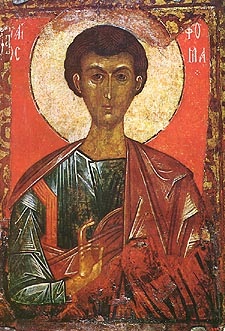
The Apostle Thomas, called Didymus, or the Twin, was a Galilean.  After the descent of the Holy Ghost, he went into many provinces to preach Christ's Gospel.  He gave knowledge of the rules of Christian faith and life to the Parthians, Medes, Persians, Hyrcanians, and Bactrians.  He went last to the East Indies.  Here he provoked the anger of one of the idolatrous kings, because the holiness of his life and teaching, and the number of his miracles, drew many after him, and brought them to the love of Christ Jesus.  He was therefore condemned, and slain with lances.  He crowned the dignity of the Apostleship with the glory of martyrdom, on the Coromandel coast, not far from Madras.

The Lesson is taken from a Sermon
by St. Gregory the Pope

It is written: By his Spirit the Lord hath garnished the heavens.  Now the garniture of the heavens are the godly powers of preachers, and this garniture, what it is, Paul teacheth us thus:  To one is given by the Spirit the word of wisdom; to another the word of knowledge by the same Spirit; to another gifts of healing by the same Spirit; to another working of miracles; to another prophecy; to another discerning of spirits; to another divers kinds of tongues; to another the interpretation of tongues; but all these worketh that one and the selfsame Spirit, dividing to every man severally as he will.

So much power then as have preachers, so much garniture have the heavens.  Wherefore again it is written:  By the word of the Lord were the heavens made.  For the Word of the Lord is the Son of the Father.  But, to the end that all the Holy Trinity may be made manifest as the Maker of the heavens (that is, of the Apostles), it is straightway added touching God the Holy Ghost: and all the host of them by the Breath of his mouth.  Therefore the might of the same heavens is the might of the Spirit, for they had not braved the powers of this world, unless the strength of the Holy Ghost had comforted them.  For we know what manner of men the Teachers of the Holy Church were before the coming of this Spirit: and since he came we see in whose strength they are made strong.


Picture
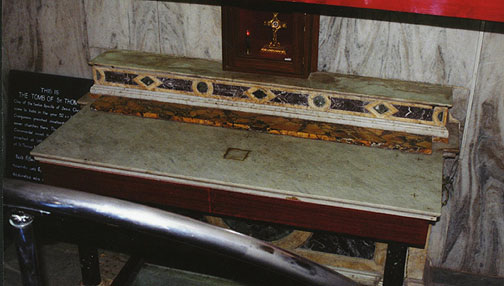
The tomb of St. Thomas the Apostle in Mylapore Cathedral, Madras, India
St. Gregory of Tours (Glor. Mart.), before 590, reports that Theodore, a pilgrim who had gone to Gaul, told him that in that part of India where the corpus (bones) of Thomas the Apostle had first rested (Mylapur on the east or the Coromandel Coast of India) there stood a monastery and a church of striking dimensions and elaboratedly adorned, adding: "After a long interval of time these remains had been removed thence to the city of Edessa." The location of the first tomb of the Apostle in India is proof both of his martyrdom and of its Apostolate in India. The evidence of Theodore is that of an eyewitness who had visited both tombs — the first in India, while the second was at Edessa. The primitive Christians, therefore, found on both coasts, east and west, witness to and locate the tomb at Mylapur, "St. Thomas", a little to the south of Madras; no other place in India lays any claim to possess the tomb, nor does any other country. On these facts is based their claim to be known as St. Thomas Christians.

Eleison Comments CCCXXXVI (336)

12/20/2013

 
Picture
BILLOT I

For years I have been giving a conference on the Seven Ages of the Church, based on the Venerable Bartholomew Holzhauser’s Commentary on the book of the Apocalypse. Holzhauser, a German priest of the first half of the 1600’s, said that he wrote it under inspiration. The conference has been popular, especially because it fits the craziness of our age into a harmonious pattern of the history of the Church. What I had not realized, however, is that Holzhauser’s vision is shared by a famous classical theologian, making it more difficult to dismiss Holzhauser as a mere visionary or “apparitionist”.

It is in an Epilogue to the first volume of his classic Treatise on the Church of Christ that Cardinal Louis Billot (1846-1931) lays out in some detail the correspondence affirmed by Holzhauser between seven main periods of Church history and the seven Letters to the seven churches of Asia that make up Chapters II and III of the book of the Apocalypse. Billot’s Epilogue never mentions Holzhauser, but it is difficult to imagine that there is no connection. However, Billot takes care to start out the correspondence not from any vision or inspiration, but from the Greek names of the seven churches. The suitability of these names to the Church’s evolving history is either a remarkable coincidence, or more likely a trace of Providence at work – God, the Master of History !

Thus Billot says that Ephesus (Apoc. II, 1-7) signifies in Greek a “starting out”, obviously suitable to the Apostolic Age (33-70 AD) with which the Church began. Smyrna (Apoc.II, 8-11) names the second church and means “myrrh”, corresponding to the passion and sufferings of the Church’s Second Age (70-313 AD), that of the Martyrs. Pergamus (Apoc. II, 12-17) was a city famous for literature, so that “pergamum” came to mean material on which to write, corresponding to the cluster of great Church writers belonging to the Church’s Third Age, that of the Doctors (313-800). Thyatira names the next church (Apoc. II, 18-29), and means “splendour of triumph”, corresponding to the 1,000-year triumph of the Catholic Church, reaching from Charlemagne (742-814) to the French Revolution (1789).

These thousand years might also be reckoned from around the conversion of Clovis (496) to the outbreak of Protestantism (1517). But whether one marks the decline of Christendom from the Reformation or the Revolution, in any case Sardis, naming the fifth church (Apoc. III, 1-6), was the city of Croesus, a fabulously rich man, evoking an abundance of money, material prosperity and spiritual decadence, such as characterize modern times. Indeed the warnings to the church of Sardis correspond perfectly to our own age today, as we shall see with Billot in further “Comments”.

We move clearly into the future with the sixth church, that of Philadelphia (Apoc.III, 7-13), meaning “love” (Phil-) of “brotherhood” (- adelphia). Cardinal Billot has this name correspond to a last great triumph of the Church, marked notably by the conversion of the Jews as prophesied by St Paul (Rom.XI, 12), and by their reconciliation with the Gentiles, brothers at last in Christ (Eph.II, 14-16).

But the church of Philadelphia is warned that tribulation is coming (Apoc.III, 10), which corresponds to the seventh and last Age of the Church, that of Laodicea (Apoc. III, 14-22), named from judgment (dike) of the peoples (laon). It will be the Age of the last and most terrible trial of the Church, the persecution of the Antichrist, followed by the General Judgment of all souls that will ever have lived, and so of all peoples.

Kyrie eleison.

© 2011-2013 Richard N. Williamson. All Rights Reserved.

A non-exclusive license to print out, forward by email, and/or post this article to the Internet is granted to users who wish to do so provided that no changes are made to the content so reproduced or distributed, to include the retention of this notice with any and all reproductions of content as authorized hereby. Aside from this limited, non-exclusive license, no portion of this article may be reproduced in any other form or by any other electronic or mechanical means without permission in writing from the publisher, except by a reviewer who may quote brief passages in a review, or except in cases where rights to content reproduced herein are retained by its original author(s) or other rights holder(s), and further reproduction is subject to permission otherwise granted thereby.


Ember Friday in Advent

12/20/2013

 
advent ember day
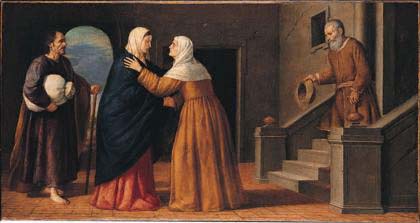
At that time: And Mary arose in those days, and went into the hill country with haste, into a city of Judah; and entered into the house of Zacharias, and saluted Elisabeth.

Sermon of
St. Ambrose the Bishop

When any one asketh another for credence, he is bound to give some reasonable ground.  And so the Angel, when he announced to Mary the counsel of God, gave, as a proof, the conception of Elisabeth, then aged and barren, that Mary might perceive, by this example, that with God nothing is impossible.  When the holy virgin had heard it, she arose and went to visit her cousin.  She did not go to see if what she had heard was true, because she did not believe God, or because she knew not who the messenger had been, or yet because she doubted the fact adduced in proof.  She went joyfully as one who hath received a mercy in answer to his vow goeth to pay the same.  She went with devotion, as a godly person goeth to execute a religious duty.  She went into the hill country in joyful haste.  And is it not something that she went up into the hills?  God was already in her womb, and her feeling bore her continually upward.  The grace of the Holy Spirit knoweth no slow working.

Godly women will learn from the example of the Mother of God to take a tender care of their kinswomen who are with child.  In pursuance of this charity, Mary, who had hitherto  remained alone at home, was not deterred by her maidenly shyness from entering on a public journey; she faced for this end the hardships of mountain travelling; and encountered with a sense of duty the weary length of the way.  The Virgin left her home, and went into the hill country with haste, unmindful of the trouble, and remembering only the office to which her cousinly love prompted her, in spite of the delicacy of her sex.  Maidens will learn from her not to idle about from house to house, to loiter in the streets, nor to take part in conversations in public.  Mary, as she was hasteful to pass through the public roads, so was she slow again to enter on them: she abode with her cousin about three months.

As the modesty of Mary is a pattern for the imitation of all maidens, so also is her humility.  She went to see Elisabeth, like one cousin going to visit another, and as the younger to the elder.  Not only did she first go, but she first saluted Elisabeth.  Now, the purer a virgin is, the humbler ought she to be.  She will know how to submit herself to her elders.  She that professeth chastity ought to be a very mistress of humility.  Lowly-mindedness is at once the very ground in which devotion groweth, and the first and principal rule of its teaching.  In this act of the Virgin then we see the greater going to visit and to succour the lesser―Mary to Elisabeth, Christ to John.


Advent  ember day

Expectation of the Blessed Virgin Mary

12/18/2013

 
Picture
Celebrated on 18 December by nearly the entire Latin Church. Owing to the ancient law of the Church prohibiting the celebration of feasts during Lent (a law still in vigour at Milan), the Spanish Church transferred the feast of the Annunciation from 25 March to the season of Advent, the Tenth Council of Toledo (656) assigning it definitely to 18 December. It was kept with a solemn octave. When the Latin Church ceased to observe the ancient custom regarding feasts in Lent, the Annunciation came to be celebrated twice in Spain, viz. 25 March and 18 December, in the calendars of both the Mozarabic and the Roman Rite (Missale Gothicum, ed. Migne, pp. 170, 734). The feast of 18 December was commonly called, even in the liturgical books, "S. Maria de la O", because on that day the clerics in the choir after Vespers used to utter a loud and protracted "O", to express the longing of the universe for the coming of the Redeemer (Tamayo, Mart. Hisp., VI, 485). The Roman "O" antiphons have nothing to do with this term, because they are unknown in the Mozarabic Rite.

This feast and its octave were very popular in Spain, where the people still call it "Nuestra Señora de la O". It is not known at what time the term Expectatio Partus first appeared; it is not found in the Mozarabic liturgical books. St. Ildephonsus cannot, therefore, have invented it, as some have maintained. The feast was always kept in Spain and was approved for Toledo in 1573 by Gregory XIII as a double major, without an octave. The church of Toledo has the privilege (approved 29 April 1634) of celebrating this feast even when it occurs on the fourth Sunday of Advent. The "Expectatio Partus" spread from Spain to other countries; in 1695 it was granted to Venice and Toulouse, in 1702 to the Cistercians, in 1713 to Tuscany, in 1725 to the Papal States. The Office in the Mozarabic Breviary is exceedingly beautiful; it assigns special antiphons for every day of the octave. At Milan the feast of the Annunciation is, even to the present, kept on the last Sunday before Christmas. The Mozarabic Liturgy also celebrates a feast called the Expectation (or Advent) of St. John the Baptist on the Sunday preceding 24 June.

December 17th - St Lazarus

12/16/2013

 
Picture
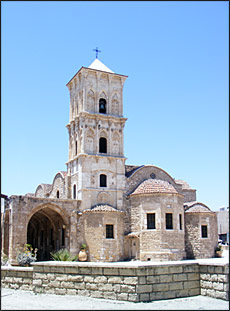
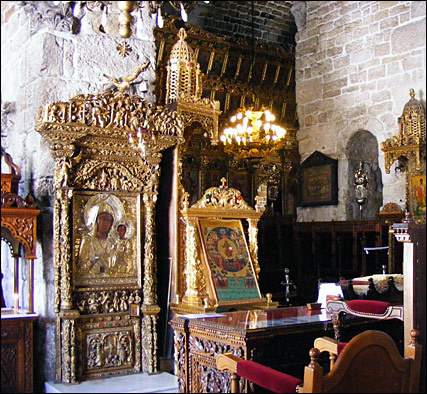
The Church of Saint Lazarus is named for New Testament figure Lazarus of Bethany, the subject of a miracle recounted in the Gospel of John, in which Jesus raises him from the dead. According to Orthodox tradition, sometime after the Resurrection of Christ, Lazarus was forced to flee Judea because of rumoured plots on his life and came to Cyprus. There he was appointed by Paul and Barnabas as the first Bishop of Kition (present-day Larnaca). He is said to have lived for thirty more years and on his death was buried there for the second and last time. The Church of Agios Lazaros was built over the reputed (second) tomb of Lazarus.

St Lazarus - The Friend of Christ


Lazarus, whom Jesus loved, the man who was buried twice, left Bethany because “the chief priests decided to kill Lazarus as well (as Jesus), since it was on his account that many of the Jews were leaving them and believing in Jesus.” [John 12:10-11] According to ancient Cypriot tradition he went to Kition, Larnaca, Cyprus, where later he was met by the Apostles Paul and Barnabas on their missionary journey through Cyprus, and was ordained by them as the first Bishop of Kition.

Lazarus - The first Bishop of Kition (Larnaca)


This tradition is supported not only by archaeological evidence, but also by the credible religious historian, Arethas, Archbishop of Cesarea, who related the discovery of Larzarus' tomb and the transport of his bones to Constantinople in the late ninth century.

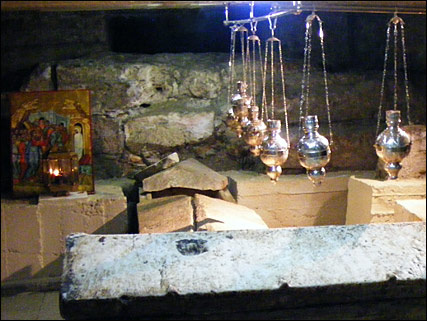
The church we see today, dating back to the early tenth century is in fact the third church built upon this site, which was once the location of the ancient necropolis where Lazarus had been buried. The foundations of one of the previous churches may still be seen beneath the current St Lazarus in Lazarus' tomb. 

The bones of the saint were first discovered in 890 A.D. in his tomb in the small church that existed at that time, the second built on the site. These were found in a marble sarcophagus which was inscribed with the following:

"Lazarus four days dead and friend of Christ".              

The then Emperor of Byzantium, Leo VI the Wise, according to custom, carried the bones to Constantinople, and in exchange for them, he sent money and technicians to build the church that we see today.

Picture
Lazarus Church

The transport of the holy relics from Kition (Larnaka) to Constantinople was related by Arethas, bishop of Caesarea thus giving historical credibility not only to the event, but also to the fact that the bones of Lazarus in Kition was a well-know fact of the time.
There is another worthy tradition to mention about Mary and Martha coming to Cyprus to visit St. Lazarus. According to this tradition, Lazarus sent a ship to the Holy Land to bring Mary, Martha, as well as John the apostle and some other disciples to Cyprus because he missed them and wanted to see them.
Picture

Dear Reader

12/16/2013

 
Dear Readers, archbishoplefebvre.com is currently undergoing financial difficulties, the web-master who donates his time and money can no longer afford to fully finance the project. Thus recently the email account was closed due to lack of funds and the domain is due for renewal early in 2014. Currently the site reaches up to 1000 new people a day, who find the Truths of the Catholic Faith on-line. This is the season for giving, if you can in anyway support this project financially even in a small way, many people shall benefit. There is a page below for those wishing to assist below. God Bless. Help here

http://www.archbishoplefebvre.com/donate.html
<<Previous
Forward>>


    archbishop lefebvre
    Click to see more

    Enter your email address for daily posts:

    Delivered by FeedBurner

    Archives

    December 2014
    October 2014
    September 2014
    August 2014
    July 2014
    June 2014
    May 2014
    April 2014
    March 2014
    February 2014
    January 2014
    December 2013
    November 2013
    October 2013
    September 2013
    August 2013
    July 2013
    June 2013
    May 2013

    Categories

    All
    Apologetics
    Archbishop Lefebvre
    Bishop Williamson
    Blessed Sacrament
    Catechism
    Catholic History
    Chalk Talks
    Chastisement
    Devotions
    Easter
    Eleison Comments
    Eleison Comments
    Eleison Comments Italian
    Encyclicals
    Espanol Eleison Comments
    Families
    Fatima
    Feast Days
    For Fathers (Dads)
    For Moms
    Fortitude
    Holy Ghost
    Holy Name
    Holy Souls
    Holy Week
    Home Schooling
    Lent
    Liberalism
    Litanies
    Liturgy
    Marriage
    Martyrology
    Martyrs
    Mass
    Meditations Of Abl
    Modesty
    News
    New World Order
    Obedience
    Our Lady
    Our Lady Of Quito
    Our Lord
    Pentecost
    Pioneer Priests
    Prayers
    Sacramentals
    Sacraments
    Sacred Heart
    Saint Of The Day
    Saints For April
    Saints For August
    Saints For December
    Saints For February
    Saints For January
    Saints For July
    Saints For June
    Saints For March
    Saints For May
    Saints For November
    Saints For October
    Saints For September
    Scandal
    Scapular
    Sermons
    Sspx
    St Benedict
    St Joseph
    St Michael
    St Michael
    Sundays Of The Year
    Temptations
    The Church
    The Last Things
    The Mass
    The Pope
    The Rosary
    The Saints
    The Virtues
    Tradcat Comments
    Truth Society

    Picture
    Click to see inside the store
    Picture
    k d
    Counter Site
    While Archbishop Lefebvre Blog is provided free of charge, there are administrative and technical costs associated with making it available to subscribers worldwide and with operating this site. Contributions to offset these costs are appreciated, and may be made via the button below

    Archbishop Lefebvre

    Promote Your Page Too
Powered by Create your own unique website with customizable templates.