ArchbishopLefebvre.com
Links
  • Archbishop Lefebvre
    • Biography of Archbishop Lefebvre
    • Who is he?
    • In his own words
  • Sermons
    • Sunday Sermons
  • Letters
    • Archbishop Lefebvre >
      • To Friends and Benefactors
      • Other Letters
    • Bishop Williamson >
      • Friends and Benefactors
      • Eleison Comments >
        • Italiano
        • Espanol
      • To SSPX Priests
  • Blog
  • Books
    • E-Books
    • Free Catholic Books
    • Archbishop Lefebvre
    • Bibles
    • Blessed Sacrament
    • Children Books
    • Childrens Saints
    • DVDs
    • Hell
    • Purgatory
    • Our Lady
    • Sacred Heart
    • Missals
    • Missale Romanum
    • Summa Theologica
    • Saints
  • Catholic Faith
    • Catechisms
    • Catholic Art
    • Chant
    • Dogmas of the Catholic Church
    • Encyclicals
    • Sermons
    • History >
      • HughesVol1index
    • Liturgy
    • Sacraments
    • Prayers >
      • Blessings
    • Way of the Cross
  • SSPX Crisis
    • sspx Archbishop Lefebvre
    • monks nuns
    • SSPX Bishop Fellay
    • SSPX Bishop Tissier
    • ex-sspx Bishop Williamson
    • ex-sspx chazal
    • sspx couture
    • sspx fox
    • ex-sspx fuchs
    • ex-sspx girouard
    • ex-sspx hewko
    • sspx laisney
    • sspx ockerse
    • ex-sspx pfeiffer
    • sspx themann
    • Fr. Ringrose
  • Links
    • Other Sites
    • Donate
    • Facebook
    • Twitter
    • You Tube
  • TradCat Items
    • Beeswax Candles
    • Chapel Veils
    • Prayer Cards - Our Lady
    • Prayer Cards - Espanol
    • Protected Scapulars
    • Scapulars
    • Unbreakable Rosaries
  • Crisis in Church
    • Declaration of the 2006 Chapter (SSPX)
    • Fr Hewko to SSPX Superiors
    • History of the Archbishop and Rome
    • Vatican II more important than Nicea!
    • The Archbishop and Religious Liberty
    • The right to resist an abuse of power
    • How Are Catholics To Respond To The Present Crisis

Thoughts for the Fifth Sunday after Easter

5/24/2014

 
Picture
The Power of Prayer

 “Ask and you shall receive” (John, 16:24)


Christ made a very extraordinary promise to His followers which is expressed in today's Gospel. Our Lord said, “Ask and you shall receive.” This promise of Christ was intended to urge us to make frequent use of prayer.

Prayer, in general, is the raising of our minds and hearts to God. We may pray for any of four purposes--to adore God, to thank Him for His blessings, to ask Him pardon of our sins, and to seek His favours. It is this last type of prayer, the prayer of petition, to which Our Lord referred when He said, “Ask and you shall receive.”

In a word, Our Lord promises to prayer infallible efficacy. He tells us that any favour we ask in prayer will be granted. Of course, this promise must be taken with proper qualifications. Christ was referring mainly to prayer for spiritual favours. Often the temporal favours we ask in prayer -- a better job, recovery of hearth, success in business, etc., would not be for our spiritual welfare, and we cannot expect that Christ would grant those petitions. But when we ask for some benefit for our soul, such as a greater love for God, patience in trials, the light to see the course of action God wishes us to follow, etc., we have absolute assurance, based on the promise of the Son of God, that we shall obtain what we seek.

This promise is especially applicable to the graces we need to overcome temptation. For this reason we can be certain that if we pray in time of temptation we shall preserve God's grace in our soul. No one can ever claim that he did not receive the grace to overcome any temptation.

If he did yield to the temptation it is an indication that he did not pray or at least that his prayer did not possess the proper qualifications. For undoubtedly Our Blessed Lord was referring only to prayer endowed with the necessary qualities, such as humility, confidence and perseverance. When we pray with these dispositions of soul we have nothing to fear during the entire course of life, for God is with us by His all powerful grace.

Practical Application

Fill your souls with a great desire to make use of prayer as Our Lord wills, and pray frequently for all your needs of body or of soul.

The next three days, preparatory to the feast of the Ascension, are called Rogation Days, days set aside by the Church as a time of special prayer, both for temporal favours (such as an abundant harvest) and for all the spiritual needs of our soul.
Eleison Comments - CCCLVIII (358)

5/23/2014

 
Picture
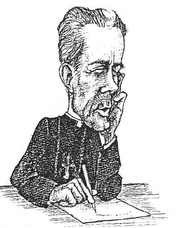
CHURCH INFALLIBILITY -- IV

To Cardinal Newman is attributed a wise comment on the 1870 definition of the Pope’s infallibility: “It left him as it found him.” Indeed that definition will have changed nothing in the Pope’s power to teach infallibly, because it belongs to the unchanging nature of God’s true Church that God will protect it from error, at least when its supreme teaching authority is engaged. All such engagement is now called the Church’s “Extraordinary Magisterium”, but only the name can have been new in 1870, just like the name of the “Ordinary Universal Magisterium”. If Vatican I declared the latter also to be infallible, it must also have been so from the beginning of the Church. To discern the realities behind the two names, let us go back to that beginning.

By the time Our Lord ascended to Heaven, he had with his divine infallibility entrusted to his Apostles a body of doctrine which they were to hand down intact to his Church to the end of the world (Mt. XXVIII, 19-20), doctrine which all souls were to believe on pain of damnation (Mk. XVI, 15-16). This Deposit of the Faith, or public Revelation, God was bound to make recognisable and accessible to souls of good will, because obviously the true God could never condemn eternally a soul for refusing to believe in an untruth. By the death of the last Apostle this Deposit was not only infallible but also complete.

Then from the Apostles onwards would God protect all churchmen from ever teaching error ? By no means. Our Lord warned us to beware of “false prophets” (Mt. VII, 15), and St Paul likewise warned against “ravening wolves” (Acts, XX, 29-30). But how could God permit such a danger to his sheep from erring pastors ? Because he wants for his Heaven neither robot pastors nor robot sheep, but pastors and sheep that will both have used the mind and free-will he gave them to teach or follow the Truth. And if a mass of pastors betray, he can always raise a St Athanasius or an Archbishop Lefebvre, for instance, to ensure that his infallible Truth remains always accessible to souls.

Nevertheless that Deposit will be unceasingly exposed to ravening wolves, adding error to it or subtracting truth from it. So how will God still protect it ? By guaranteeing that whenever a Pope engages all four conditions of his full teaching authority to define what does and does not belong to it, he will be divinely protected from error – what we call today the “Extraordinary Magisterium”. (Note how this Extraordinary Magisterium presupposes the infallible Ordinary Magisterium, and can add to it no truth or infallibility, but only a greater certainty for us human beings.) But if the Pope engages any less than all four conditions, then his teaching will be infallible if it corresponds to the Deposit handed down from Our Lord – today called the “Universal Ordinary Magisterium”, but fallible if it is not within that Deposit handed down, or Tradition. Outside of Tradition, his teaching may be true or false.

Thus there is no vicious circle (see EC 357 of last week) because Our Lord authorised Tradition and Tradition authorises the Magisterium. Indeed it is the function of the Pope to declare with authority what belongs to Tradition, and he will be divinely protected from error if he engages his full authority to do so, but he can make declarations outside of Tradition, in which case he will have no such protection. Now the novelties of Vatican II such as religious liberty and ecumenism are way outside of Church Tradition. So they come under neither the Pope’s Ordinary nor his Extraordinary Magisterium, and all the nonsense of all the Conciliar Popes does not oblige any Catholic to become either a liberal or a sedevacantist.

Kyrie eleison.

Tradition is of Popes the measuring-rod Because it came at first only from God.


© 2011-2014 Richard N. Williamson. All Rights Reserved.
A non-exclusive license to print out, forward by email, and/or post this article to the Internet is granted to users who wish to do so provided that no changes are made to the content so reproduced or distributed, to include the retention of this notice with any and all reproductions of content as authorized hereby. Aside from this limited, non-exclusive license, no portion of this article may be reproduced in any other form or by any other electronic or mechanical means without permission in writing from the publisher, except by a reviewer who may quote brief passages in a review, or except in cases where rights to content reproduced herein are retained by its original author(s) or other rights holder(s), and further reproduction is subject to permission otherwise granted thereby.

Saint of the day - St. Rita of Cascia

5/22/2014

 
Picture
May 22
Patron of impossible cases
1381 - 1457

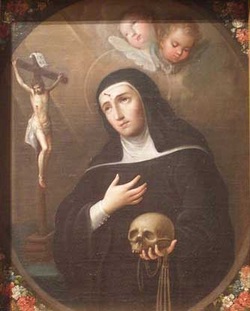
St. Rita was born at Spoleto, Italy in 1381. At an early age, she begged her parents to allow her to enter a convent. Instead they arranged a marriage for her. Rita became a good wife and mother, but her husband was a man of violent temper. In anger he often mistreated his wife. He taught their children his own evil ways.

Rita tried to perform her duties faithfully and to pray and receive the sacraments frequently. After nearly twenty years of marriage, her husband was stabbed by an enemy but before he died, he repented because Rita prayed for him. Shortly afterwards, her two sons died, and Rita was alone in the world. Prayer, fasting, penances of many kinds, and good works filled her days. She was admitted to the convent of the Augustinian nuns at Cascia in Umbria, and began a life of perfect obedience and great charity.

Sister Rita had a great devotion to the Passion of Christ. "Please let me suffer like you, Divine Saviour," she said one day, and suddenly one of the thorns from the crucifix struck her on the forehead. It left a deep wound which did not heal and which caused her much suffering for the rest of her life. She died on May 22, 1457. She is the patroness of impossible cases. Her feast day is May 22.

Some criticism have addressed Rita's portrayal of in an inaccurate religious habit. While most common images of Rita show her in a classic Augustinian traditional black habit, historical accuracy shows that the religious sisters in the monastery of Saint Mary Magdalene in 14th-century Cascia, Italy wore beige or brown habits, particularly with a white veil with a brown edge ribbon. This correction was particularly noted in the 2004 film Santa Rita da Cascia.

The forehead wound

One day when she was about sixty years of age, she was meditating before an image of Christ crucified, as she was accustomed to do. Suddenly a small wound appeared on her forehead, as though a thorn from the crown that encircled Christ’s head had loosed itself and penetrated her own flesh. For the next fifteen years she bore this external sign of stigmatization and union with the Lord.

Roses

A story is told that near the end of her life, Rita was bedridden at the convent. A cousin visited her and asked her if she desired anything from her old home. Rita responded by asking for a rose from the garden. It was January and her cousin did not expect to find anything due to the weather. However, when her relative went to the house, a single blooming rose was found in the garden and her cousin brought the rose and fig back to Rita at the convent. St. Rita is often depicted holding roses or with roses nearby. On her feast day, churches and shrines of St. Rita provide roses to the congregation that are blessed by the priest during Mass.


May 21st - St. Christopher Magallanes and Companions

5/21/2014

 
Picture
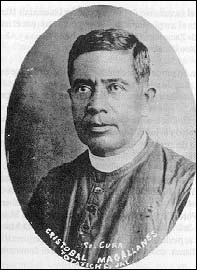
Saint Christopher Magallanes and his Companions Cristóbal Magallanes Jara was born in the state of Jalisco in Mexico in 1869. He was ordained priest at the age of 30 and became parish priest of his home town of Totatiche. He took a special interest in the evangelization of the local indigenous Huichol people and founded a mission for them. When government persecution of the Catholic Church began and the seminaries were closed, he opened a small local “auxiliary seminary.” He wrote and preached against armed rebellion but was falsely accused of promoting the Cristero rebellion. He was arrested on 21 May 1927 while on the way to celebrate Mass at a farm. He was executed without a trial, but not before giving his remaining possessions to his executioners and giving them absolution. With him are celebrated 24 other Mexican martyrs of the early 20th century.

Other saints: St Eugène de Mazenod (1782 - 1861) He was born at Aix-en-Provence in the south of France and had to flee together with his family when the French Revolution broke out. When he returned, in 1802, it was in a penniless and uncertain state, but after a period of depression he began to develop a concern for the French Church, which had been attacked and half destroyed by the Revolution. He discerned a vocation to the priesthood and was ordained in 1811. He returned to Aix-en-Provence and lived as a wandering priest with no parish church. He and the companions he gathered round him went from village to village, preaching in Provençal, the language of the people. Facing opposition from the local clergy, Eugène went straight to the Pope and obtained official recognition of the “Oblates of Mary Immaculate,” of which he was then elected Superior General. He continued to guide the order until his death. He was appointed auxiliary bishop of Marseilles in 1832, provoking a furious and debilitating five-year diplomatic row with the French government. At length he became Bishop of Marseilles in 1837, on the retirement of his predecessor. He continued to rebuild the strength of the French Church, and the Oblates of Mary Immaculate were persuaded to send missionaries to other parts of the world, so that they are now active in 68 countries.

Saint for Today - St Bernardine of Sienna 

5/20/2014

 
Picture
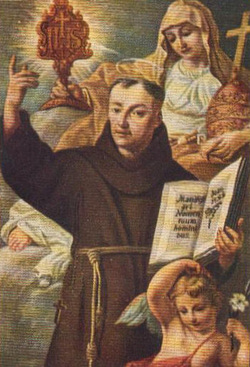
Bernardine Albizeschi, of a noble family of Siena, gave clear marks of sanctity from his earliest years; for he was well reared by pious parents, and when studying the rudiments of grammar, he used to give up his time for play, and applied himself to works of piety, to fasting, prayer, and especially to devotion to the most blessed Virgin.  His charity to the poor was indeed extraordinary.  As time went on, that he might be better able to cultivate these virtues, it was his will to enroll himself among those who took care of the hospital of blessed Mary of the Ladder of God (Santa Maria della Scala) in Siena, from which place there came forth so many men celebrated for holiness.  There he laboured, in bodily suffering and with unbelievable charity, to take care of the sick while a terrible pestilence was raging.  And among his other virtues, he guarded his chastity as a holy thing, and it was in danger because of his handsome appearance, and no one, not even the most depraved, ever dared to say an improper word in his presence.

After suffering a serious illness lasting four months, which he bore with the greatest patience, when he had safely recovered he began to think of embracing some institute of the religious life.  To prepare his way for this, he hired a little hut on the outskirts of the city; and in it he hid himself, leading a more austere life in every way, and assiduously beseeching God to shew him the path he was to follow.  A divine inspiration led him to prefer to all others the order of blessed Francis, in which he excelled in humility, patience, and the other virtues of a religious man.  The rector of the convent noticing this, and having previously perceived that Bernardine had experience in teaching and in sacred letters, imposed the duty of preaching upon him.  The saint most humbly accepted the office, though he was aware that the weakness and hoarseness of his voice unfitted him for it: but he sought God's help, and was miraculously freed from these impediments.

And although those times abounded with vices and crimes, and with bloody civil wars in Italy, so that all things, divine and human, were thrown into utter confusion, Bernardine went through the cities and towns, and in the Name of Jesus, which was ever on his lips and in his heart, restored the fallen piety and morals to a great extent by his word and example.  After this had been done, several important cities asked the Supreme Pontiff to make Bernardine their bishop; but this office he most strenuously rejected with invincible humility.  At length the man of God, worn out with heavy labours, after working many and great miracles, and also having written pious and learned books, died a happy death, at the age of sixty-six, in a city of the Abruzzi, called L'Aquila.  New miracles daily made him illustrious, and, in the sixth year after his death, the Supreme Pontiff Nicholas V placed him in the list of the Saints.

Picture
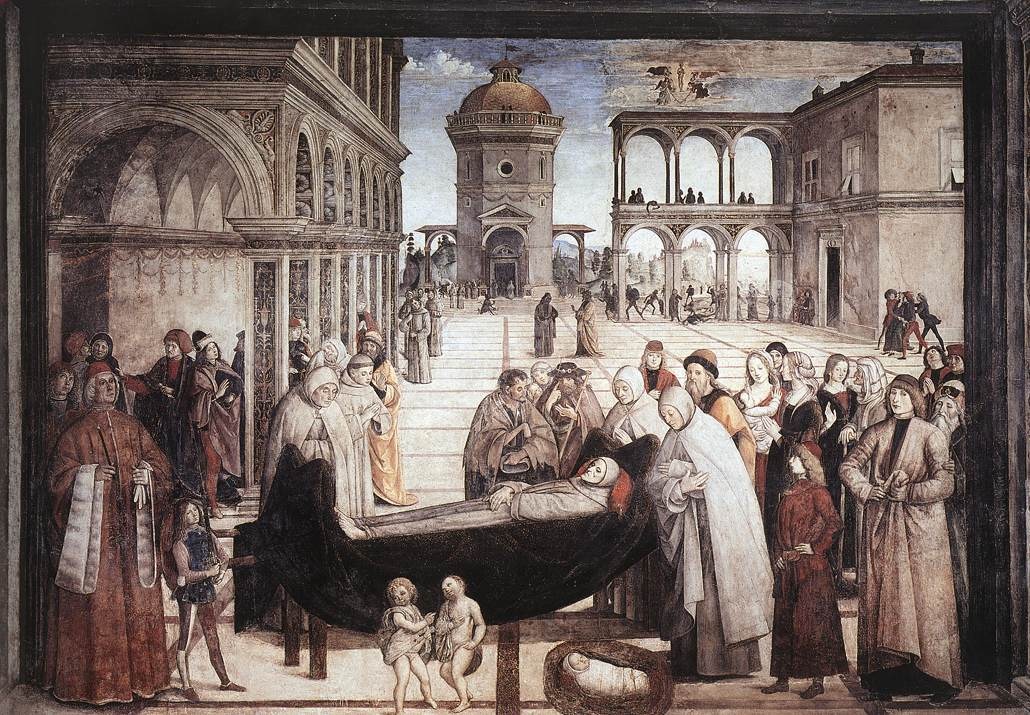
The Burial of St. Bernardine of Siena

May 19th - St Pudentiana

5/19/2014

 
Picture
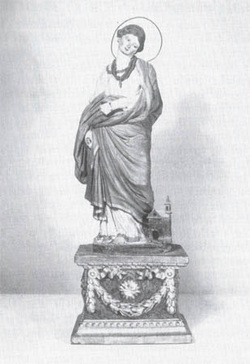
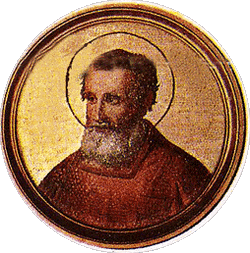
The maiden Pudentiana was the orphan daughter of Pudens the Roman Senator.  She was a Christian of eminent godliness.  She with her sister Praxedes distributed to the poor the money which they obtained by the sale of their inheritance.  She gave herself continually to fasting and prayer.  By her care the whole of the household, being ninety-six persons, were baptized by Pope Pius I.  Whereas the Emperor Antoninus had forbidden the Christians to offer sacrifice in public, Pope Pius used to meet with them in Pudentiana's house, to celebrate the holy rites.  She was a gracious hostess to them, and ministered to them in such things as are needful for the body.  She thus busied herself in works of Christian godliness until she passed from this present life to a better.  She was buried in her father's sepulchre in the cemetery of Priscilla on the Salarian Way upon the 19th day of May.

Saint for Today - St Peter Celestine

5/19/2014

 
Picture
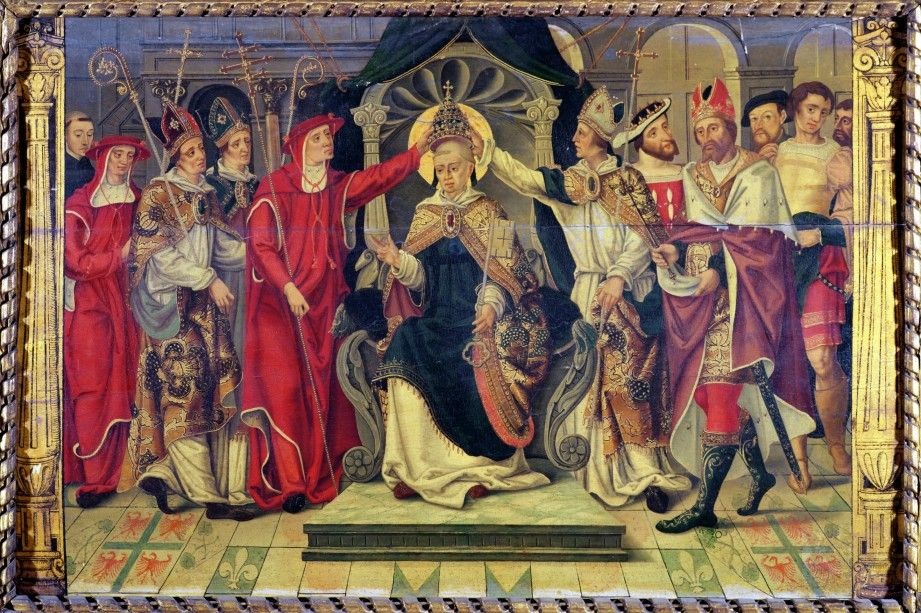
Peter, who is called Peter Celestine, because when he became Pope he did so under the title of Celestine V, was the son of respectable Catholic parents, and was born at Isernia in Apulia.  He was hardly entered on boyhood, when he withdrew into a desert, in order to keep his soul safe from the snares of the world.  In solitude he fed his mind with heavenly meditation, and brought his body into subjection, even by wearing an iron chain next to his bare flesh.  He founded, under the Rule of St. Benedict, that congregation which was afterwards known as the Celestines.  His light, as of a candle set upon a candlestick, could not be kept hidden, and after the Church of Rome had for a long while been widowed of a shepherd, he was chosen without his knowledge and in his absence, to fill the chair of Peter.  The news of his election filled himself with as great amazement, as it did all others with sudden joy.  When, however, he was seated in the exalted place of the Papal dignity, he found that the many cares by which he was beset made it wellnigh impossible for him to give himself to his accustomed meditations; of his own free will, he resigned the burden and the honour together; and, while he sought to return to his old way of life, he fell asleep in the Lord.  How precious his death was in his sight was gloriously manifested by a Cross which appeared shining in the air before the door of the cell.  He was illustrious for miracles both during his life and after his death, and when these had been duly investigated, Clement V, in the eleventh year after his departure hence, enrolled his name among those of the Saints.


Picture

Fourth Sunday after Easter

5/18/2014

 
Picture
At that time: Jesus said to his disciples: Now I go my way to him that sent me: and none of you asketh me: Whither goest thou? 

Sermon
by St. Augustine the Bishop

The Lord Jesus told his disciples what things they should suffer after that he was gone away from them, and then (as John recordeth) he said: These things I said not unto you at the beginning, because I was with you; but now I go my way to him that sent me.  The first thing to be noticed here is, whether he had not already told them of their future sufferings.  That he had done so amply before the night of the Last Supper, is testified by the other three Evangelists; but according to John, it was when that Supper was ended, that he said: These things I said not unto you at the beginning, because I was with you.

Are we then to try to loose the knot of this difficulty by asserting that, according to these three Evangelists, it was on the eve of the passion, albeit before the Supper, that he had said these things unto them, and therefore not at the beginning, when he was with them, but when he was about to leave them, and go his way to the Father?  And in this way we might reconcile the truthfulness of what this Evangelist saith here: These things I said not unto you at the beginning: with the truthfulness of the other three.  But this explanation is rendered impossible by the Gospel according to Matthew, who telleth us how that the Lord spake to his Apostles concerning their sufferings to come, not only when he was on the point of eating the passover with them, but at the very beginning, when the names of the twelve were first given, and they were sent forth to do the work of God.

It would seem then that when he said: These things I said not unto you at the beginning, because I was with you: he meant by These Things, not the sufferings, which they were to bear for his sake, but his promise of the Comforter who should come to them, and testify while they suffered.  This Comforter then, or Advocate (for the Greek word Paraclete may be interpreted in both senses), would be needful to them when they saw Christ no more; and therefore it was that Christ spoke not of the Holy Spirit at the beginning while he himself was with his disciples, because his visible presence was then their sufficient Comfort.

Picture

Thoughts for the Fourth Sunday after Easter

5/18/2014

 
Picture
The Infallibility of the Church

“When He the Spirit of truth has come, He will teach you all the truth” (John, 16:13)

The words of today's Gospel were spoken to the apostles by Our Blessed Lord on the night before His death. The apostles were saddened and uncertain, and Christ wished to console them by assuring them that in the near future He would send the Holy Ghost to give them light and strength. This promise was fulfilled on Pentecost, when the Holy Spirit descended upon the apostles and disciples in the form of tongues of fire, giving them wisdom and courage so that they were enabled to go forth into the streets of Jerusalem to preach the Gospel without fear or hesitation.

This promise of Our Blessed Saviour was directed to the apostles as the official teachers of His Church; hence, it was intended also for their successors in this office, the Bishops of the Catholic Church and, in the first place, the Pope. In these words of the Son of God we find confirmation of the doctrine of our Holy Faith which asserts that the Holy Ghost will protect these teachers from error in their task of communicating Christ's message to the souls of men even to the end of time.

To many non-Catholics the claim of the Church to infallibility seems preposterous. But it should appear most reasonable to anyone who admits that Jesus Christ is true God, able to watch over the teaching office of His representatives and empowered to send the third person of the Holy Trinity to protect these teachers from leading the faithful astray by error.

For this reason Catholics believe that their Church is infallible. The prerogative of infallibility is possessed by the Bishops when they assemble in council with the Pope, and also when, under his jurisdiction and approval, they agree in teaching some doctrine of faith or morals in their respective dioceses. Above all, infallibility belongs to the Pope when he speaks ex cathedra that is, when, as head of the entire Church, using the fullness of his teaching power, he defines a doctrine of faith or morals to be held by all the faithful. When Catholics receive a doctrine taught in this manner by the official teachers of their Church they know that it has come to them under the protecting power of the Holy Ghost and is infallibly true.

Practical Application

Thank God that when you make an act of faith in the doctrines taught by the Catholic Church you have absolute assurance that God Himself has protected those who announced it from error. Often make acts of faith in the teachings of the Church.

Saint for Today - St Paschal Baylon

5/17/2014

 
Picture
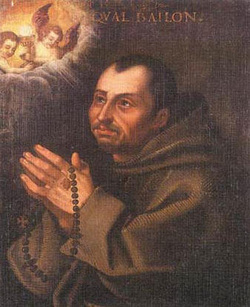
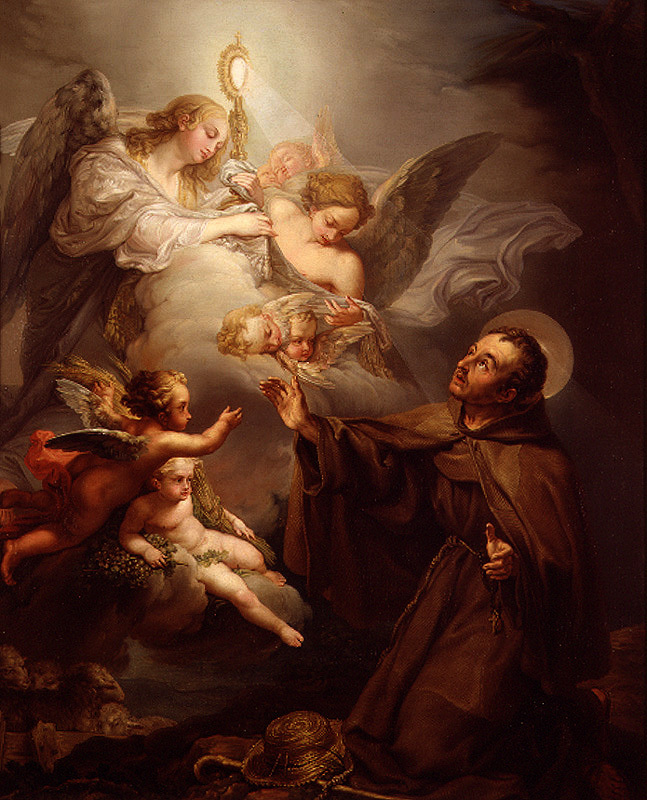
Paschal Baylon was the son of poor and godly parents, in the town of Torre Hermosa, and Diocese of Sagunta in Aragon.  From his childhood he gave indications of a holy life.  He was naturally of a good disposition, and very wishful to learn about heavenly things.  His boyhood and youth he passed in the occupation of a shepherd.  This way of life pleased him well, because he thought it one useful and fitted to nourish lowliness and keep innocency.  He ate little, and was instant in prayer.  He had great weight and favour with his fellows and neighbours, whose quarrels he healed, corrected their mistakes, enlightened their ignorance, and roused them from idleness.  They all greatly honoured and loved him, as though he were their father and teacher, and even then many called him Beato, that is, The Blessed.

In a world which was to him a dry land where no water is, Paschal grew up a lily of the vallies, planted in the House of the Lord, whose strange sweetness spread all around.  When he took upon him an harder life, by entering the Institute of Discalced Grey Friars, of the strict Observance, he rejoiced as a strong man to run a race, and gave himself up altogether to serve the Lord, thinking by day and by night only how he might attain more and more to have that mind in him which was was also in Christ Jesus.  And so it came to pass in a little while, that his very elders set him before them for their model, as a pattern of a man seeking to be perfect in the path of the Seraphic Order.  Paschal himself held the lowly place of a lay brother, and deemed himself the off-scouring of all things.  He took most cheerfully, and discharged with the greatest humility and patience, the hardest and meanest work of the house, as though such were his peculiar right.  His flesh would sometimes rebel against his spirit, but he broke it under the yoke of mortification, and brought it into subjection.  Day by day the spirit of self-denial waxed stronger in him, and forgetting those things which were behind, he reached forth unto those things which were before.

To the Virgin Mother of God he had vowed himself when he was but a very young boy, and he paid her every day the services of a son, and trusted her as a mother.  It is hard to tell how intense was the love which bound him to the Most Holy Sacrament of the Eucharist, a love which seemed literally stronger than death, for when his dead body was found lying on the bier, its eyes opened and shut twice when the Sacred Host was lifted up, to the amazement of all that were there.  When he was among heretics, he suffered much and grievously at their hands for plainly and openly telling the truth touching this Sacrament: they often sought after him to murder him, but by the singular Providence of God he was delivered from those wicked men.  When he was at prayer he often became utterly insensible, and his soul fainted away with the love of God.  During these trances it was believed that he received directly from heaven that knowledge which he had, and which enabled him, although a man altogether rough and unlettered, to answer the hardest questions upon the mysteries of the faith, and even to write some books.  At last, full of good works, he joyfully passed away to be ever with the Lord, at the hour foretold by himself, on the Feast of Pentecost, the 17th day of May, in the year of salvation 1592, on which day also he had been born fifty-two years before.  Illustrious for the graces above mentioned, and for the miracles which he worked both during his life and after his death, he was named Blessed by Pope Paul V, and Alexander VIII enrolled him among the Saints.  At length, Leo XIII declared and appointed him in a special manner the patron in heaven of eucharistic conferences, and likewise of all societies of the most holy Eucharist, whether founded up to that time, or that might founded in the future.

Picture
<<Previous
Forward>>


    archbishop lefebvre
    Click to see more

    Enter your email address for daily posts:

    Delivered by FeedBurner

    Archives

    December 2014
    October 2014
    September 2014
    August 2014
    July 2014
    June 2014
    May 2014
    April 2014
    March 2014
    February 2014
    January 2014
    December 2013
    November 2013
    October 2013
    September 2013
    August 2013
    July 2013
    June 2013
    May 2013

    Categories

    All
    Apologetics
    Archbishop Lefebvre
    Bishop Williamson
    Blessed Sacrament
    Catechism
    Catholic History
    Chalk Talks
    Chastisement
    Devotions
    Easter
    Eleison Comments
    Eleison Comments
    Eleison Comments Italian
    Encyclicals
    Espanol Eleison Comments
    Families
    Fatima
    Feast Days
    For Fathers (Dads)
    For Moms
    Fortitude
    Holy Ghost
    Holy Name
    Holy Souls
    Holy Week
    Home Schooling
    Lent
    Liberalism
    Litanies
    Liturgy
    Marriage
    Martyrology
    Martyrs
    Mass
    Meditations Of Abl
    Modesty
    News
    New World Order
    Obedience
    Our Lady
    Our Lady Of Quito
    Our Lord
    Pentecost
    Pioneer Priests
    Prayers
    Sacramentals
    Sacraments
    Sacred Heart
    Saint Of The Day
    Saints For April
    Saints For August
    Saints For December
    Saints For February
    Saints For January
    Saints For July
    Saints For June
    Saints For March
    Saints For May
    Saints For November
    Saints For October
    Saints For September
    Scandal
    Scapular
    Sermons
    Sspx
    St Benedict
    St Joseph
    St Michael
    St Michael
    Sundays Of The Year
    Temptations
    The Church
    The Last Things
    The Mass
    The Pope
    The Rosary
    The Saints
    The Virtues
    Tradcat Comments
    Truth Society

    Picture
    Click to see inside the store
    Picture
    k d
    Counter Site
    While Archbishop Lefebvre Blog is provided free of charge, there are administrative and technical costs associated with making it available to subscribers worldwide and with operating this site. Contributions to offset these costs are appreciated, and may be made via the button below

    Archbishop Lefebvre

    Promote Your Page Too
Powered by Create your own unique website with customizable templates.